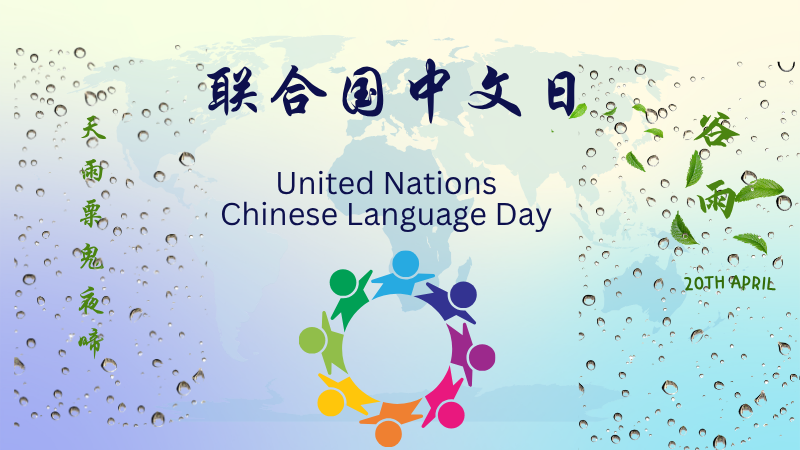
On 20 April, the United Nations will mark its 17th Chinese Language Day, one of six official language days designed to promote multilingualism and cultural diversity. For many, this day may pass unnoticed, yet behind this date lies a rich cultural story and a compelling case for why learning Chinese could be one of the most strategic decisions you make.
April 20: a date rooted in cultural heritage
The choice of 20 April is associated with Cāngjié (仓颉), the legendary inventor of Chinese characters. According to tradition, when he created the writing system, the heavens responded with falling grain and weeping spirits, signalling the transformative power of Chinese characters.
One of the 24 solar terms in the traditional Chinese calendar, Gǔyǔ (谷雨 “Grain Rain”) falls on 20 April. Gǔyǔ marks a time when rainfall supports the growth of crops, symbolising regeneration and vitality.
By choosing this date, the United Nations not only recognises the historical depth of Chinese but also its ongoing cultural significance in shaping how millions of people understand and communicate with the world.
Characters: more than just writing
For learners, Chinese characters (汉字) are often the biggest hurdle and also the most rewarding aspect of the language. Unlike alphabet-based systems, Chinese characters carry meaning as well as sound. This makes the Chinese writing system visually and conceptually rich.
Consider the character “休” (xiū), meaning “to rest,” formed from “亻” (person) and “木” (tree), suggesting a person leaning against a tree. Two “person” components form “从” (cóng), meaning to follow, and three people make a crowd “众” (zhòng); two “tree” components form “林” (lín), woods, and three form “森” (sēn), a forest. Chinese characters reveal how ancient Chinese thinkers conceptualised the world.
Studies have shown that learning characters helps strengthen memory, sharpens visual recognition, and encourages you to engage with language analytically. It opens access to Chinese literature, media, and cultural practices in their original form, something translation can never fully replicate.
If you’re interested in finding out more about how Chinese characters work, please do check out the free Chinese learning resources that I created using the open-source browser-based tool set Xerte.
Culture: understanding a global power
China’s global influence, economically, politically, and culturally, continues to grow. From technology and green energy to film and social media, Chinese culture is increasingly visible on the world stage. Understanding the language gives you direct insight into these developments rather than relying solely on external interpretations.
For students in disciplines such as architect, engineering, politics, or international relations, this cultural literacy is particularly valuable. It enables you to interpret context, navigate cross-cultural communication, and build more meaningful professional relationships.
Careers: a strategic advantage in the global job market
From a careers perspective, Chinese is a high-impact skill: Mandarin is the most widely spoken first language globally, yet in the UK it remains relatively rare. This creates a clear supply-and-demand gap. UK-China trade links, as well as broader engagement with Chinese-speaking regions, mean that employers value candidates who can operate across linguistic and cultural boundaries.
Even at a basic or intermediate level, Chinese can differentiate your CV. It signals resilience (because it is not an easy language to learn), global awareness, and a willingness to take on challenges. For competitive graduate schemes, internships, or international opportunities, that distinction can make a measurable difference.
The journey begins when you take your first step
The idea of learning Chinese alongside a degree might seem daunting, but it is more accessible than you might think. We offer institution-wide language programmes with daytime and evening classes, summer schools, and online modules tailored to your needs.
This summer, we will again offer language courses in Chinese and other languages; if you cannot wait to learn your first Chinese characters, please check out Introduction to Chinese Characters.
I hope the UN Chinese Language Day serves as a reminder that language shapes opportunity. By engaging with Chinese, you are not only learning a language; you are positioning yourself at the intersection of tradition and global innovation.
As the Chinese saying tells us, 千里之行始于足下 Qiānlǐ zhī xíng shǐ yú zúxià, A journey of a thousand miles begins with a single step.
So, what are you waiting for?!
Respond