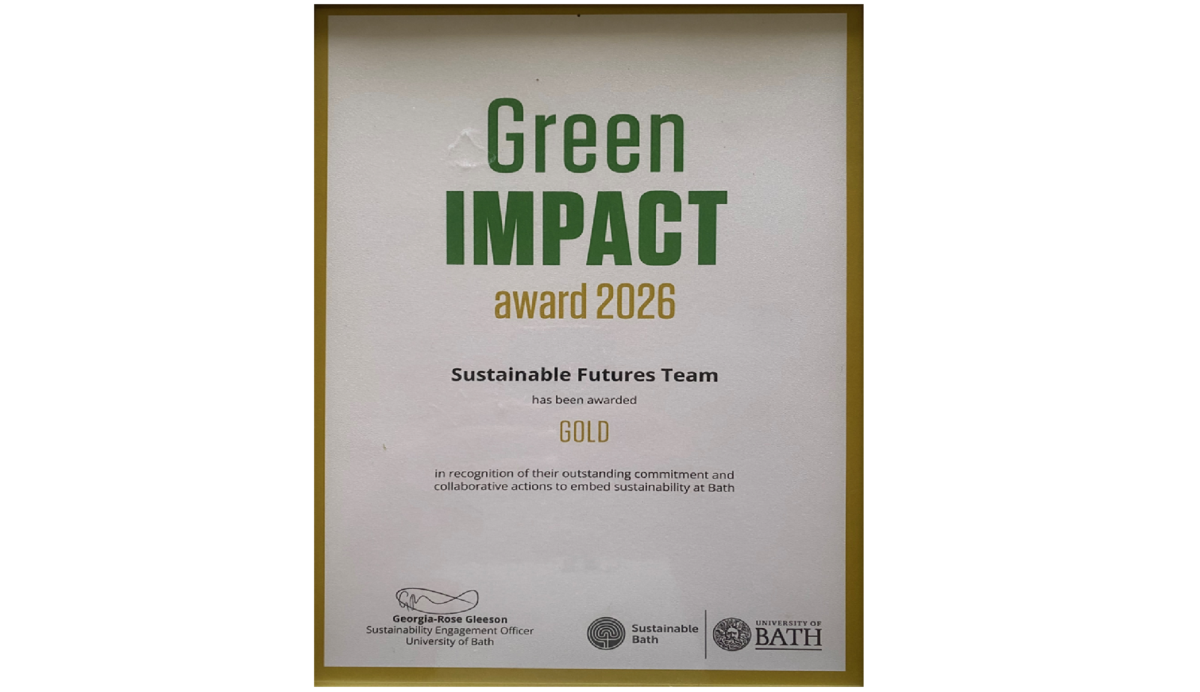
Last July, I wrote about the Skills Centre's Silver Award in the university's Green Impact Programme, describing a team taking its first tentative steps into structured sustainability work. This year, I am delighted to share that we have been awarded Gold.
But this post is not really about a certificate. It is about how our team grew, what changed in how we worked together, and why this year, more than any other, the case for taking sustainability seriously at work stopped feeling abstract.
A bigger, broader team
One of the most significant shifts this year was who was in the room. What began as a Skills Centre initiative expanded to include colleagues from Careers, and Human Resources (HR). We were also joined by two students, keen to get involved and ensure the student voice was central.
That mix mattered. Careers colleagues brought a sharper focus on how sustainability shows up in the advice we give students about future workplaces and employers. HR brought a view of sustainability as something woven into culture, recruitment, training and how people experience working here. And our two student members reminded us, often, that the people who will live longest with the consequences of decisions made now are the ones currently sitting in our sessions and drop-ins.
Where last year's team met monthly and worked in relative isolation, this year's cross-team structure meant sustainability stopped being "the Skills Centre's thing" and became something genuinely shared. That, as much as any specific action, is what we think tipped us from Silver to Gold.
Building on what we started
Last year we flagged five focus areas, largely at the planning stage: our digital resources footprint, sustainable resource creation, sustainability literacy for students, embedding sustainability into teaching and assessment support, and sustainable travel planning. This year was about turning plan into practice.
We acted on the legacy digital resources audit we described last year, retiring content that no longer served a purpose rather than leaving it consuming server space indefinitely. We built sustainability considerations into how we plan and deliver sessions, rather than treating it as an afterthought. And working with Careers and HR gave us new territory to explore, from how we talk to students about sustainable career choices, to how sustainability features in the way the wider team recruits, inducts and supports staff.
None of this was dramatic. It was the unglamorous, consistent work of following through on commitments, which is exactly what the Plan-Do-Check-Act cycle we described last year is designed for.
A summer that made the stakes hard to ignore
Writing this at the start of August, it would feel strange not to name what has been happening outside our windows. This summer has been extraordinary, and not in a good way. By mid-July 2026 had already recorded more days above 30°C than the whole of the famous summer of 1976 and became the first year on record to see temperatures reach 35°C in May, June and July. Large parts of England and Wales have seen barely a third of their typical summer rainfall, and a flash drought developed rapidly across central, southern and eastern England, triggering water-use restrictions for millions of people.
This followed 2025's summer, which was itself the UK's hottest on record. Met Office analysis suggests a summer as hot as 2025 is now roughly 70 times more likely than it would have been without human-caused greenhouse gas emissions. Two record-breaking summers in a row is not a coincidence or a run of bad luck. It is the pattern climate scientists have been warning about for decades, arriving in our own back gardens, campuses and commutes.
That is a sobering backdrop for a blog post about a workplace award. But it is also, we think, exactly the point. The University's Climate Action Framework commits Bath to net zero across scope 1 and 2 emissions by 2030, and net zero across all scopes by 2040. Those targets can feel like someone else's job, set at institutional level, delivered by estates and facilities teams. This summer was a reminder that they are not. Every team, including ours, has a role in getting there, and every year we wait to start is a year we can't get back.
What Gold means going forward
Our Silver Award last year felt like a beginning. Gold feels like proof that the beginning worked, but it is still not an endpoint. The University's sustainability pages set out an ambitious, whole-institution approach, from the Leave No Trace campaign, to sustainable procurement, to the annual Sustainability Survey that shapes future priorities. We want to keep plugging our small corner of the university into that bigger picture rather than treating our Green Impact work as a self-contained project that wraps up each May.
Practically, that means continuing to widen participation beyond this year's team, building genuine staff-student collaboration into how we plan sustainability work rather than students joining an existing structure, and using what we have learned about cross-team working to make the next round of goals more ambitious than the last.
A personal call to action
If you take one thing from this post, let it be this: you do not need to wait for a formal programme, a team invitation, or a certificate to act. Two students changed the shape of our team this year simply by asking to join. You can have a similar effect, whether that's exploring the University's Introduction to Climate Change course, asking your communities, student, staff and outside the university, what their sustainability commitments actually are, or just having the same conversation we found ourselves having all summer, about what a hotter, drier UK means for how we live and work, and who it impacts most.
Thank you to everyone across the Skills Centre, Careers, and HR who made this year's Gold Award possible, and especially to the students and staff who supported us.
Respond