
Posted on behalf of Professor Turi King
Resolve Forensics and Forensic Investigative Genetic Genealogy (FIGG)
Professor Turi King reflects on her visit to the Resolve Forensics laboratory in Utah, to see how forensic investigative genetic genealogy (FIGG) is used in practice.
When Sir Alec Jeffreys invented DNA fingerprinting, later known as DNA profiling, in 1984, it went on to spark a revolution in policing. It’s hard to overstate the breakthrough: using DNA alone, it was possible to identify an individual, for example from biological traces (e.g. blood, saliva) left at a crime scene. But DNA profiling relies on having a known profile to compare it to. Police need to be able to take the DNA profile generated from the crime scene, upload it to a database of other profiles - in the U.K. it’s the national DNA database (NDNAD) - to look for a match with a known individual. Or they need a suspect’s DNA profile to compare with one from the crime scene. But what happens when there isn’t a match on the NDNAD or with a suspect?
Standard forensic DNA profiling is fantastic for identifying an individual using a relatively small number of highly variable genetic markers and, because of how DNA is inherited, we share half-our DNA, and therefore half the same genetic markers, in common with each of our parents, our children and siblings. So sometimes the police try what’s known as familial searching: looking for individuals on the NDNAD where the number of matching genetic markers is high enough that it could be an immediate family member which then gives them a new line of investigation. But that technique, too, may generate no leads.
But now there is a newer tool in the police’s toolkit in the form of what’s known as forensic investigative genetic genealogy or FIGG, not yet used in the U.K.. And it’s a good idea to chat a bit about my background to understand why I am so interested in this, and, of course, what it is!
My background is unusual for an academic. I started in archaeology but hit a turning point in my career while sitting in an undergraduate lecture at Cambridge. I was listening to my lecturer, Erika Hagelberg, speaking about her work on the Romanov case: Tsar Nicholas and his wife, children and members of their staff were killed during the Russian revolution and their bodies hidden. Decades later, their remains were discovered and identified using both forensic genetic and osteological analysis. I was hooked. I changed direction, winning a scholarship to study in the Department of Genetics at the University of Leicester where DNA profiling was invented by Professor Sir Alec Jeffreys.
Alec ended up on my PhD panel where I applied forensic profiling techniques to the Y chromosome (inherited from father to son only) and the link with surnames (also inherited down the male line) meaning that I was at the forefront of the emerging field of genetic genealogy, and its potential forensic utility, some 25 years ago. With my background in archaeology and later genetics, it was perhaps inevitable that I would apply forensic genetic techniques to historical and ancient cases as part of my research.
Fast forward a few years and I’m known for having led the identification of King Richard III (an element of which included genetic genealogy) and then co-presenting DNA Family Secrets on the BBC using genetic genealogy to help adoptees, donor-conceived and others find biological parents and siblings. For this programme, it’s not the forensic NDNAD which is used, or indeed the same sort of DNA tests, it’s the direct-to-consumer DNA tests used by genealogists, who use them to confirm relationships, find as yet unknown relatives, and build their family trees. When a person takes a DNA test with one of these companies, what is returned to them is a list of people who coincidentally have also taken a test and share DNA with them such that they must share a common ancestor within the last few generations. Armed with that information, genealogists, if they don’t already recognise which relative it is, will build the family trees, work out the common ancestor and therefore which branch of the family tree they come from. As the databases grow, the more likely it is to have 2nd and 3rd cousin (or even closer) DNA matches and then use publicly available records to build their family trees, identify common ancestors and their descendants.
I do the same thing, only for DNA Family Secrets (and the people I help privately) it’s using this technique to trace a particular individual (a parent, sibling, or even just understand their ancestry) by having the person take a DNA test and then using their DNA matches to build the family trees backwards in time to common ancestors and down again to be able to answer their question: this is your biological parent or parents, or, this is your half-sibling or what-have-you.
Nearly a decade ago, the potential for the use of this technique for forensics hit the headlines in the cold case of the Golden State Killer: a serial rapist and killer active in the 1970s and 1980s in California who had never been caught. Here the police had the DNA from one of the crime scenes tested using the same sorts of typing that is used by direct-to-consumer DNA testing companies and uploaded it to some of the genetic genealogy databases used by family historians. By building the family trees, they homed in on a wider family and then, using a combination of information and DNA testing, traced down to the single individual, the perpetrator: Joseph DeAngelo, caught decades after his last crime. It was not without its ethical issues.
This technique is now used regularly in U.S. and Canada and with other countries such as Sweden, Denmark and Australia also now starting to use it. But if it’s going to be used here, then we need to ensure that it’s carried out to the highest scientific and ethical standards. And, of course, with my background both in forensic genetics and genetic genealogy, this is an area I’m hugely interested in.
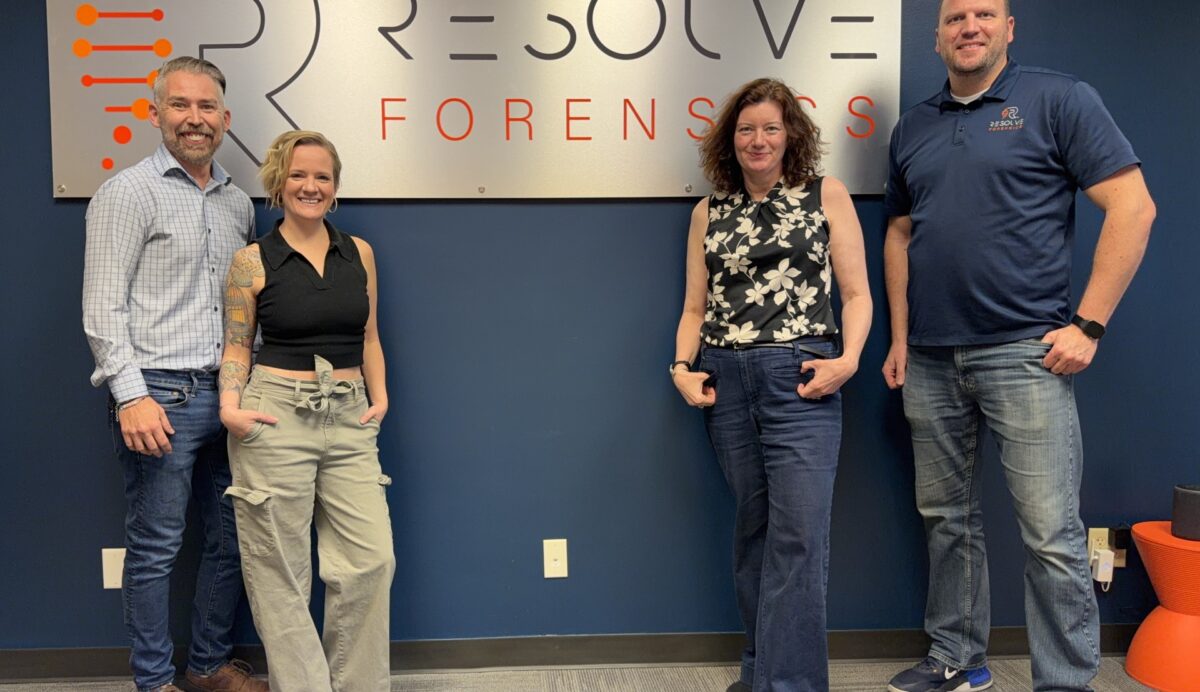
So, you can imagine how wonderful it was for me to get nattering to Danny Hellwig at an International Symposium for Human Identification where I’d been flown in to give a keynote about my decades-long career in genetic genealogy. Danny and his partner, Whitney Orr, are the proud owners of Resolve Forensics, one of the companies at the forefront of FIGG in the U.S. and, of extreme importance to me, dedicated to carrying out the work under ethical guidelines. Wouldn’t it be great if I could head over the pond and see how they were doing it there and if there is a way we could partner.
Step in Bath P-ACE who very kindly agreed to fund my application to go and spend a few days with them in their lab, understand their processes and approach. I can only tell you it was an incredibly exciting experience. With their Chief Scientific Officer, Derek Cutler, Danny, Whitney and I discussed about how eventually the technique will likely be used in the U.K. and that we want to ensure that it’s carried out to the highest standards both scientifically and ethically. We also spoke about some of the misunderstandings around FIGG: for example, that the police can actually see the DNA sequence of people who are genetic matches, or that by simply being a part of one the databases used in such investigations, that someone will automatically become part of solving a crime – that’s simply not the case. What we’re hoping with our partnership is to be a part of the conversation of FIGG being utilised in the U.K., dispelling misinformation about the approach, and developing the ethical guardrails and guidelines to allow it’s use here. Watch this space.
In the meantime, I hear that the Home Office is already, quite understandably cautiously, looking into the possibility of using FIGG and the framework for this. I hope to continue to feed into discussions about this technology.
End note
The Bath Policing Academic Centre of Excellence is one of nine Policing Academic Centres of Excellence (P‑ACE), funded by the Economic and Social Research Council (ESRC) and the National Police Chiefs’ Council. Its role is to strengthen connections between academic research and policing practice.
Reflecting on Bath P‑ACE’s involvement, Co‑Director Professor Katie Maras noted:
“Bath P‑ACE was established to support the translation of research into policing practice, and we were therefore delighted to contribute to the development of Professor King’s exploration of forensic investigative genetic genealogy (FIGG) and its potential application in the UK through our Rapid Response Fund. The next phase of this work will focus on informing national policy discussions around the responsible, ethical and effective use of FIGG within the UK”.
Dr Andrew Stafford, Research Lead at the Office of the Police Chief Scientific Adviser (OPCSA), added:
“We are interested to learn from Professor King’s visit to Resolve Forensics and welcome her suggestions for how FIGG could be used in law enforcement settings in the UK, and what professional practice and accreditation could look like”.
Respond