
Author: Kimi Costello, Department of Psychology, University of Bath
Author bio: Kimi Costello is an undergraduate psychology student with interests in developmental psychopathology and psycholinguistics.
Author contact: kca904@bath.ac.uk
Abstract
Exposure to sexual content, for example online pornography, is linked to adverse psychosexual, socio-behavioural and mental health outcomes in children and adolescents. Intervention approaches such as parental and external regulation, identified as integral to mitigating these negative outcomes, are an important avenue for research and intervention. In particular, it is currently unclear which is the superior strategy. A critical review of the literature on interventions to sexual content risks published between 2001 and 2024 was conducted, with the aim of evaluating their respective effectiveness. The literature review found that although restrictive approaches are the most common strategy employed by parents, this type of mediation is largely ineffective in reducing online risks. Conversely, active parental mediation, which prioritises education and autonomy, appears more effective but requires high parental digital literacy. Child-focused educational interventions are proposed as the superior strategy, addressing gaps in digital literacy and sex education whilst empowering children to independently navigate online risks. This conclusion is supported by both psychosociological theory and empirical research. Consequently, the current review calls for efforts to integrate digital and sexual education in school curriculums, following support from further quantitative research to validate the necessity and effectiveness of such interventions.
Author: Kimi Costello (email: kc904@bath.ac.uk) is an undergraduate psychology student currently on placement from the BSc programme, with interests in developmental psychopathology and psycholinguistics.
Background
Despite providing a wealth of opportunities for children’s communication and information access (Ali, 2020), the ubiquitous Internet access at the disposal of the current generation of children (Ofcom, 2021) does not come without risks. One source of harm overlooked in research (Finkelhor et al., 2021) and consequently in the development of harm-reduction strategies (Ryckman, Guerra, and Finch, 2020) is content risks. Defined as developmentally inappropriate online information or media (Livingstone and Smith, 2014), content risks affect almost a third (31%; Ofcom, 2021) of 12-15-year-olds, demanding more attention from researchers and policymakers.
Exposure to sexually explicit content or pornography, defined as material intended for sexual arousal (McManus, 1986), can result in sexual callousness or aggression (Zillmann, 2000); damaged self- or body-image; abnormal neurodevelopmental trajectories; internet addiction (Alexandraki et al., 2018) and impaired socio-behavioural functioning (McKee et al., 2010; Owens et al., 2012) in adolescents. The longitudinal relationship between these outcomes and mental health difficulties such as depression (Khadr et al., 2018; Shore et al., 2018) highlights the relevance of online sexual content risks to the current child mental health crisis (Newlove-Delgado et al., 2022).
Sexual content harms can occur as a result of harassment (Ryckman, Guerra, and Finch, 2020), or upon seeking informative content and being inadvertently exposed to explicit material through Internet algorithms ‘pushing’ pornography (Jones, Mitchell, and Finkelhor, 2013). Indeed, Madigan et al. (2018) estimate a fifth of 12–16.5-year-olds to have unintentionally encountered harmful sexual content. This age range, known as early-to-middle adolescence, constitutes a crucial stage of development characterised by puberty onset and a desire for autonomy (Comstock, 1994). Consequently, early adolescents often reject parental authority in order to engage in risky behaviour (Espinoza and Juvonen, 2011). However, lower socio-cognitive sophistication and reduced critical thinking hinders their ability to anticipate harms (Blakemore, 2017; Eisenberg et al., 2005), necessitating intervening strategies. A gap exists in determining the superior intervention for policy recommendation and implementation (Finkelhor et al., 2021).
Therefore, this literature review aims to synthesise current theoretical and empirical research investigating strategies to reduce online content risks. It critically evaluates the effectiveness of existing strategies, and feasibility of candidate strategies, to reduce such harms to early-to-middle adolescents. In this context, ‘effectiveness’ is a multifaceted concept comprising evidenced reduction in objectively measured harm; broadness of contextual applicability; and protection of children’s basic psychological and developmental needs.
Methods
Scopus and Google Scholar were searched for empirical studies on content risks and intervention strategies in early to middle adolescents. To reflect contemporary Internet use, articles published between 2001 and 2024 were included in the review, depicting literature emerging from statistics provided from the first Youth Internet Safety Survey (Jones, Mitchell, and Finkelhor, 2013), which highlighted the risks associated with Internet use amongst adolescents from the year 2000 onwards.
Key words included in the search were: (1) ‘adolescents’ OR ‘teenagers’ AND (2) ‘online content risks’ OR ‘sexual content risks’ OR ‘pornography risks’ AND (3) ‘intervention’ OR ‘parental mediation’ OR ‘active mediation’ OR ‘restrictive mediation,’ OR ‘content harm reduction’ OR ‘sexual health education.’ Key word searches generated 405 papers (see Figure 1). In the title review, ninety-six papers fit the following inclusion criteria: written in English; referenced at least two of the search words described above. Abstract screening, requiring papers to refer to items from all three key word groups, resulted in 28 papers. In the full-text screening, which generated 19 papers, articles were included which provided information about the usage, barriers to uptake, or effectiveness of mediation strategies targeted at online content risks.
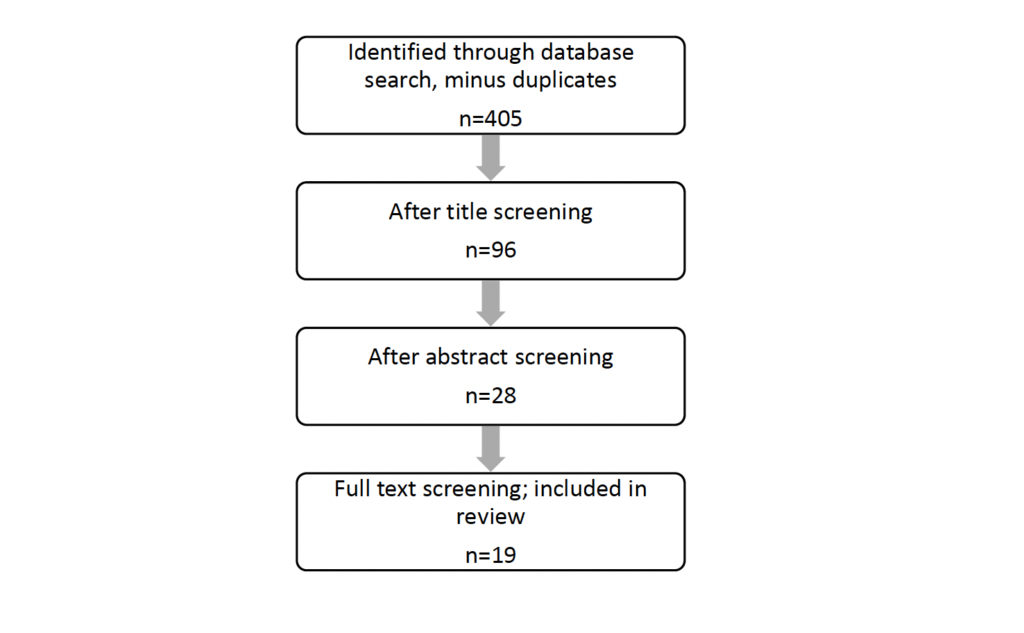
Organisation of literature
Previous literature reviews on the topic summarise the literature thematically (e.g., according to nature of online risk; Madigan et al., 2018) or chronologically (e.g., Jones, Mitchell, and Finkelhor, 2013), treating risk and intervention as separate issues. However, models which integrate research lines investigating harms and intervention strategies can provide the basis for understanding how the two interact. Therefore, the literature in the current review is organised in relation to the specific interaction of mediation strategy (namely restrictive mediation, active mediation and education) and content harm outcomes.
Theoretical stance
The current literature is contextualised within socio-developmental psychological theory and research, to highlight the psychosocial processes at play in content-risk intervention. Specifically, an adaptation of Bronfenbrenner’s (1979) systemic-ecological framework, whereby the developing child is situated in the context of the techno-microsystem (the immediate online environment) as an actor on their social, relational and individual macrosystems (Johnson, 2010; Martin and Alaggia, 2013), is employed to emphasise the importance of acknowledging the pervasiveness of Internet-connected technology in children’s lives today.
Results and Discussion
Restrictive mediation
According to socialisation theory, parents act as primary agents of their children’s social engagement, influencing the behaviour through which social development occurs (Maccoby, 2007). Therefore, parents have an important role in reducing online harm. Using exploratory factor analysis on survey data from 461 parent-and-child pairs, Sciacca et al. (2022) clustered 16 mediation items to demonstrate how this parental responsibility operates in online contexts according to two main types of technology mediation: active and restrictive. The former is characterised by discussing safe media practices with the child, whereas the latter describes setting limitations on use. According to a structured literature review (Nichols and Selim, 2022), restrictive mediation is the most commonly used parental strategy. Proponents of restrictive mediation assume that less time spent online reduces risks (Sciacca et al., 2022). However, a meta-analysis (Chen and Shi 2019) found that whilst this strategy is the most effective in decreasing the overall time that children spend using the Internet, it is not necessarily successful in reducing actual online risks, as measured by instances of numerous media-related harms. Additionally, effectiveness varied significantly according to age, online medium, and culture, limiting the strategy’s ‘contextual scope.’ Specifically, restrictive mediation was less effective in older and Western children, and those using social media or video games. Furthermore, it was associated with an increased risk of Internet addiction, which in turn is related to negative developmental, mental health and educational outcomes (Singh and Barmola, 2015). Ultimately, considering the prevalence of technology in contemporary childhood (Johnson, 2010), restriction alone cannot effectively mediate the ubiquitous influence of the Internet. Thus, it seems that the supposed merits of restrictive mediation (reducing overall time online) fail to outweigh its limitations.
Cognitive dissonance theory (Festinger, 1957) offers insight into the mechanisms underlying the relationship between restrictive parental mediation and increased risk of harm relative to other strategies. According to Festinger’s (1957) theory, restrictive mediation may displace an otherwise risk-evaluative justification for not using media, resulting in a conserved favourable attitude to the Internet. In other words, rather than attributing Internet restrictions to their own evaluation of risks, children whose Internet use is restrictively mediated see their parents’ presence as the only barrier to complete access. In the absence of this (often temperamental; Young et al., 2024) restriction, children may see no reason to limit themselves, consequently accessing a greater volume of harmful material when unsupervised.
This process has empirical support in the context of sexual content risks. A survey by Nathanson (2002) found that restrictive mediation was related to more positive attitudes towards viewing televised violence and sex. Some (e.g., Livingstone and Helsper, 2008) dispute the generalisability of television research to Internet outcomes due to differences in the number and magnitude of risks. However, this effect is likely present, if not greater, in Internet use, as Internet-connected devices such as smartphones are often confined into a smaller personal space, where favourable attitudes to viewing sexually explicit content are easier to exercise (Hatuka and Toch, 2016; McKeown, Parry, and Penny Light, 2017). A more recent survey by Shin and Ismail (2014) found that restrictive mediation was positively associated with risky social media behaviour among children, supporting the applicability of the restriction-risk process to Internet use. Collectively, this evidence suggests restrictive mediation has low effectiveness in reducing online harm.
Active mediation
Active mediation, whereby parents employ an educative approach whilst entrusting their child with responsibility over navigating online risks (Sciacca et al., 2022), may be a more appropriate strategy in reducing sexual content harm (Chen and Shi, 2019). Self-determination theory (Deci and Ryan, 1985) suggests that supporting children’s autonomy will encourage self-determination and moral internalisation of safe Internet practices. Consequently, children obey guidance and engage in less risky (i.e., sexual content-seeking) behaviour. This is particularly important to early-to-middle adolescents, for whom autonomy has developmental importance (Comstock, 1994). Active mediation allows this value to be conserved, promoting healthy psychosocial development (Van Petegem et al., 2012), whilst overcoming the barrier of parents’ inability to observe all instances of Internet use.
Limited research was identified on the direct impact of active mediation on harms and interventions associated with viewing sexually explicit content specifically. This is important because there may be unique differences in the impact of active mediation in this context. Chen and Shi (2019) did not differentiate between types of content risks (i.e., violent, sexual or hate opinions), limiting their findings’ generalisability to the present analysis. For example, parents may struggle to implement active mediation when discussing the risks of viewing sexually explicit material, due to discomfort discussing this particular topic (Mullis et al., 2021), a lack of knowledge of the risks (Young et al., 2024), or denial that their children might access such material (Davis et al., 2021). Consequently, drawing conclusions about sexual content risks from Chen and Shi’s (2019) findings may produce an overestimate of the effectiveness of active mediation. Research specific to sexual content risks is required to elucidate how active mediation functions in this specific context.
Moreover, an important prerequisite for effective active mediation is that parents hold the necessary digital skills to inform their children of safe use, known as digital literacy (Livingstone et al., 2017). Therefore, for active mediation to be recommended as a strategy to successfully reduce online harm to children on a large scale, policy would have to address the issue of adult digital literacy (Ofcom, 2023). This is especially important when considering that children of low socioeconomic status often have less digitally-confident parents, as illustrated by the finding that active mediation is more common amongst middle-class families (Clark, 2013). Consequently, active mediation may only be plausible for those of higher socio-economic status. Thus, whilst this strategy has been reported to be the most effective in reducing online content harm (Chen and Shi, 2019), it is not necessarily the most feasible in terms of administering governmental advice to parents who may have low digital literacy or confidence.
Education
A final approach identified in the literature is education external to parental mediation. Educating children themselves on how to safely navigate digital content permits them to exercise agency and self-determination over safe online behaviour, whilst considering the limited capacities of certain parental demographics to implement digital education (Livingstone et al., 2017). Additionally, as digital resources are increasingly transcending the boundaries of parental monitoring (viewing material can now be confined within the personal space of a smartphone or virtual reality headset; Fiani et al., 2020), an ‘internal’ approach to Internet mediation is increasingly required.
Research demonstrates that in the absence of sufficient education, young people turn to pornography as a source of information (Albury, 2014). Therefore, insufficient sex education not only neglects but perpetuates content risks. Qualitative survey research conducted with UK parents (Rudoe and Ponsford, 2023), reporting: “schools really need to work on pornography,” suggests that current UK sex education neglects to address sexual content risks. This is a perspective replicated in qualitative research with parents from other Western cultures (Davis et al., 2021). Students themselves identify an over-emphasis on biological mechanisms in sex education, and neglect of the emotional aspects of sexuality, including those associated with online content (Seiler-Ramadas et al., 2020).
There was a significant lack of research on external educative approaches to mediating online content risks. Qualitative studies like those described above provide an in-depth picture of lived experience (Queirós, Faria, and Almeida, 2017), allowing researchers to obtain rich data which can inform further investigation. For example, quantitative questionnaire data could supplement existing research by using items deducted from qualitative findings, such as ‘to what extent do you agree that schools need to better inform children of the risks of pornography?’ This design allows larger-scale distribution to participants (Queirós, Faria, and Almeida, 2017), meaning the sample can represent generalisable attitudes on sexual content education and inform modifications to the national curriculum.
Conclusions
Summary
This review has critically synthesised research on the prospective and evidenced practical value of several online harm-reduction strategies, with implications for both research and policy. In terms of parental mediation, ‘active’ appears to be superior to ‘restrictive.’ This is surprising considering the latter is the most common approach. Its inefficacy can however be explained by developmental psychosocial phenomena. Specifically, considering the immediate influence of the techno-microsystem on the developing child (Johnson, 2010), restriction is likely to exacerbate online risks (Shin and Ismail, 2014) and damage child-parent trust (Festinger, 1957). Though active mediation seems more effective, its practical value over external education must be considered. 9
Future directions
Further investigation could advance the implications of this review by empirically demonstrating how each of the strategies operate in relation to real-world risks. For example, randomised controlled field research can provide naturalistic insight into lived experiences (Paluck and Cialdini, 2014). The effectiveness of parental mediation strategies could be demonstrated using a randomised-controlled experiment measuring self-reported frequency of exposure to harmful content in children who receive either active or restrictive mediation. Notably, ethical challenges arise when attempting to inquire about children’s exposure to inappropriate content without inadvertently introducing them to unfamiliar sexual concepts (Livingstone, 2014; Oates et al., 2021). More implicit measures such as open-ended questions about uncomfortable online experiences, depressive symptom questionnaires (e.g., PHQ-9; Williams, 2014), and screen time markers could be used to overcome this challenge.
Practical considerations must also be taken when attempting to extrapolate policy recommendations from empirical research. Though active mediation appears the superior parental strategy for reducing harm, as suggested by theory (Deci and Ryan, 1985) and empirical research on general online risks (Chen and Shi, 2019), it is not necessarily plausible for all parental demographics, particularly the less digitally-literate (Livingstone et al., 2017). Consequently, its promotion could exacerbate existing socioeconomic disadvantages (Clark, 2013). Therefore, childhood educational intervention will most likely effectively target sexual content risks, concurrently addressing digital literacy.
Qualitative research suggests that presently, sexual-online education is inadequate in the UK. Further quantitative research could build on this to empirically communicate the necessity of comprehensive online sexual education in the national curriculum. This could subsequently be supplemented by efficacy trials of candidate programs. Specifically, an improved education program should address the cross-section of online and sexual education to address this novel developmental domain (Johnson, 2010) in young adolescent’s lives.
Acknowledgements: No acknowledgements.
Conflicts of interest: The author declares no conflict of interest.
References
Albury, K., 2014. Porn and sex education, porn as sex education. Porn Studies, 1(1-2), pp. 172-181.
Alexandraki, K., Stavropoulos, V., Burleigh, T. L., King, D. L., & Griffiths, M. D., 2018. Internet pornography viewing preference as a risk factor for adolescent Internet addiction: The moderating role of classroom personality factors. Journal of behavioral Addictions, 7(2), pp. 423-432.
Ali, W., 2020. Online and remote learning in higher education institutes: A necessity in light of COVID-19 pandemic. Higher education studies, 10(3), pp. 16-25.
Blakemore, S. J., 2017. Social‐cognitive development during adolescence. Child psychology and psychiatry: Frameworks for clinical training and practice, pp. 91-95.
Bronfenbrenner, U., 1979. The ecology of human development. Harvard University Press.
Chen, L., & Shi, J., 2019. Reducing harm from media: A meta-analysis of parental mediation. Journalism & Mass Communication Quarterly, 96(1), pp. 173-193.
Clark, L. S., 2013. The parent app: Understanding families in the digital age. New York: Oxford University Press.
Comstock, J., 1994. Parent‐adolescent conflict: A developmental approach. Western Journal of Communication, 58(4), pp. 263-282.
Davis, A. C., Wright, C., Curtis, M., Hellard, M. E., Lim, M. S. C., & Temple-Smith, M. J., 2021. ‘Not my child’: Parenting, pornography, and views on education. Journal of Family Studies, 27(4), pp. 573-588.
Deci, E. L., & Ryan, R. M., 1985. Intrinsic motivation and self-determination in human behavior. New York: Springer.
Eisenberg, N., Cumberland, A., Guthrie, I.K., Murphy, B.C., Shepard, S.A, 2005. Age Changes in Prosocial Responding and Moral Reasoning in Adolescence and Early Adulthood. Journal of Research on Adolescence, 15(3) pp. 235-260.
Espinoza, G., & Juvonen, J., 2011. The Pervasiveness, Connectedness, and Intrusiveness of Social Network Site Use Among Young Adolescents. Cyberpsychology, behavior and social networking, 14(12), pp. 705-709.
Festinger, L., 1957. A theory of cognitive dissonance. Stanford: Stanford University Press.
Fiani, C., Saeghe, P., McGill, M., & Khamis, M., 2024. Exploring the Perspectives of Social VR-Aware Non-Parent Adults and Parents on Children’s Use of Social Virtual Reality. Proc. ACM Hum.-Comput. Interact, 8(54).
Finkelhor, D., Walsh, K., Jones, L., Mitchell, K., & Collier, A., 2021. Youth internet safety education: Aligning programs with the evidence base. Trauma, violence, & abuse, 22(5), pp. 1233-1247.
Hatuka, T., & Toch, E., 2016. The emergence of portable private-personal territory: Smartphones, social conduct and public spaces. Urban Studies, 53(10), pp. 2192-2208.
Johnson, G.M. 2010. Internet Use and Child Development: Validation of the Ecological Techno-Subsystem. Journal of Educational Technology & Society, 13(1), pp. 176–185.
Jones, L. M., Mitchell, K. J., & Finkelhor, D., 2013. Online harassment in context: Trends from three Youth Internet Safety Surveys (2000, 2005, 2010). Psychology of Violence, 3(1), pp. 53–69.
Khadr, S., Clarke, V., Wellings, K., Villalta, L., Goddard, A., Welch, J., Bewley, S., Kramer, T., Viner, R., 2018. Mental and sexual health outcomes following sexual assault in adolescents: a prospective cohort study. Lancet Child Adolescent Health, 2(9): pp. 654-665.
Livingstone, S., & Helsper, E. J., 2008. Parental mediation of children's internet use. Journal of broadcasting & electronic media, 52(4), pp. 581-599.
Livingstone, S., Ólafsson, K., Helsper, E. J., Lupiáñez-Villanueva, F., Veltri, G. A., & Folkvord, F., 2017. Maximizing opportunities and minimizing risks for children online: The role of digital skills in emerging strategies of parental mediation. Journal of communication, 67(1), pp. 82-105.
Livingstone, S., & Smith, P. K., 2014. Annual research review: Harms experienced by child users of online and mobile technologies: The nature, prevalence and management of sexual and aggressive risks in the digital age. Journal of child psychology and psychiatry, 55(6), pp. 635-654. 12
Maccoby, E. E., 2007. Historical Overview of Socialization Research and Theory. In: J. E. Grusec & P. D. Hastings (Eds.), Handbook of socialization: Theory and research. The Guilford Press, pp. 13–41
Madigan, S., Villani, V., Azzopardi, C., Laut, D., Smith, T., Temple, J.R., Browne, D., Dimitropoulos, G., 2018. The Prevalence of Unwanted Online Sexual Exposure and Solicitation Among Youth: A Meta-Analysis. Journal of Adolescent Health, 63(2) pp. 133-141.
Martin, J., & Alaggia, R., 2013. Sexual abuse images in cyberspace: Expanding the ecology of the child. Journal of Child Sexual Abuse, 22(4), pp. 398–415.
McManus, M., 1986. Final report of the Attorney General's Commission on Pornography. Nashville: Rutledge Hill Press.
McKee, A., Albury, K., Dunne, M., Grieshaber, S., Hartley, J., Lumby, C., and Mathews, B., 2010. Healthy Sexual Development: A Multidisciplinary Framework for Research. Journal of Sexual Health, 22(1): pp. 14–19.
McKeown, J., Parry, D.C., & Penny Light, T., 2017. “My iPhone Changed My Life”: How Digital Technologies Can Enable Women’s Consumption of Online Sexually Explicit Materials. Sexuality & Culture, 22, pp. 340 – 354.
Mullis, M. D., Kastrinos, A., Wollney, E., Taylor, G., & Bylund, C. L., 2021. International barriers to parent-child communication about sexual and reproductive health topics: a qualitative systematic review. Sex Education, 21(4), pp. 387-403.
Nathanson, A. I. (2002). The unintended effects of parental mediation of television on adolescents. Media Psychology, 4(3), pp. 207-230.
Newlove-Delgado, T., Marcheselli, F., Williams, T., Mandalia, D., Davis, J., McManus, S., Savic, M., Treloar, W. & Ford, T., 2022. Mental Health of Children and Young People in England, 2022 - wave 3 follow up to the 2017 survey. NHS Digital.
Nichols, S., & Selim, N. 2022. Digitally mediated parenting: A review of the literature. Societies, 12(2), 60.
Oates, J., Carpenter, D., Fisher, M., Goodson, S., Hannah, B., Kwiatkowski, R., Prutton, K., Reeves, D., Wainright, T. 2021. BPS Code of Human Research Ethics. British Psychological Society.
Ofcom, 2021. Online Nation 2021 Report. Available from: https://www.ofcom.org.uk/siteassets/resources/documents/research-and-13
data/online-research/online-nation/2021/online-nation-2021-report.pdf?v=326530
Ofcom, 2023. Adults’ Media Use and Attitudes Report 2023. Available from: https://www.ofcom.org.uk/siteassets/resources/documents/research-and-data/media-literacy-research/adults/adults-media-use-and-attitudes-2023/adults-media-use-and-attitudes-report-2023.pdf?v=329409
Owens, E. W., Behun, R. J., Manning, J. C., & Reid, R. C., 2012. The impact of internet pornography on adolescents: A review of the research. Sexual Addiction & Compulsivity, 19(1-2), pp. 99-122.
Paluck, E.L. and Cialdini, R.B., 2014. Field research methods. Handbook of research methods in social and personality psychology, pp. 81-97.
Queirós, A., Faria, D., & Almeida, F., 2017. Strengths and limitations of qualitative and quantitative research methods. European journal of education studies.
Rudoe, N., & Ponsford, R., 2023. Parental attitudes to school-and home-based relationships, sex and health education: evidence from a cross-sectional study in England and Wales. Sex education, pp. 1-18.
Ryckman, L. F., Guerra, C., & Finch, A. 2020. Strategies to prevent online sexual abuse of children. Social Science Protocols, 3, 1-7.
Sciacca, B., Laffan, D. A., Norman, J. O. H., & Milosevic, T. 2022. Parental mediation in pandemic: Predictors and relationship with children's digital skills and time spent online in Ireland. Computers in Human Behavior, 127, 107081.
Seiler-Ramadas, R., Grabovac, I., Niederkrotenthaler, T., & Dorner, T. E., 2020. Adolescents’ perspective on their sexual knowledge and the role of school in addressing emotions in sex education: An exploratory analysis of two school types in Austria. The Journal of Sex Research, 57(9), pp. 1180-1188.
Shin, W., & Ismail, N., 2014. Exploring the role of parents and peers in young adolescents' risk taking on social networking sites. Cyberpsychology, Behavior, and Social Networking, 17(9), pp. 578-583.
Shore, L., Toumbourou, J. W., Lewis, A. J., & Kremer, P., 2018. Longitudinal trajectories of child and adolescent depressive symptoms and their predictors–a systematic review and meta‐analysis. Child and Adolescent Mental Health, 23(2), pp. 107-120.
Singh, N., & Barmola, K. C., 2015. Internet addiction, mental health and academic performance of school students/adolescents. Int J Indian Psychology, 2(3), pp. 98-108.
Van Petegem, S., Beyers, W., Vansteenkiste, M., & Soenens, B., 2012. On the association between adolescent autonomy and psychosocial functioning: examining decisional independence from a self-determination theory perspective. Developmental psychology, 48(1), pp. 76.
Williams, N., 2014. PHQ-9. Occupational medicine, 64(2), pp. 139-140.
Young, R., Tully, M., Parris, L., Ramirez, M., Bolenbaugh, M., & Hernandez, A., 2024. Barriers to mediation among US parents of adolescents: A mixed-methods study of why parents do not monitor or restrict digital media use. Computers in human behavior, 153, 108093.
Zillmann, D., 2000. Influence of unrestrained access to erotica on adolescents’ and young adults’ dispositions toward sexuality. Journal of adolescent health, 27(2), pp. 41-44.
Respond