Can you briefly introduce yourself — what you study, your year, and your career interests?
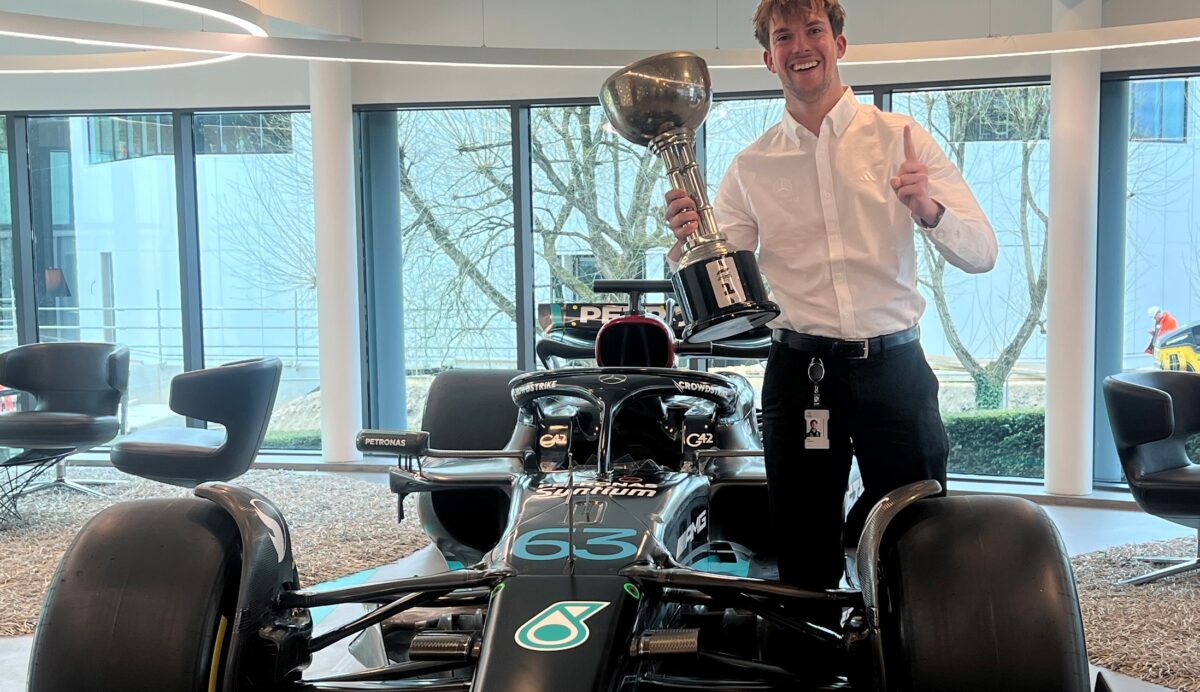
Hi! I am Sam Snudden and I am a Graduate Design Engineer at Mercedes AMG Petronas F1 Team and a Uni of Bath Alumni. While I was at Bath I studied MEng Mechanical Engineering with Automotive (with Placement) and graduated in 2025.
Throughout university I committed a lot of time to Bath’s Formula Student team (TBRe) including being Composites Lead in my final year. Also for my placement year I worked as a Composite Research Engineer at GKN Aerospace.
Before and throughout university, my career aim has always been to work in Formula 1, so I am very grateful that I have achieved my dream role straight out of university, especially by taking a different path than I might have expected. I hope to share some advice on how the process went for me, and how Linkedin can be a useful tool.
Can you tell us a bit about your use of Linkedin as a university student?
Since starting my placement year at GKN Aerospace, I started to build up my Linkedin profile, posting regularly about the work I was completing in the industry I was in. I found out quickly that LinkedIn is a great tool for networking, not only to stay connected with professionals you might meet on placement, but also to reach out/ connect to potentially important people at target companies (e.g Early Careers Recruiter). It also gives a great opportunity to show off any interesting skills or projects that you have completed - especially on placement.
Something I ended up doing in this time was to connect with some of these Early Careers Recruiters in different F1 teams and while this was mainly to keep notified for potential roles for the future I have learnt that it is also a great way to showcase yourself to these recruiters.
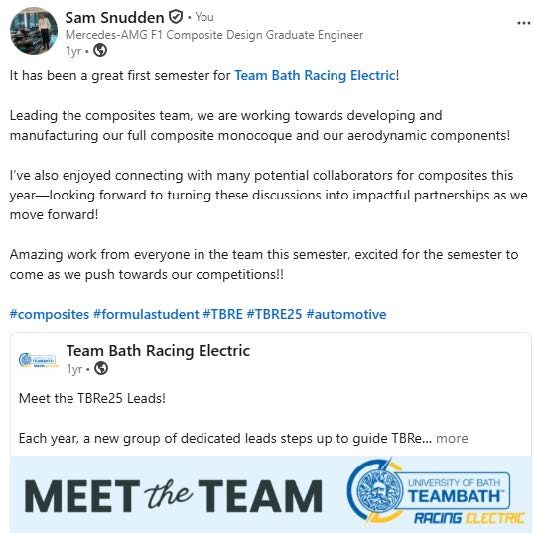
After returning from placement, I kept up with fairly regular Linkedin posts, sharing progress of work within the Formula Student team - showcasing new sponsors I had brought in and some updates on our composite manufacturing - which led to getting interaction with an F1 Early Careers Recruiter.
Explain how using Linkedin led to your Role at Mercedes F1 Team.
I ended up getting my role in a way that I never expected, as it wasn’t through a direct open application but from a shortlisting. From posting a brief update on my work in TBRe, I had an Early Careers Advisor like my post. From that I messaged her whether there would be any roles available at Mercedes - it was the case that they were building a talent pool for a Graduate Composite Design Engineer. And shortly after joining the talent pool by sending my CV over, a role became available and I got an interview and then the job!
Did you expect any kind of response or engagement from it?
In all honesty, I never expected the post to get the level of engagement it did. I originally shared it simply as a way to highlight my work and the effort I’d been putting in. It was really encouraging to see that my posts did get noticed and led to this great role! Especially having not done an F1 placement, it felt much more difficult to find the role I was looking for.
How did you approach writing the post—what did you include, and what tone did you use?
I think it is important to take a professional and informational approach to LinkedIn posts. Making it clear and concise is also important so that the important people take time to read it. It is also important to really explain and showcase in detail what you are working on / have achieved. It helps to showcase that you know what you are doing!
I’d think it is a balance of trying to post somewhat frequently, but also to include some good substance which showcases the work that you are doing and not just posting for the sake of posting.
What do you think made your post stand out to the recruiter?
I would have said that the post that did get approached was one of my less content heavy posts, but from talking to our Early Careers Recruiter I think it stands out by being concise and informational and served as a great way to promote my lead role in the Formula Student team. It can also just be a matter of the right place, right time! You never know when someone might be looking to recruit for a talent pool in the industry you are interested in, so the more constructive updates you can post, the more you can be on their timeline.
How has this experience changed the way you think about job searching or networking?
It has greatly encouraged me on the usefulness of networking and LinkedIn, even from a university level. LinkedIn is a free tool where you can show off your work and activities directly to employers! By finding a good balance of consistently posting and showcasing your work, it can be a great way to stand out and be noticed by early careers recruiters and stand out from the crowd.
I have also learnt that not all positions are sourced in the same way (I have realised since getting my role that there are often talent pools that are collated from sources such as LinkedIn), therefore connecting with people within F1 or any company can be important and useful, especially with early careers representatives.
What advice would you give to other students about using LinkedIn or other platforms to showcase their work?
Be concise but consistent. Think of LinkedIn as your portfolio — a place to professionally showcase your work, achievements, and growth. There’s nothing to lose by putting your accomplishments out there and connecting with professionals in your interested field. Use it as a space to show yourself off and what you’re working on. For me, taking on extra projects at university — like Formula Student — and seeking out work experience helped me build a stronger skill set, and LinkedIn was the perfect platform to highlight that.
What the last year has shown me is that it can be worth it, and when you least expect it! And it shows the power of networking.
It’s worth saying that you shouldn’t expect to be reached out to from these posts, but that it is important to be proactive if someone engages with your content. A simple like or comment can be the start of a valuable conversation.
I’m not sure how common my situation is in the recruitment process, but it’s a great example of how taking a different approach to promoting yourself can help you stand out and move closer to your dream graduate role!
Would there be any other general advice for students looking for a Graduate role?
Apart from really utilising the ability to post in LinkedIn, messaging can also be useful. While I don’t recommend badgering people, I really recommend at least connecting to important recruiting agents for the role you are targeting - this is how your posts can get noticed!
Occasionally, you can message these connections about a potential role that you are seeking, especially for a Graduate role. This is probably the most difficult to balance your approach - it is important to stay professional and accept that you may not get a response. But the more familiar they could be from your posts on their timeline, the more willing they might be to help. I would definitely recommend this if you had made a connection during placement, or had the chance to have a conversation at a careers fair! As someone who didn’t get an F1 placement, the graduate role search felt difficult, and there were definitely less advertised roles, especially for a particular department.
I hope that my experience can show that there are some additional methods that you can utilise to stand out for a role without just waiting for a role to pop up. There is a benefit to being proactive!
Respond