
How universities can strengthen their contribution to society through innovation
For many years, universities in the UK have used the term knowledge exchange to describe the many ways in which knowledge, expertise, and research are shared beyond academia. It remains an important concept, recognising that universities contribute to society through far more than teaching and research alone. [
Yet increasingly, industry, our government, and now our university are using another word: innovation.
Not because innovation fully replaces knowledge exchange, but because it can provide a new perspective. Innovation helps us think beyond how knowledge moves between organisations and communities. It describes how ideas, talent, and partnerships come together to create new value. Innovation brings together the many routes through which universities exchange knowledge and focus on the next horizon, where we deliver impact and create value.
Thoughts for you
As universities seek to increase their impact, innovation is becoming a more useful way to describe the broader contributions they make to society, the economy, and the place. This broader concept encompasses not only activity pathways but also the outcomes they help create. It reflects both the generation of new ideas and their adoption in ways that deliver societal, economic, or environmental value.
When I speak with colleagues across the University of Bath and with external partners, discussions often focus less on institutional terminology and more on practical challenges and opportunities:
- How do we help organisations become more competitive?
- How do we accelerate the adoption of new technologies, including AI?
- How do we support sustainable economic growth?
- How do we improve lives, places, and public services?
- How do we turn ideas into real-world impact?
These are fundamentally innovation questions. They focus on the change we want to create and the value we hope to generate through education, research, partnership, and enterprise.
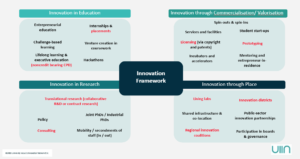
The framework shown above offers a useful way of understanding what innovation means in a modern university. It is far broader than commercialisation alone and extends well beyond patents, licences, and spin-outs.
Innovation in Education
Innovation starts with people. Through entrepreneurial education, challenge-based learning, placements, internships, hackathons, and venture creation activities, students develop the skills, confidence, and mindset needed to tackle complex problems. Perhaps the most powerful innovation outcome is not a new company or technology, but a graduate who leaves university equipped to create positive change wherever they work.
Innovation in Research
Research remains fundamental, generating the knowledge and insights that underpin innovation. Increasingly, however, innovation occurs through collaboration with external partners, helping to ensure that ideas are applied, then adopted. Through contract research, consultancy, industrial PhDs, and collaborative R&D projects, universities create pathways that connect discovery with adoption. The challenge is not simply to generate knowledge, but to ensure that it is used to create societal, economic, and environmental value.
Innovation in Valorisation (or Commercialisation)
This is the area most people instinctively think about when discussing innovation. Patents, licensing, proof-of-concept funding, incubators, accelerators, and spin-out companies all play a critical role in translating research into economic and societal value. These activities remain important, but they represent only one part of a much wider innovation system.
Perhaps the more interesting question is not simply how universities generate financial returns, but how they create value more broadly. Some innovations create commercial value through products, services, or new ventures. Others influence public policy, improve professional practice, strengthen public services, or help organisations make better decisions.
For example, research that informs a new government policy may never become a spin-out company, yet its societal impact could be significant. Equally, a piece of consultancy may help a local authority improve a service used by thousands of people. In both cases, the innovation lies not simply in creating new knowledge but in ensuring that knowledge is adopted and creates meaningful benefit.
Seen in this way, commercialisation is an important pathway to impact, but it is not the only one. Innovation can create economic, societal, and environmental value through many different routes.
Innovation Through Place
To me, one of the most interesting developments is the growing recognition that innovation is also shaped by place.
Innovation Districts, living laboratories, shared facilities, regional coalitions, and public-sector partnerships create environments where new ideas can emerge and scale more rapidly. Innovation is not simply something that organisations do; it is something that ecosystems enable. For universities, this means thinking not only about what happens on campus, but also about our role within cities, regions, and wider economic networks.
Three Key Insights
1. Innovation provides a helpful lens through which to view university impact.
Knowledge exchange, research commercialisation, partnership working, skills development, and civic engagement all contribute to innovation in different ways. Thinking in terms of innovation can help connect these activities around a common focus on creating value and impact.
2. Innovation occurs through education, research, enterprise, and place simultaneously.
Innovation is often associated with commercialisation, yet universities create value in many different ways. Education, research, enterprise, and place-based partnerships all contribute to innovation and should be recognised as part of the same system.
3. Universities create the greatest impact when they act as convenors within innovation ecosystems.
Universities rarely innovate alone. Their greatest contribution often lies in bringing together students, researchers, businesses, public-sector organisations, and communities to solve complex challenges. Innovation thrives when universities act as connectors within broader ecosystems.
Looking Ahead
As universities face increasing expectations to demonstrate their value and impact, there is an opportunity to articulate a broader innovation narrative; one that connects education, research, partnerships, enterprise, and place.
Viewed in this way, innovation is not just a standalone activity. It is how universities unlock the potential of people and ideas to create better futures. At Bath, this reflects an ambition to combine research excellence, outstanding student outcomes, and strong partnerships to deliver meaningful benefits for society, the economy, and the communities we serve.
Question for readers
When you think about innovation in universities, what comes to mind first?
How might we broaden the conversation to recognise the contribution of education, research, partnerships, enterprise, and place in creating impact?
We would be interested in your views. Please share your thoughts with us at innovation-enterprise@bath.ac.uk.