Members of the Institute for Digital Security and Behaviour (IDSB) are collaborating with colleagues across the University of Bath as part of a multi-disciplinary project looking at how AI might be developed to help emergency responders manage complex crises. The project, Crisis CoPilot, was one of the initiatives funded as part of the IDSB-supported Security, Defence and Resilience Sandpit, which was held at the University of Bath earlier this year.
What are we doing?
The application of AI to aid crisis management has been the focus of recent research in areas such as disaster and humanitarian response, and crisis communication. The potential benefits of AI in assisting incident response within UK emergency contexts has also increasingly been under the spotlight, with recent national events exploring the possible impact of such technologies on multi-agency emergency interoperability.
At the University of Bath, we are building on this foundation to explore practical AI tools and solutions that can support crisis response in the UK, bringing together colleagues from computer science, mathematical sciences, psychology, mechanical engineering, and management. Crucially, we are not attempting to replace the hard-won expertise, judgement and intuition of crisis responders. This is neither feasible nor desirable. Instead, we are exploring how AI can be exploited to support expert human capabilities in such situations; freeing up human cognitive capacity on the ground and in command to process complex information and deploy their expertise even more effectively.
Our initial work in this direction asks whether foundation models can read the operational logic out of existing emergency plans and bring several agencies' plans into a single connected picture. As an early test, we applied this to the plans that would have been triggered by the Manchester Arena attack in 2017. Working from the plans alone, and not the inquiry, our method used foundation models, acting as intelligent agents, to analyse the separate agency plans and bring them together into a single connected graph, revealing the same kind of coordination gaps that the public inquiry also identified. These experiments were an early pilot of the AI systems we intend to develop and deploy, led by Dr Harish Tayyar Madabushi, with graduate research student Min Ye and Professor Maria Battarra of the School of Management.
The importance of stakeholder engagement
A key part of this work has involved convening a multi-agency stakeholder workshop, which was held in Bath on 26 June 2026 in particularly balmy weather. Subsequent meetings were also held with invited guests unable to attend on the day. The workshop and discussions included Wiltshire Police, Avon and Somerset Police, London Fire Brigade, NHS Emergency Capabilities Unit, Joint Emergency Services Inter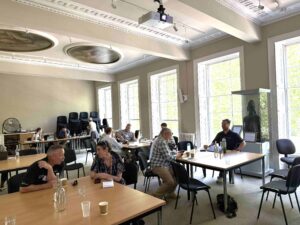 operability Principles (JESIP), National Inter-Agency Liaison Officer (NILO), Defence Security and Technology Laboratory (Dstl, MOD), and industry partner insights and perspectives. They have been vital in capturing diverse stakeholder views and experiences, as well as building the collaborative partnerships necessary for impactful research. The workshop was led by Dr Rachel Paskell, Chartered Clinical Psychologist and Senior Lecturer in the Department of Psychology, whose work focuses on trauma events and response, including the human factor elements of working in crisis, mass casualty and chronic stress environments.
Discussions explored the types of coordination failures and information sharing breakdowns that may be experienced on the ground and in command and coordination, both during and immediately after, complex incidents. We also considered and critiqued the approach that we were taking to the development of a potential AI tool, with project lead Dr Harish Tayyar Madabushi, a Senior Lecturer in the Department of Computer Science, leading the discussion on the work that the team has done to date and its applicability to the experiences and challenges that are faced on the ground.
Crucially, the session enabled us to develop relationships with practitioner communities, laying the foundation for effective engagement and collaboration as the project progresses.
So, what next for Crisis Copilot?
We are continuing to develop our plans and ideas based on the work done to date and the stakeholder feedback and engagement that we've had. Specifically, we will be developing a funding application that enables us to build on the success of the project so far and continue to be open to additional potential partners and collaborators who are interested in working with us in this area.
Collaboration and interdisciplinarity is a vital part of this project and we are keen to hear from stakeholders who are interested in being involved or finding out more. If this is you, please email Dr Harish Tayyar Madabushi (htm43@bath.ac.uk) and do share this blog with your colleagues and relevant networks.
Respond