Latin America's social protection systems have long relied on families to care for older relatives, but demographic change is steadily eroding this source of support. Brandon D. Hernández Jaramillo, Lecturer at Universidad del Norte and an independent researcher specialising in population ageing and kinship demography, examines how shrinking family networks could reshape the region's future care needs.
Governments across Latin America are beginning to grapple with population ageing. Life expectancy is rising, fertility rates are falling and the proportion of adults aged 65 and over is growing faster than almost anywhere else in the world. At the same time, the family networks that have traditionally supported older people are becoming smaller.
In most Latin American countries, formal systems of elderly care remain limited. Residential care provision is scarce, home care services are underdeveloped and pension systems often leave older people without adequate income. As a result, families continue to provide the vast majority of support.
According to estimates by the Inter-American Development Bank, around 90% of care received by older adults in the region is provided by relatives, such as children and siblings. This care is largely unpaid and falls disproportionately on women.
Historically, this model has been sustained by relatively large family networks. In 1990, a person reaching old age could expect to have nearly six living relatives on average. However that number is steadily reducing due to demographic changes, leaving fewer family members available to provide care.
The shrinkage of family support networks
New analysis using demographic kinship models from the Max Planck Institute for Demographic Research and population projections from the United Nations (UN) estimates how the size of family support networks for older adults is likely to change across 12 Latin American countries between 1990 and 2060. The analysis focuses on close relatives most likely to provide support in later life, including children, grandchildren, siblings, nieces/nephews and mothers.
Family networks are projected to shrink substantially across the region. In Paraguay, where a typical 70-year-old could expect around 11 living relatives within this support network in 1990, the figure is projected to fall to around 3.4 by 2060. In Chile, the equivalent figure is projected to decline from around five relatives to fewer than two.
Although countries are at different stages of demographic transition, the overall trend is remarkably consistent. The region as a whole is converging toward a narrow band of between 1.9 and 3.4 living kin by mid-century.
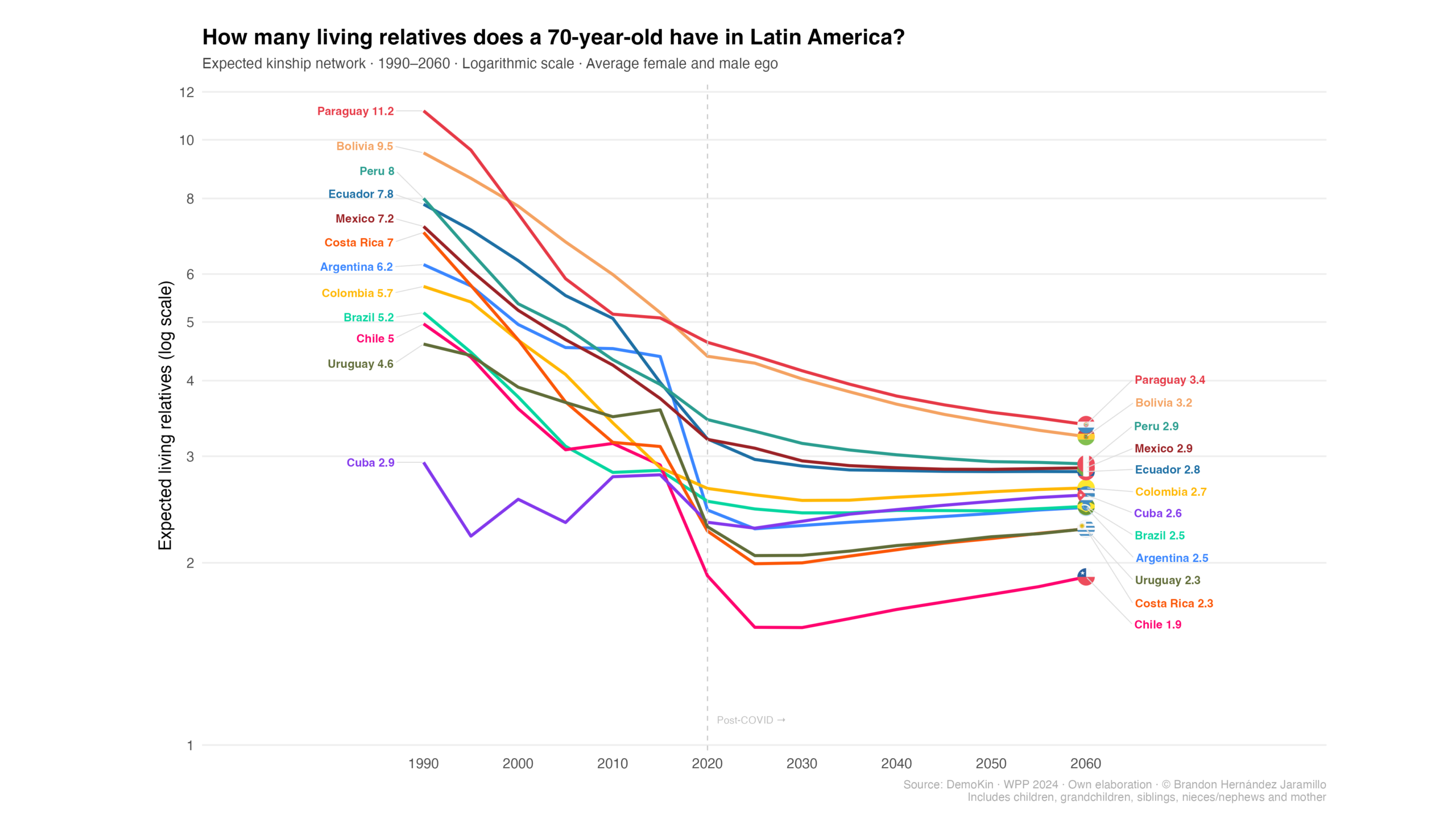
Figure 1. Expected number of living kin for a 70-year-old across 12 Latin American countries, 1990–2060 (logarithmic scale). Includes children, grandchildren, siblings, nieces/nephews and mother. Source: DemoKin; UN World Population Prospects 2024 · © Brandon Hernández Jaramillo.
But these projections do not tell us how many relatives will actually provide care. Rather, the number of potential carers places an important upper limit on the availability of care. Geographic distance, employment conditions and the health of potential carers will influence whether support is available in practice.
Impact of fertility decline
Differences between countries that experienced fertility decline earlier, such as Chile and Uruguay, and those where fertility remained higher for longer, such as Paraguay and Bolivia, are narrowing rapidly. The changing rankings of countries illustrate this convergence. Countries that urbanised earlier and experienced fertility decline sooner already have some of the smallest family networks in the region. Countries that entered demographic transition later continue to have larger networks, but these are shrinking rapidly.
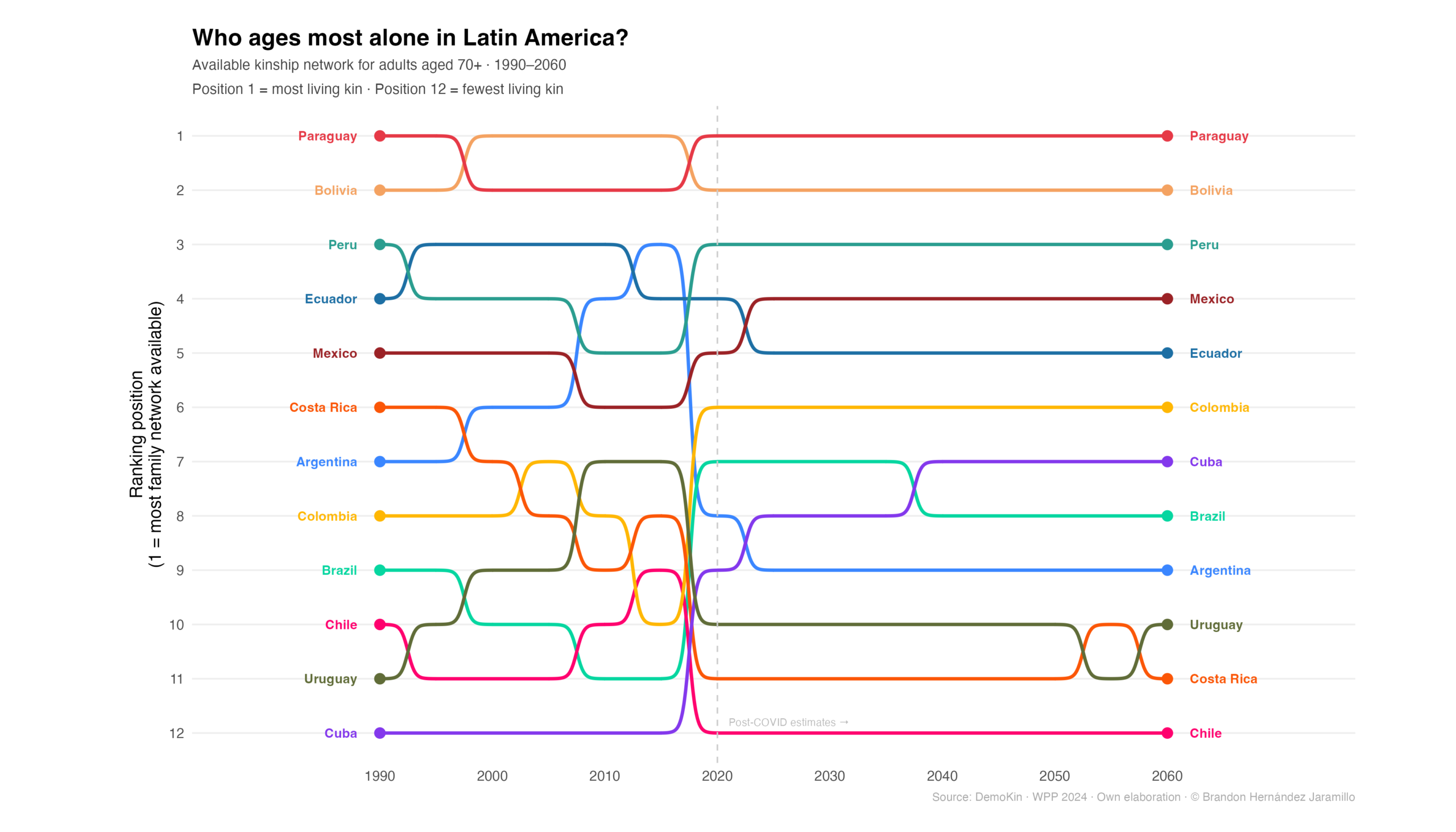
Figure 2. Ranking of 12 Latin American countries by available family network for adults aged 70+, 1990–2060. Position 1 = most living kin · Position 12 = fewest living kin. Source: DemoKin; World Population Prospects 2024 · © Brandon Hernández Jaramillo.
The case of Colombia highlights how quickly demographic assumptions can become outdated. The analysis finds that a typical 70-year-old Colombian in 2060 is expected to have around 2.7 living relatives within their core support network, down from almost six in 1990. But Colombia’s national statistics agency, DANE, reported a fertility rate of just 1.0 children per woman in 2025. This was 40% lower than the fertility assumptions embedded in the UN projections for the same year.
When the kinship model is recalculated using the observed fertility rate, the projected number of living relatives falls further, to around 1.5 by 2060. This suggests that family support networks may contract even more rapidly than current international projections indicate. The grey band in Figure 3 shows this gap.
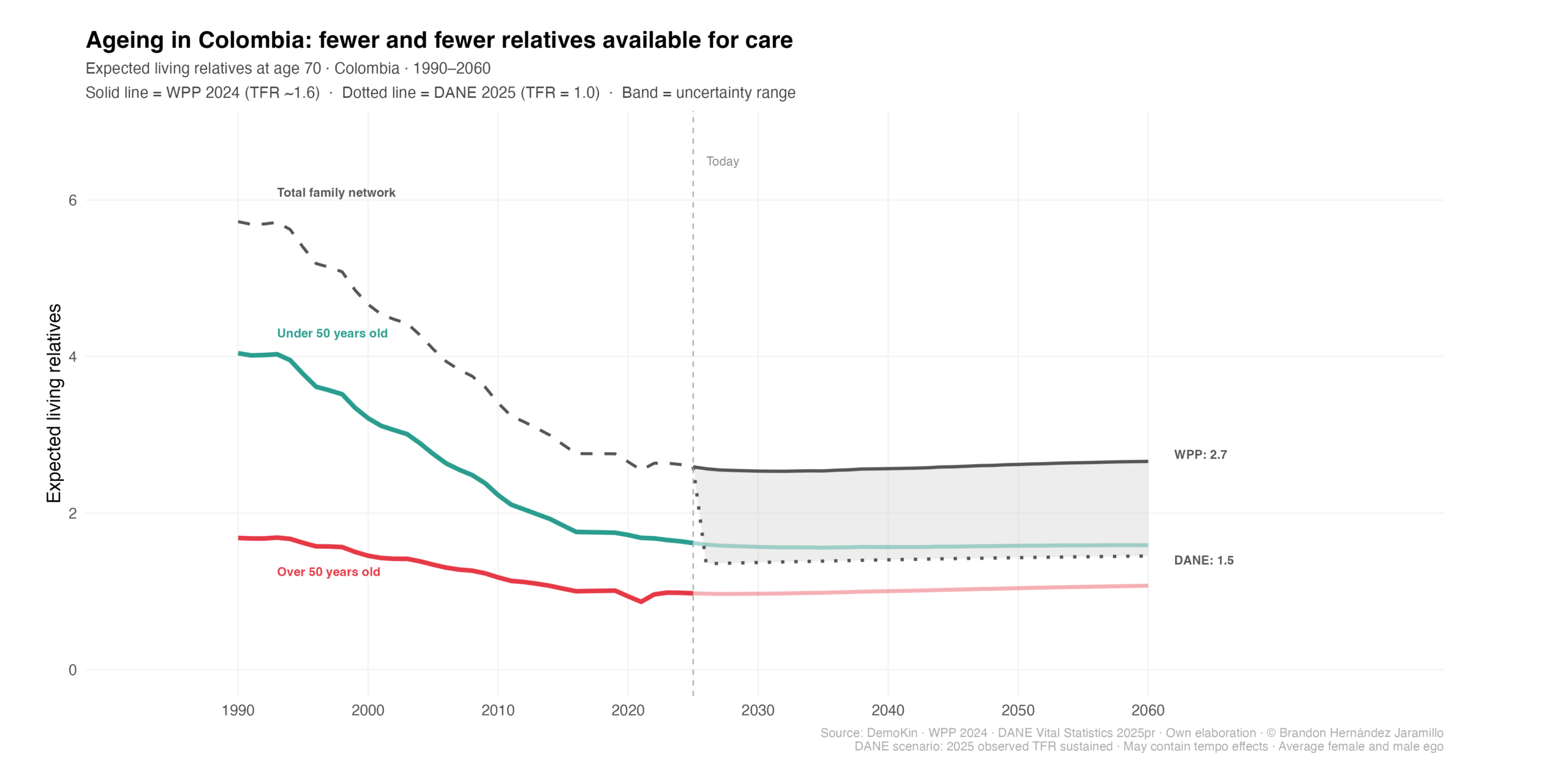
Figure 3. Expected living kin for a 70-year-old in Colombia, 1990–2060. Solid line = World Population Prospects 2024 scenario (Total Fertility Rate ~1.6). Dotted line = scenario based on DANE 2025 fertility observations (Total Fertility Rate = 1.0). Grey band = uncertainty range. Source: DemoKin · World Population Prospects 2024; DANE Estadísticas Vitales 2025 · © Brandon Hernández Jaramillo.
Implications for policy
As family networks become smaller, the responsibility of caring for older relatives is likely to be shared among fewer people. Those who do provide care may be required to do so for longer periods and with less support from other family members. The consequences of which are likely to be felt most strongly by women, who continue to undertake the majority of unpaid care work. Greater caring responsibilities can affect labour market participation, earnings and retirement savings, reinforcing existing inequalities over the life course.
This raises important questions about the sustainability of social protection systems in the region. Many existing arrangements rely heavily on the assumption that families will continue to provide care when public services are unavailable or insufficient. As family networks shrink, that assumption becomes increasingly difficult to sustain.
An immediate priority therefore lies in the expansion of formal long-term care provision. This includes investing in home care services, developing a trained and adequately paid care workforce and increasing access to residential care beyond the wealthiest sections of society.
There is also a strong case for recognising and supporting informal carers. Across much of Latin America, unpaid care work remains largely invisible within social protection systems. Measures such as pension credits for time spent caring, income support and respite services could help reduce the financial and personal costs associated with caring responsibilities.
Furthermore, governments must take demographic projections more seriously when designing social protection systems. Recent global research projects a 67% decline in total family size for Latin America and the Caribbean by the end of the century, the largest reduction of any world region. Policymakers who continue to operate on older demographic assumptions risk planning for populations and family structures that no longer exist.
The adults who will require care in the coming decades are already alive. The family members who might otherwise have supported them are becoming fewer with each successive generation. The challenge for policymakers is not whether to adapt to this demographic reality, but how quickly they can do so.
All articles posted on this blog give the views of the author(s), and not the position of the IPR, nor of the University of Bath.