

Public debate often assumes that communities become more hostile to immigration when asylum seekers are housed nearby. Max Strangleman-Sykes, a Politics and International Relations finalist at the University of Bath, explains why local increases in asylum accommodation do not appear to drive support for anti-immigration policies and what this means for our understanding of how electoral support is shaped in Britain.
New analysis suggests that the areas that received the largest increases in asylum seekers between 2019 and 2024 became no more hostile to immigration than those that received the fewest. Attitudes hardened to a similar extent regardless of local asylum accommodation. This finding challenges the assumption that anti-immigration politics is driven by new asylum arrivals in local communities. Instead, it suggests that opposition is shaped by headline immigration figures and national political and media debate, independent of local conditions.
Local opposition to asylum seekers: the common explanation
As asylum applications across Europe have grown over the past two decades, anti-immigration and right-wing populist parties have become a fixture of the political landscape, with several recently entering government. These parallel developments have prompted a popular assumption that communities receiving asylum seekers resist their presence locally and subsequently become more hostile to immigration, driving growing support for anti-immigration parties.
This belief is perhaps best captured in the words of former United Kingdom (UK) Home Secretary, Suella Braverman: support for immigration is a "luxury belief", while the residents living alongside asylum seekers see them as a strain on community cohesion and public services.
At first glance, recent events in the UK appear to affirm this view.
In 2024, the UK recorded its highest-ever number of asylum applications, reaching 108,138, and, by 2025, it registered the highest level of concern about immigration among 107 countries surveyed globally. Indeed, the local backlash may appear real: rioters attacked asylum hotels following the Southport attack in summer 2024, while Reform UK, the party most popularly associated with anti-immigration politics, has risen to lead national voting intention polls.
However, new research suggests a different picture. Between 2019 and 2024, the areas that received the largest increases in asylum seekers became no more hostile to immigration than those that received the fewest, even though attitudes toward immigration became more negative across the UK overall. In other words, the assumed local backlash has not materialised in public attitudes.
This finding is striking given the context of the period. As the cost-of-living crisis brought the largest fall in living standards in seventy years, the housing of asylum seekers in hotels drew considerable public attention, with asylum widely framed as a national emergency and its claimants as recipients of preferential treatment. This has prompted intense political response, from Rishi Sunak’s Rwanda plan to Keir Starmer’s promise to “smash the gangs” behind Channel crossings.
Yet in spite of this, worsening attitudes towards immigration are not being driven by the communities closest to asylum seekers. Increased support for anti-immigration parties, then, does not appear to stem from the opening of a new asylum hotel down the road.
Full dispersal: the 2022 policy that reshaped the geography of asylum
Since 1999, the UK has managed asylum accommodation through a 'dispersal system'. Under this system, the Home Office can house asylum seekers anywhere in the country whilst their claim is being processed, regardless of where they would prefer to live. To keep costs down, accommodation has traditionally been concentrated in a relatively small number of urban areas with low housing costs, primarily in deprived parts of northern England, the West Midlands and London.
As asylum applications reached record levels, this dispersal arrangement came under increasing pressure, and the pipeline of available accommodation was unable to keep pace. To provide accommodation quickly, the Home Office relied more heavily on hotels. The proportion of asylum seekers housed in hotels rose from around 5% in early 2020 to almost half of all asylum accommodation by 2023.
Under mounting pressure to reduce its reliance on expensive hotel accommodation, the Conservative government introduced the ‘full dispersal’ policy in April 2022. For the first time, every local authority in England, Scotland and Wales was expected to participate in housing asylum seekers. As a result, many areas experienced their largest-ever increases in asylum accommodation.
Despite its name, however, 'full dispersal' did not, in practice, lead to every local authority hosting significantly more asylum seekers. The policy brought many areas with little prior exposure into the system, but it did not do so evenly. Some areas saw dramatic increases. Braintree in Essex, for instance, hosted virtually no asylum seekers in 2019, but by 2024 it housed around 555. Hillingdon in Greater London, already home to roughly 540 at the start of the period, saw numbers rise to more than 2,200; more than quadrupling its total. By contrast, a smaller number of areas saw little change and continued to host relatively low numbers of asylum seekers.
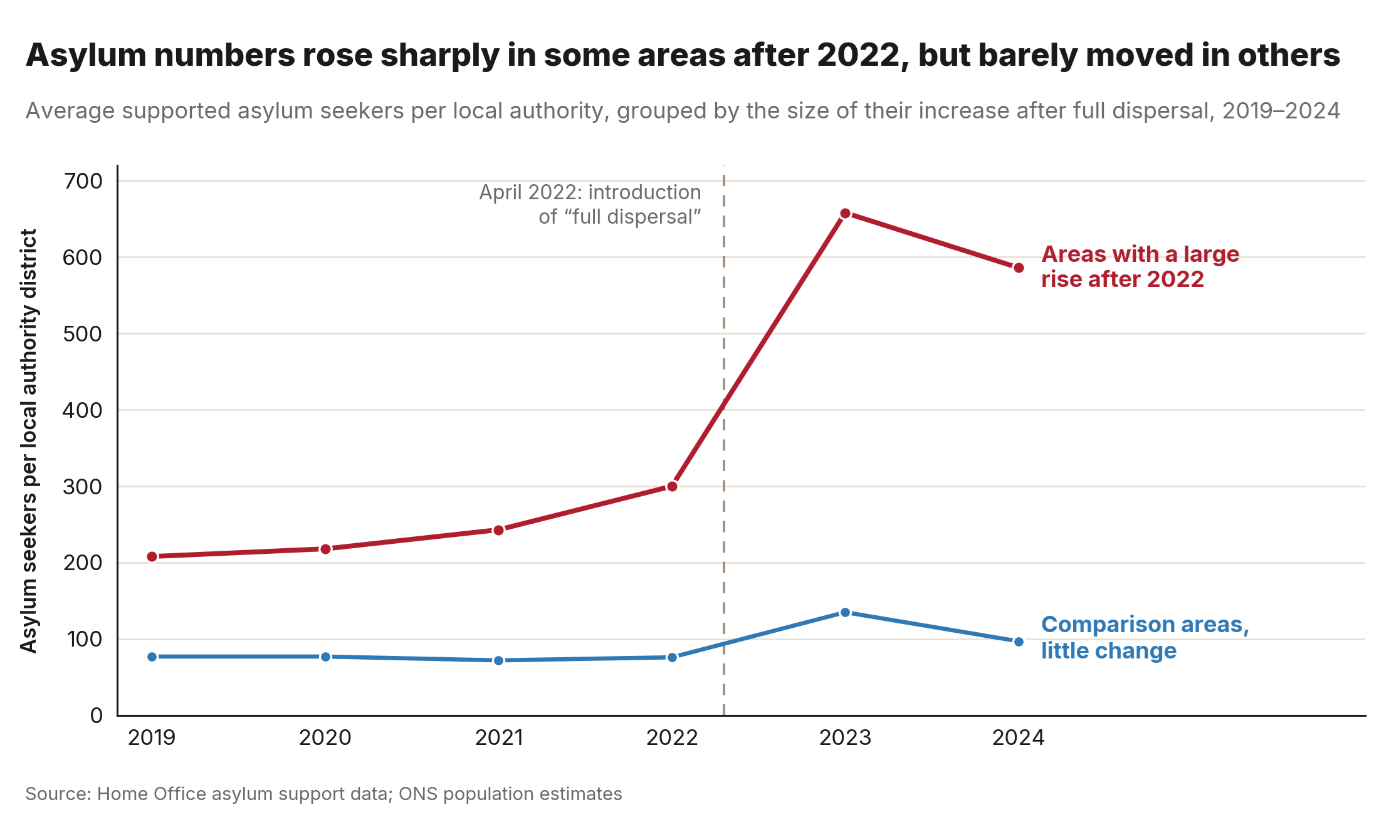
Figure 1
As Figure 1 shows, in areas that absorbed large numbers following the reform, the average number of asylum seekers per local authority rose at a record rate from 2022. In other areas, it changed very little. Figure 2 maps the locations of the largest increases across England.
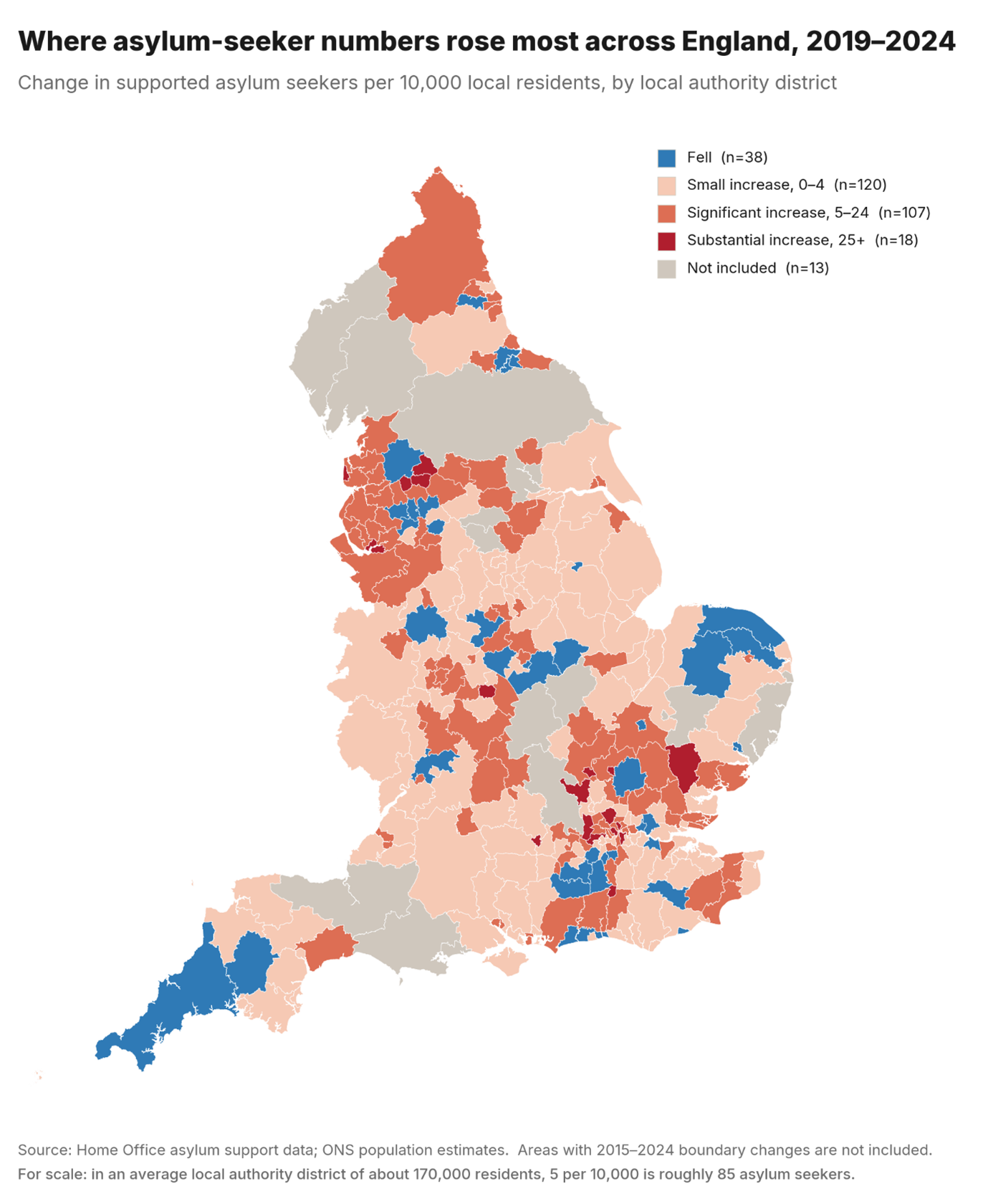
Figure 2
This uneven impact made a natural experiment possible, enabling a comparison of how attitudes to immigration changed in areas that experienced significant asylum seeker influxes against those that did not.
Areas receiving asylum seekers did not become more hostile to immigration
How did local attitudes to immigration change as asylum seekers were dispersed across England in record numbers?
To answer this question, the research linked British Election Study (BES) respondents to Home Office data at the local authority level, tracking changes in attitudes across 283 areas between 2019 (before the policy change) and 2024 (after the asylum influx). Immigration attitudes were measured using two BES survey questions: whether respondents thought too many immigrants had been admitted to Britain, and whether they believed immigration had a positive or negative impact on the economy.
At the national level, responses to both questions became more negative. However, this shift was not driven by areas that received more asylum seekers. Places that experienced significant increases in asylum accommodation did not become more hostile than those that received few or none. Attitudes towards immigration changed almost identically in both groups, differing by less than one-third of a point on a 0-100 scale.
The findings were similar for views about immigration’s economic impact. Areas receiving more asylum seekers became around three points more negative on average, but this difference was too small and inconsistent to indicate a meaningful effect. In the areas that received the largest increases in asylum seekers, even this small difference disappeared. Compared to places receiving the fewest asylum seekers, these areas actually became slightly less negative towards immigration’s economic impact.
Where does support for anti-immigration parties actually come from?
The absence of a measurable local backlash in attitudes has two important implications for how we understand politics in Britain.
First, it suggests that growing opposition to immigration is not being driven by direct local experience. Instead, increased public concern about immigration tracked media coverage of small boat crossings more closely than it tracked the spread of asylum accommodation. As politicians from across the political spectrum sought to demonstrate credibility on immigration, “crisis” language became increasingly common in mainstream political debate, framing the issue in ways that helped shape attitudes from the top down. This is consistent with a body of established research showing that hostility towards immigration tends to increase when national political and media attention makes the issue more prominent, regardless of what is happening locally.
Second, the findings highlight the divergence between public attitudes and voting behaviour. People’s underlying views on immigration tend to change gradually across the country, whereas electoral support can swing quickly in a single area. The findings here fit this pattern. Although attitudes became more negative across England between 2019 and 2024, they did not harden more quickly in areas receiving asylum seekers. Rising support for an anti-immigration party in a particular area should, therefore, not be interpreted as evidence that local residents have recently changed their views. More often, voters may be acting on long-standing attitudes that have become more urgent or politically important because of national debates.
Looking ahead to the next general election, the rise of Reform UK and Restore Britain may be better understood as the mobilisation of attitudes that already existed within the electorate, amplified by disaffection with mainstream parties, rather than as a direct response to recent local changes in asylum accommodation. The evidence suggests that the drivers of anti-immigration politics emerge from the national political environment, or function as a vessel for broader anxieties, rather than from people’s direct experience of immigration in their own communities.
All articles posted on this blog give the views of the author(s), and not the position of the IPR, nor of the University of Bath.