

Death and bereavement have consequences that extend beyond healthcare. Professor Kate Woodthorpe, Co-Director of the University of Bath’s Centre for Death and Society, explains how a more coordinated, whole-of-government approach could alleviate some of the legal, financial, administrative and social challenges facing individuals, families and communities.
End of life should not be treated solely as an issue for the dying individual, nor solely as a matter for healthcare. A whole-of-government approach to death, dying and bereavement could help ensure that responsibility for navigating this complex period does not fall disproportionately on bereaved individuals. Policy should recognise that many of the challenges associated with bereavement can be anticipated and better supported, helping to protect people, communities, employers, public services and the wider economy from some of its longer-term consequences.
Death is more than a health issue
At a time when debates about control at the end of life are dominating the UK news cycle, for example in the recent House of Commons vote against legalising assisted dying in England and Wales, questions about whether death should be understood as a medical ‘problem’ to be managed have rarely been more pertinent, nor more salient for a growing part of the population reaching the last decades of their lives.
Around 570,000 people die each year in England and Wales. As the baby boomer generation ages, this number is expected to rise by around 10% over the next 15 years.
Much of the policy and political debate about the end of life is focused on demand for, and the provision of, health and social care. But dying and death also have significant social and financial consequences, particularly for those close to the individual. At this point, multiple government departments and agencies can become involved, yet there is currently no coordination between them.
For example, in recent years, policy and legislative activity relating to death and dying has involved public bodies and other organisations including the Law Commission of England and Wales, the Financial Conduct Authority, the Department for Work and Pensions (DWP), the Ministry of Justice, the Department for Education and the Scottish Government. This fragmented landscape reflects the fact that death is not simply a health event. It can trigger a complex set of legal, financial, administrative and social consequences for individuals, families and communities.
From fragmented services to a whole-of-government approach
There is evidence to suggest that how the end of life and its aftermath are managed can have longer-term consequences for bereaved people. Research from Japan suggests that well-managed end-of-life and post-death processes can have a preventative and protective function, helping people to maintain relationships, remain economically active and avoid some of the wider harms associated with bereavement, including isolation and financial insecurity. There is currently no equivalent body of UK research quantifying the economic and health costs of poorly managed end-of-life and post-death processes, or the potential value of coordinating them. Establishing this evidence base should therefore be a policy priority.
England and Wales has an opportunity to lead internationally by reconceptualising death as both a health and a social issue, and by coordinating public sector responsibilities around dying, death and loss. This does not mean treating death as something that can be ‘solved’. Rather, it means recognising that the consequences of dying extend well beyond the individual and that public services should be designed accordingly.
Local government and communities are often better placed than central government to understand the needs of their populations. But devolving responsibility without providing the resources, infrastructure and coordination to support it risks simply shifting accountability for an unavoidable part of life onto local services that cannot address it alone.
There are already examples of what this can look like. Close to the University of Bath, the Compassionate Frome Project in Somerset has demonstrated how partnerships between public services, local businesses and organisations, and voluntary, community and social enterprise (VCSE) organisations can enable people and communities to prepare for the end of life and support one another through loss.
Designing a better pathway through death and bereavement
Not everyone will want to support others in their local community however, and there is a clear role for the state in providing straightforward and consistent policies and systems that can be easily navigated at this point in people’s lives. There is a need for a more coherent pathway through dying, death and bereavement. Establishing consistent and effective connections across government departments and public services would be a practical starting point. The objective should be to support both the individual who is dying and those around them who are likely to become bereaved, reducing avoidable administrative, financial and social harms at an already difficult time.
Such a pathway could include, for example, requiring a search of the National Will Register when a death is registered. More radically, it could explore whether making a will should be encouraged or facilitated at significant life stages, such as entering into a legal partnership, having children or taking on major financial commitments, so that responsibility for dealing with a person’s affairs after death is clearer. It could also involve a commercial equivalent of the DWP’s ‘Tell us Once’ service, which allows a death to be reported to multiple government organisations in one process, or more effective signposting and information-sharing between the different agencies and organisations people encounter before and after death.
These are not simply administrative changes. They reflect a more fundamental shift in how policy understands death. The end of life should not be treated solely as an issue for the dying individual, nor solely as a matter for healthcare. It is a social transition with consequences for families, communities, employers, financial institutions, public services and the wider economy.
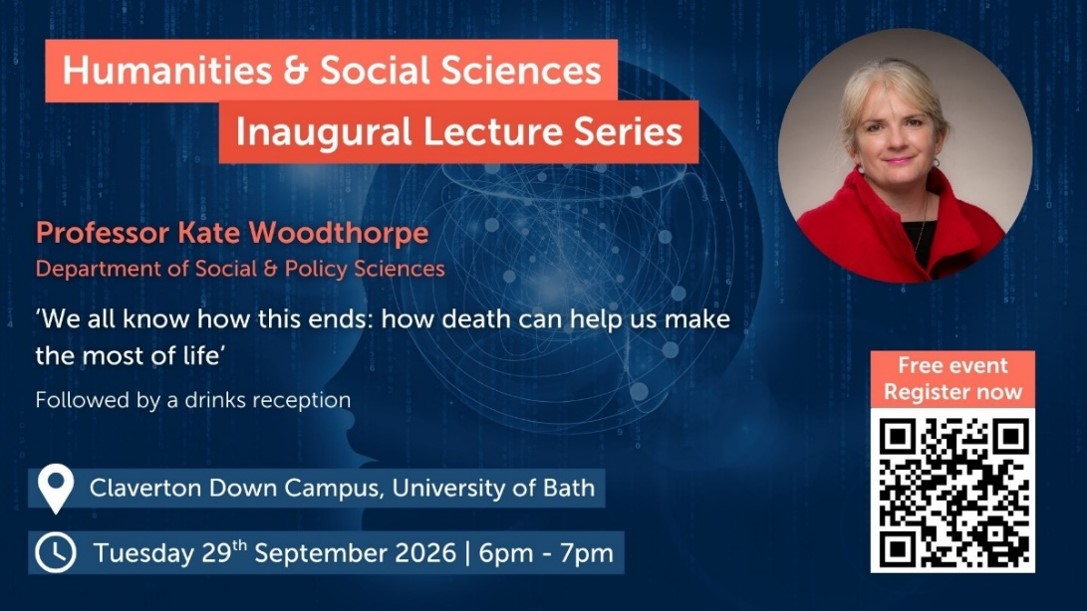
If you would like to find out more about the Centre for Death and Society, you can attend Kate’s inaugural professorial lecture on 29 September:
About the author: Kate Woodthorpe is a Professor in the Department of Social and Policy Sciences at the University of Bath. Kate is currently the only UK-based academic on the editorial boards of three major death studies journals: Death Studies, Omega and Mortality. She was a Special Adviser to the Work and Pensions Select Committee Inquiry into Bereavement Benefits and previously advised the Competition and Markets Authority during an investigation into the funeral industry.
All articles posted on this blog give the views of the author(s), and not the position of the IPR, nor of the University of Bath.