As competition between the world’s major powers intensifies, middle powers are coordinating their responses to help stabilise international affairs. Avital Zuk Avina, a researcher and lecturer specialising in political communication and international relations, examines how the UK and Canada are leading efforts to build new coalitions and what this could mean for the future of the international order.
The international order that emerged after the Cold War is under increasing strain. The United States (US) has adopted a more nationalist approach to international affairs, while China continues to expand its influence through BRICS (Brazil, Russia, India, China, South Africa, Egypt, Ethiopia, Iran and the United Arab Emirates).
Rather than aligning fully with either of the world’s leading powers, a growing number of states are seeking alternative forms of cooperation. The United Kingdom (UK) and Canada are increasingly positioning themselves at the centre of this effort, promoting greater cooperation among middle powers.
A return to geopolitical blocs
For much of the second half of the twentieth century, international politics was structured around three broad groupings: capitalist democracies aligned with the US, the Soviet bloc and a diverse group of non-aligned states that sought to maintain autonomy from the two superpowers.
Although the Cold War’s “Three Worlds” model is largely no longer used (modern discourse favours developmental indicators such as the Global North and South), today’s geopolitical landscape resembles a similarly fractured structure. On one side sits US President Donald Trump’s Board of Peace. On the other is an expanding BRICS grouping, influenced largely by China. Between these blocs lies a growing group of states seeking strategic flexibility, economic development and greater influence over international decision-making. For example, those who joined the Coalition of the Willing in Ukraine, or the UK-led Hormuz summits.
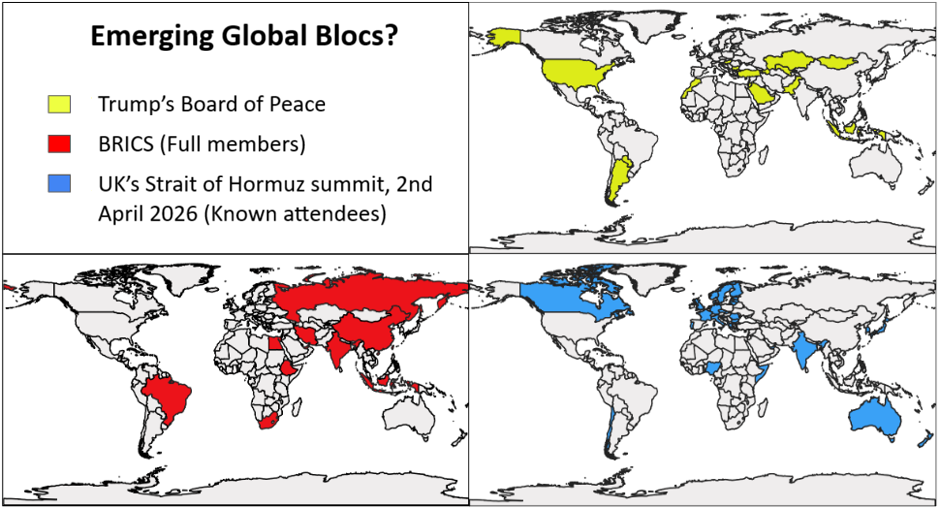
These groupings remain fluid. Many states continue to cooperate with multiple partners simultaneously, pursuing different relationships across trade, security and diplomacy. Nevertheless, intensifying competition between major powers is creating new incentives for middle powers to coordinate their responses, and cooperate on economic development, stability and strategic autonomy to protect their interests.
Middle powers in the driving seat
In April 2025, European Commission President Ursula von der Leyen stated that "the West as we knew it no longer exists." In January 2026, speaking at the World Economic Forum in Davos, Canadian Prime Minister Mark Carney emphasised that the rules-based international order had experienced "a rupture, not a transition" and called for closer coordination among middle powers in response to economic coercion and geopolitical fragmentation. Carney’s speech received a standing ovation; an unusual occurrence at a World Economic Forum gathering.
The UK has offered its own response to these challenges. Following the disruption to shipping through the Strait of Hormuz during the US-Israeli conflict with Iran, British Prime Minister Keir Starmer convened a meeting of more than 40 countries to explore diplomatic and political measures aimed at restoring freedom of navigation. On 13 April 2026, Starmer confirmed that the UK would not support the US naval blockade, insisting the UK remained focused on bringing together a coalition of countries to reopen the critical waterway peacefully. The UK subsequently announced a joint summit with France aimed at restoring free transit through the Strait.
These initiatives reflect a shift towards coalition-building among states seeking to manage international crises without relying on US leadership. This approach aligns with a wider strategic argument that, rather than attempting to compete directly with larger powers, middle powers can generate influence by bringing together countries with shared interests on specific issues such as security, trade, finance and technology.
The logic of “minilateral” coalitions
What is emerging is not a return to traditional multilateralism (where multiple countries work together to pursue shared goals), but the growing importance of smaller and more focused forms of international cooperation. Scholars often describe this approach as minilateralism: the use of limited coalitions of states to address specific challenges. Minilateralism complements, rather than replaces, existing international institutions, building on the continued legitimacy of global frameworks including the United Nations (UN) Charter, and long-standing principles such as opposition to territorial acquisition by force.
The UK and Canada are particularly well placed to lead such efforts. Both possess significant diplomatic networks, advanced economies and strong links across multiple regions. The UK’s permanent seat on the UN Security Council, alongside France’s, provides additional diplomatic leverage that many other middle powers lack.
Leading rather than participating
The case for middle-power cooperation is becoming stronger as geopolitical competition intensifies and major powers demonstrate an interest in spheres of influence not seen since the period that presaged the First World War. Recent developments suggest that international cooperation remains possible even in the absence of active US leadership. The adoption of the Pandemic Treaty by the World Health Assembly in 2025 demonstrated that international cooperation remains possible. Likewise, agreement among UN member states on new international financing arrangements without Washington illustrates that multilateral governance continues to evolve despite growing geopolitical tensions.
Canada’s approach to this differs from the more inward-looking nationalism seen elsewhere. Rather than reducing international engagement, Mark Carney appears to be using nationalism as a vehicle for coalition-building, rallying the country outward toward the UK, the European Union (EU) and structures like the Joint Expeditionary Force.
For example, at the 14th Ministerial Conference (MC14) of the World Trade Organisation (WTO) in March 2026, Carney offered to "broker a bridge" between the EU and the Comprehensive and Progressive Agreement for Trans-Pacific Partnership — a move that demonstrates efforts to unite with the EU, the Baltic and Nordic nations, and the UK. As Carney articulated at Davos, collective investments in resilience are cheaper than every country building its own fortress.
The same strategic logic applies to the UK.
Others, such as Dr Asthana, have already argued that the UK's best route in this environment is to manage rival blocs without appearing unreliable—a compelling case. But there is a stronger version of the case to be made. Both the UK and Canada face a choice between participating in emerging coalitions and helping to shape them. To do so effectively, geoeconomic strategy must be treated as a core component of national strategy, not a niche discipline. With the UK hosting the G20 summit in 2027, there is an opportunity on the horizon to demonstrate that kind of leadership.
Implications and the case for middle-power coalitions
Growing geopolitical fragmentation has prompted renewed debate about the future of the international system. While the post-Cold War order was built around assumptions of economic integration and US leadership, today’s environment is increasingly characterised by strategic competition and volatility.
In the current context, a coalition of middle powers could become an important source of stability. Such a grouping should not exist in opposition to either the United States or China. Instead, its purpose should be to strengthen international rules, support open commerce and provide a collective voice for states whose interests are not fully represented by either major power.
The UK and Canada cannot afford to stand still. After Brexit, the UK found itself increasingly reliant on its “special relationship” with Washington; Canada, bound by geography and decades of deep economic and security integration, faces its own structural vulnerability. More than most, both countries have a vested interest in forging new alliances and assuming a leadership role — not merely to buffer against US unpredictability, but to build the architecture of stability for the many states navigating the same uncertain terrain.
For the UK and Canada, this is not a consolation prize for states caught in the middle. It is, arguably, the most consequential role in twenty-first century geopolitics.
An earlier version of this blog was published by the author and is available here.
All articles posted on this blog give the views of the author(s), and not the position of the IPR, nor of the University of Bath.