
Thank you to all students and staff who attended and contributed to the University of Bath’s Race Equality Week programme. The engagement across this series of events was truly meaningful, and it reflected a shared commitment to listening, learning and taking action together.
At the panel event on ‘First impressions and lived experience’ students, staff and a Bath applicant spoke openly about their experiences. We also heard from the parent of our prospective student, who shared her apprehension about the visibility of role models and what that means for a young person’s sense of possibility: “You can’t be something you can’t see.”
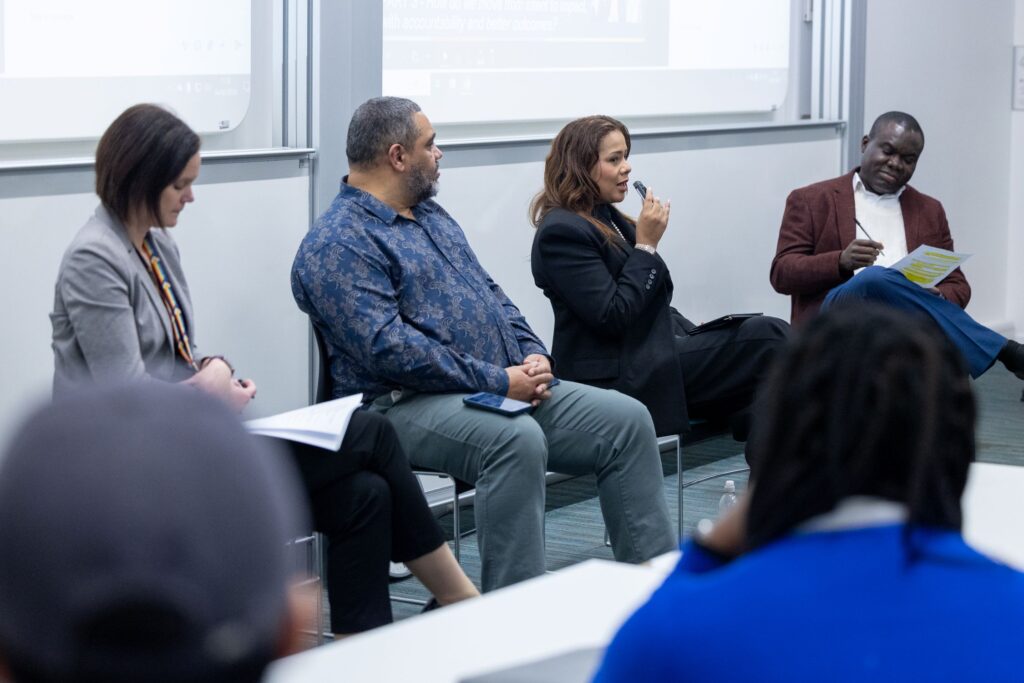
This poignant quote came up again in our second event from panellist and Cambridge scholar Malik Al-Nasir. Professor Cassie Wilson (Pro-Vice-Chancellor Student Experience and Sport) acknowledged that change needs to be structural, not symbolic. At Bath, we are embedding Race Equality throughout the institution with the implementation of our Race Equality Charter action plan. Professor Wilson expanded by saying: “We need to make equity everyone’s job.”
Professor Miranda Brawn explained how this needn’t be grand gestures or expensive projects: “Speak up against racism. The most powerful thing we can each do is to use our voice.”
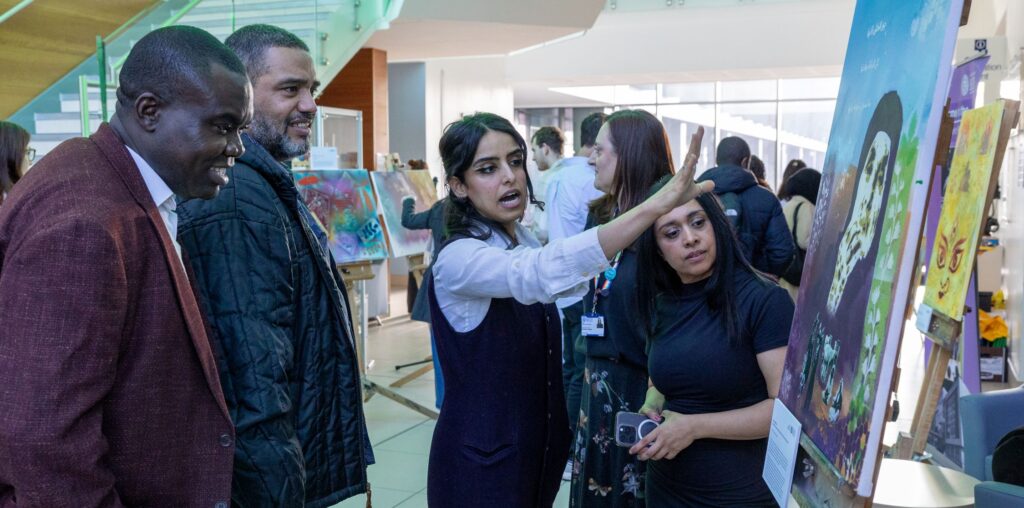
Visiting the ‘Routes to Roots’ student art exhibition from the Faculty of Humanities & Social Sciences brought home the human stories and lived experience of our students. You can find out more about the project in our series of Instagram Reels, with student interviews and a virtual gallery tour to be published over the coming month.
During Race Equality week new format of allyship sessions was offered to students and staff by our training officers, in the form of a dice based roleplaying adventure. In the session, four characters navigate a series of events centred on racial literacy. This innovative approach sparked collaborative, thoughtful, and impactful discussion, with attendees sharing feedback such as: “I thought this was a fun and informal way to explore and discuss issues around race. [It] was very engaging.”
Get in touch with Daniel and Matthew if you’d like to find out more about the session or run it with your society, department or group: deh48@bath.ac.uk and mm4136@bath.ac.uk.
However, we know that bringing attention to and striving for race equality needs to happen year-round, not just in February.
Throughout 2026 Dr Teslim Bukoye, Race Equality Charter Lead, will be working with teams across the University to implement the action plan laid out in our Race Equality Charter submission. To facilitate this, Dr Bukoye hosted a half-day workshop by the Vice-Chancellor, Deputy Vice-Chancellor and Malik Al-Nasir on ‘Breaking barriers to racial equity: Practical steps for inclusive leadership’. Forty senior leaders from across the institution, invited by the Vice-Chancellor, came together to explore race equality challenges, reflect on historical contexts, and develop practical, locally relevant solutions. The session also focused on the sustained, meaningful impact leaders can make within their areas of influence across the University.
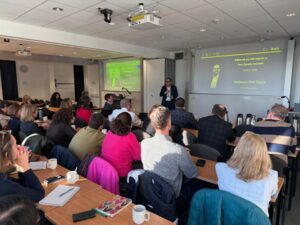 The Deputy Vice-Chancellor emphasised the importance of long-term action, noting that “structural change is not about direct recruitment to fill gaps at professorial level. It is about planting the seeds now and building the conditions for sustainable change.”
The Vice-Chancellor highlighted a number of ongoing initiatives at senior leadership level, drawing on his experience on co-leading a study on the Barriers to Black Academia and underscoring the importance of translating evidence into action. Concluding the session, the Vice-Chancellor reflected: “We should be proud of the REC Bronze award, but even more focused on what comes next. Our commitment is to deliver practical, measurable change that strengthens belonging, improves outcomes and makes race equality everyone’s responsibility across Bath.”
At Bath, we remain committed to driving the cultural and procedural changes that will make a genuine difference for our ethnic minority students and staff, in ways that are visible, consistent and sustained.
“Not everything that is faced can be changed, but nothing can be changed until it is faced.” (James Baldwin)
Race Equality Week is an important moment to reflect, but it is also a reminder that progress is shaped by what we do day-to-day: what we pay attention to, how we listen and how we translate learning into practice. As Race Equality Charter Lead, I am grateful for the time, care, and candour colleagues and students have brought to these conversations, and I warmly encourage continued engagement as we take the next steps through 2026.
Change takes all of us!
Respond
