At Bath we have a community of interdisciplinary researchers delivering world-leading research in sustainability across various fields. Following our whole-system approach, it's important that we also individually and collectively walk the talk on sustainability. In this latest blog, Rebecca Megson-Smith, Communications and Engagement Lead in the Institute of Sustainability and Climate Change (ISCC), has been chatting with institute core members to find out how they put sustainability principles into practice in their daily lives.
From hairdressers and taxi drivers to family and friends, research by Sam Hampton (ISCC Fellow) suggests that the behaviour of the people around us is most likely to affect our own actions. Similarly, work by our members shows that when leaders visibly adopt low‑carbon behaviours, those around them become more willing to do the same.
Inspired by this research and by rumours of some very sustainability‑savvy professors, I was keen to find out how theory translates into practice at home for some of our core members.
Applying systems thinking at home
I started by chatting with Jenny Baker, whose research career has been shaped by systems thinking - understanding how materials, manufacturing and energy choices affect environmental impact across an entire lifecycle. A Fellow of the Institute of Materials, Minerals & Mining, Jenny spent 15 years in the aerospace industry before moving into academia, where she now leads interdisciplinary research in solid‑state batteries, solar photovoltaics, advanced materials recycling and life cycle impact assessment.
Whilst aerospace is recognised as a high emitting industry there is a strong focus on using technology to improve efficiency and reduce energy use and this mindset carried through into her home life.
Jenny began decarbonising her home early, installing solar thermal panels in 2008. “Back then, solar thermal was significantly cheaper than photovoltaics,” she explains. “It wasn’t about perfection, just doing what made sense at the time and learning as we went.” In 2019, the family had a heat pump installed as part of an 18-year upgrade to a house that originally had poor glazing, draughts and an oil stove.
Transport has been another major shift. Jenny has driven electric since 2016 and credits careful planning with making electric vehicles viable long before charging infrastructure was widespread.
“Once you’ve driven electric, going back feels strange,” she says. “It’s cheaper, quieter and you just plan your stops.”
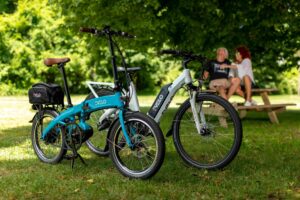
Her e‑bike, however, was the biggest disruptor.
“It was a complete game‑changer, enabling a ten-mile cycle commute with hills and wind to be accomplished without effort and allowing the family to sell our second car – a big cost and emissions saving."
Today, Jenny estimates her household emissions at under one tonne (excluding food). “If you can move everything to electric, the National Grid will do the rest for you as the UK moves from a grid that is” she says. “But first, you have to understand your impacts. That’s what gives you the power to choose.”
Seeing the whole system at home
My conversation with Marcelle McManus showed a similar pattern of development, from research, to reflection, to practical change. Marcelle is driven by a fascination with how systems work together, and how small changes can ripple through in unexpected ways.

“I started out using life cycle assessment to understand the environmental impact of products from beginning to end,” she explains. “What really struck me was how one small change can have a big impact, sometimes positive, sometimes not, once you think at a system level.”
Marcelle has been passionate about sustainability since childhood, and when she and her family bought their current home after their daughter was born, they knew it would take work to improve its efficiency. They began with insulation and solar panels, keeping an ageing gas boiler running until replacement genuinely made sense. “I didn’t want to rip out something that was still working and replace it with a big piece of infrastructure with lots of embodied carbon,” she says.
When the boiler finally failed in early 2025, the decision was clear. “There was no way I was going to put in another gas boiler,” Marcelle says.
Marcelle arranged several assessments before choosing an installer, quietly putting more than one salesperson through their paces after inaccurate claims about what the installation would involve (she admits she didn’t always disclose what she did for a living…). After a few cold months waiting for delayed parts, the air‑source heat pump was finally installed.
By opting for an air‑to‑water system, the family were able to keep most of their existing radiators, reducing disruption to a minimum.
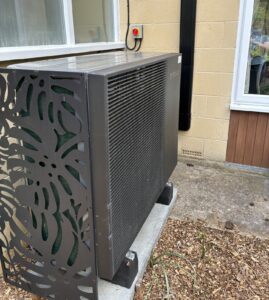
“If I were building a house from scratch,” Marcelle says, “I’d probably go for air‑to‑air, because you also get air con and therefore more climate resilience built in, but we wanted to keep things simple.” No floors were lifted, and the replacement water tank would have been required even if they had installed another gas boiler.
The results have exceeded expectations.
“I’m loving it,” says Marcelle. “The house is just constantly warm, never hot, never cold. It’s a really wonderful type of heat. Bills are already lower than before, even without switching to a heat‑pump‑specific tariff. People told me it would be good, but there’s always doubt. I’ve been surprised by how easy it’s been and how comfortable it is.”
For Marcelle, the message isn’t that everyone should change everything at once.
“The breakpoint is when something stops working,” she says. “That’s the moment to step back, look at the whole system, and ask what choice really makes sense for the future.”
For both Jenny and Marcelle, the process of living sustainably is something that they’ve undertaken, well, sustainably. Although some of the changes they’ve made have been significant in terms of cost, they’ve come as part of a chain of smaller changes along the way.
The idea that it’s not perfection we’re pursuing is a powerful one – and certainly has me reflecting, what one change can I make to shift my own move towards living more sustainably…

Rebecca Megson-Smith
ISCC Communications and Engagement Lead
Respond