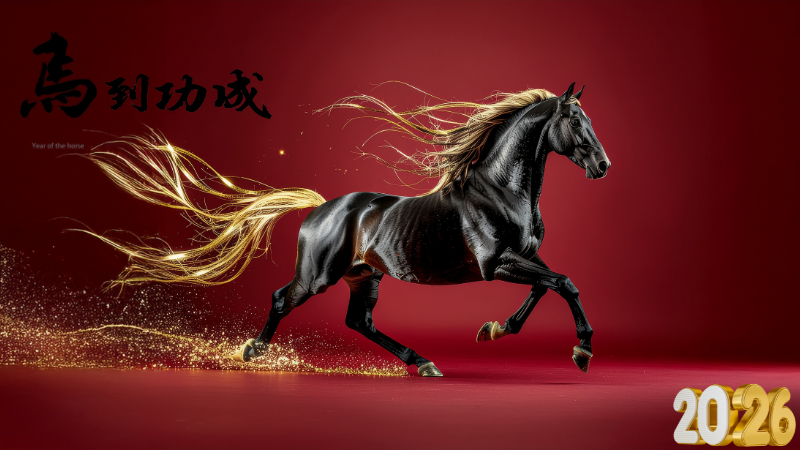
Do you know what Karl Marx and Elon Musk have in common? The question is deliberately light-hearted, and the answer may seem trivial, but it offers a useful entry point into a broader reflection befitting in the fast-approaching Year of the Horse.
No, no, they were not born in the year of the Horse. Karl Marx was born in the year of the Tiger (1818), and Elon in the year of the Pig (1971). Their connection lies in the Chinese transliteration of their names, 马克思 (Mǎ kè sī, Marx) and马斯克 (Mǎ sī kè, Musk), both share the same Chinese family name 马mǎ, meaning horse. To this list we may also add the French president with the “eye of the tiger” (l'oeil de tigre), 马克龙 (Mǎ kè lóng), but let’s not get too carried away. Let’s explore instead how learning a new language can give us the means to perceive the world through a different lens and reveal interesting connections that would be invisible in a monolingual world.
What time is the Year of the Horse?
The horse is the 7th animal in the 12-year cycle of the Chinese 'stems-and-branches' calendrical system. In the upcoming cycle, the Year of the Horse, known as 丙午年 (bǐng wǔ nián), begins on February 17.
Beyond marking years, the twelve animals also correspond to divisions of the day. The horse, associated with strong yang energy, represents the time from 11:00 to 13:00, when the sun is at its brightest. Consequently, 午 (wǔ) is used to denote the meridian line, giving us everyday terms such as 上午 (shàngwǔ, am or anti-meridian) and 下午 (xià wǔ pm or post-meridian).
The wayward wise horse
Since its initial domestication on the Eurasian steppes around 4800 BCE, the horse has played a significant role in the development of human history, transforming mobility, agriculture, warfare, trade, systems of power, and even language itself. It’s not an exaggeration to say that horses helped to shape the modern world (1).
Unlike other domesticated animals such as pigs, sheep, or cattle, the horse distinguished itself through speed, power, and a strong sense of independence. The horse’s free spirit is captured in the English proverb: You can lead a horse to water, but you can’t make it drink. The Chinese character 闯 (chuǎng, to burst in or charge through) reflects this same spirit as it vividly depicts a horse forcing its way through a gate. The earthly branch associated with the horse, 午 (wǔ), once also carried the meaning of “disobedient”.
Another character often associated with the horse is wisdom. For example, Jonathan Swift’s Houyhnhnms are rational, enlightened horses, contrasting the brutish humanoid Yahoos. In Chinese, the horse’s wisdom is crystallised in the idiom 老马识途 (lǎo mǎ shí tú): “an old horse knows the way”. In the story gives rise to the idiom, a group of old horses successfully guided a lost army across a vast desert, saving it from disaster.
The valuable and powerful Horse
Across cultures, horses have long been associated with status and value. For example, the proverb “don’t look a gift horse in the mouth”, is echoed in Spanish (A caballo regalado no se le mira el diente), Italian (A caval donato non si guarda in bocca), French (À cheval donné, on ne regarde pas les dents), and German (Ein geschenktes Pferd schaut man nicht ins Maul).
Horses are also linked to social status. Phrases such as “on a high horse” or “sur ses grands chevaux” in French associate height with authority, and, by extension, arrogance. The Italian “scendi da cavallo” (get off your horse) neatly captures the social correction aimed at those who overestimate themselves.
As a source of power, the horse completely transformed human society. It ploughed fields, carried warriors, and pulled carriages. Until the publication of Das Kapital, equine power was unparalleled in its versatility. Although industrialisation reduced the horse’s role, its legacy endures in modern language, most notably in the term horsepower. In the age of electric vehicles and space exploration, we still measure strength and capacity in horsepower.
The spirit of the horse and language learning
The horse embodies wisdom, strength, and determination. As we enter the Year of the Horse, it’s worth embracing this spirit. Let me borrow the idiom that Xi Jinping used when he spoke with Keir Stamer on the latter’s recent visit to China, to encourage you to 一马当先 (yīmǎdāngxiān, take the lead), enrol on a language course and begin a unique journey. This journey will not only be academically enriching but intellectually transformative. Learning a language will offer you unimaginable freedom as it’s not merely about acquiring practical skills, but also about gaining deeper cultural understanding and discovering new ways of seeing the world.
Wishing everyone 马到成功 (mǎ dào chéng gōng), may success arrive with the horse.
Notes:
(1) Anthony, D. W. (2007) The horse, the wheel, and language: how bronze-age riders from the Eurasian steppes shaped the modern world. Princeton University Press.
Respond