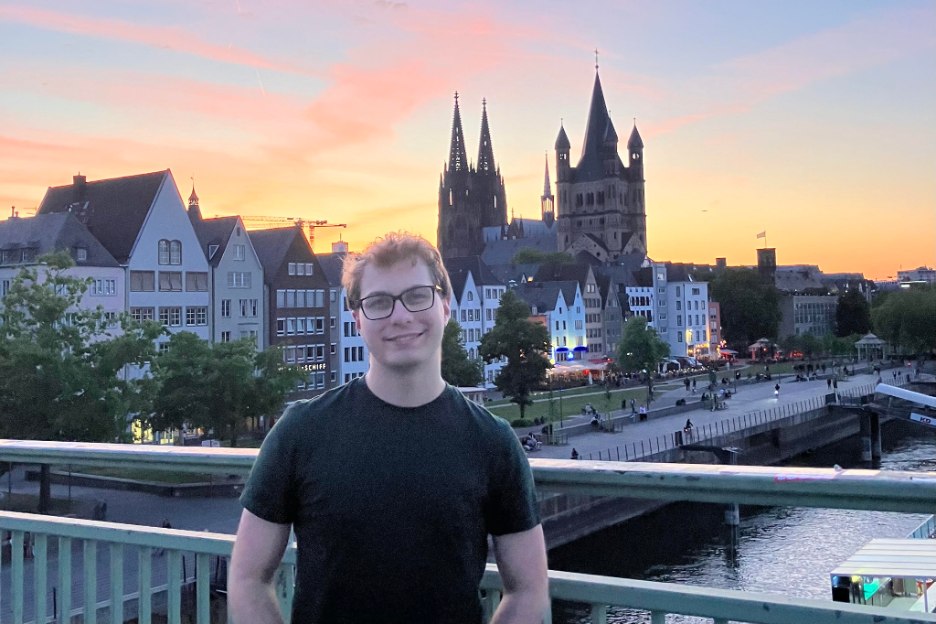
Hi! I’m Blane Wootton, now a graduate of the University of Bath, where I studied Modern Languages: French (ab initio) and German, with a year abroad in my third year. Like many students, I still wasn’t sure where my degree would take me in my future career, but undertaking a placement in Germany helped open my eyes to future possibilities.
The year abroad is perhaps both the most exciting and potentially daunting step of language degrees at Bath. Due to my language combination, I elected to undertake a study exchange at the Université Aix-Marseille during my first semester before beginning a 3-and-a-half-month project management placement at Kern Global Language Services in Cologne, in order to gain professional experience in an international environment. I could not have imagined how these key choices I made in October 2023 would have such a positive impact, but by July 2025 I landed back at Stansted airport with no regrets.
Before arriving
The university provides students plenty of assistance in finding placements for their year abroad. From seminars on writing the perfect CV and cover letter, to providing cultural advice on our countries of choice, the POLIS staff worked tirelessly to ensure we wouldn’t be chucked in at the deep end. Although you can source your own placement, there is a jobs board on Moodle, where companies who have had placements with University of Bath students before post openings. That’s exactly where I found mine. There were placements in marketing and journalism, but Kern’s project management placement was perfect for me, with offices in 32 cities to choose from, flexible duration and the chance to tackle hundreds of translation proofreadings, whilst also being central to the client-facing operations. As the only city I had been to up to that point, I chose Cologne, and after a seamless interview process in German, my placement was booked in from March to June 2025.
One of the benefits of having a semester in Germany after France is that the semesters don’t overlap tightly. This allowed me a three-month period to get all my documents ready, the soonest possible for the process. Despite this, my application still came down to the wire. I had booked accommodation and flights, but all of this was thrown into jeopardy as a crucial document from the Bundesagentur für Arbeit got lost in the post not once but twice! Here I needed to reach out to Kern and my Director of Studies, together preparing for the eventuality that my start date might have to be delayed. With just three weeks to go until my flight, we were down to the wire, and luckily the third time was the charm. With all my documents gathered, I could finally book a visa appointment, and miraculously my passport came back to me in less than a week.
The placement
After the relief of having finally arrived, I was then again reminded of my daunting impending start date. Upon arriving at the office at 8:50 AM on Tuesday 4 March, I was greeted by my manager, introduced to the team and given an in-depth rundown of my responsibilities. From here I hit the ground running. I was given lots of responsibility early on, creating customer quotes and tracking their orders in Plunet and Excel, whilst also challenging myself to hit targets of 4-5 German/French to English translations proofread per day. Although the days were long, I quickly got into the rhythm of things, enjoying the cool spring morning walks to work, where I’d buy lunch - two Laugenzöpfe mit Käse for €0.58. Over time I was entrusted with further responsibilities, such as negotiating with external translators, assisting clients who visited the office in person, as well as finalising orders and delivering them myself to clients. In May, most of the other native English interns had left, making me the primary port of call for many of the branches that needed their English translations proofread. At times this was a little overwhelming, but through organisation and prioritisation of deadlines I was able to cope with the demand under pressure effectively. By the end of my time at Kern, it was fair to say I was sad to leave the team and proud of everything I had achieved, including over 300 proofreadings completed.
Finding your feet
In case you’re worried, it’s perfectly fine to ask your team or manager for help. The team is there to support you, and it’s perfectly normal to feel you have been chucked in at the deep end. Even though I am confident in my German ability, it was a little nerve-wracking speaking to native speakers while knowing I wasn’t on the same level ability-wise, but quickly you will get to grips with things. From this, both your vocabulary and conversational skills will flourish, putting you in the perfect position to finish at Bath with a strong final year.
Looking back, the placement did more for my career direction than any careers seminar could have. Having the ability to communicate clearly in German when the stakes are real is something difficult to replicate outside of exam conditions, but I lived this experience every day at Kern. Not only has it helped make my CV much more attractive on paper, but it has inspired me to now look for careers either in Germany or with a German-speaking aspect, with the client-facing skills being particularly useful in my current job hunt in sales and recruitment roles.
Outside of the office
Although my placement was paid, living in a big city and having to travel can be expensive. Luckily, I qualified for the Turing Scheme as a young carer, which provided me with significant financial support throughout my year abroad - equivalent to roughly £12 per day. It was a lot of paperwork, but I couldn’t have done my year abroad without it. In Germany, you can also get the Deutschlandticket: For €63 per month, you are allowed unlimited travel on all S-Bahn, U-Bahn, trams, buses and regional trains (not long-distance trains like ICE, IC, EC, however). It’s also critical to ensure that you register your address with the local Bürgeramt within 14 days of moving.
One thing in particular that was quite different about doing a placement as opposed to a study exchange was how freeing it felt. Although I was in the office 40 hours per week doing a job I thoroughly enjoyed, stepping outside of the office felt incredibly cathartic, as if a weight had been released. Whereas during studies there were always assessments and exams lurking around the corner, on placement I felt as though I was able to have time to relax and explore guilt-free. This segués into another tip: use your weekends to explore! A placement can feel a lot more isolating than a study exchange, so it’s important to plan activities, not be afraid to put yourself out there, and make the most of opportunities to use your languages! It’s how the best memories are made. I spent over 6 hours on a train (a nightmare if you know German trains) visiting friends studying in Leipzig and Berlin over Easter, where I was stung by a wasp in a story we still talk about. I also went to concerts and could have been stranded after watching a Rot-Weiss Essen football match, were it not for a British stag do. When I arrived, Karneval was taking place, which made the city a beautiful mess of costumes and colours, so ensure that you are aware of any local festivals and bank holidays that may be happening in your area. Cologne is also where I met my girlfriend, and together we spent many weekends visiting picturesque villages. Therefore, don’t be afraid to see your coursemates (if logistically possible) and make the most of any existing contacts you have.
Respond