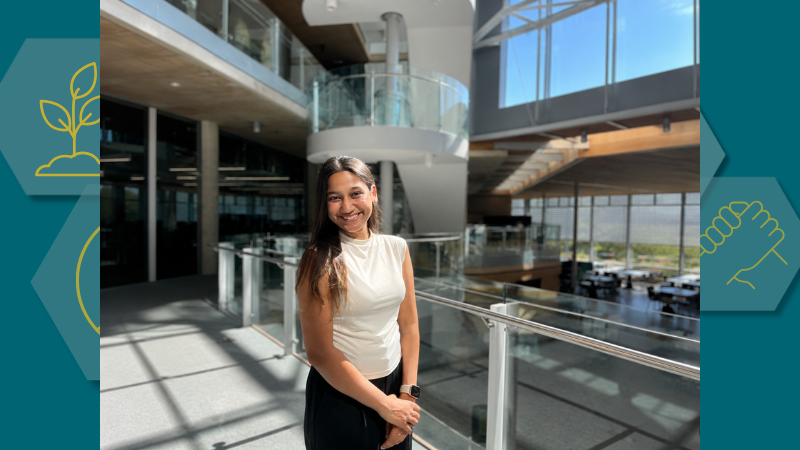
One master's year. That's roughly how long a taught postgraduate degree gives you to settle into a new country, do well academically, build a network, and pack in enough experience to actually stand out. When I reached Bath to start my MSc Marketing at the School of Management, I had a fairly simple goal: get a great degree, and pick up a few valuable skills along the way. What I didn't expect was that the "along the way" would end up being one of the most valuable parts of my time here, and that it would eventually earn me the Bath Award.
For anyone who hasn't come across it yet, the Bath Award is built around four core capabilities. For each one, you need to show three things: an article or resource you've engaged with, a training you've completed, and an event you've attended*. On top of that, you need 50+ hours of extracurricular experience overall. It sounds like a lot when you first read the requirements, but the truth is most of it happens naturally if you're someone who's curious and says yes to things. The award just gives you a framework to notice it and log it properly.
What actually went into it
The reading. I got into a habit of reading a proper article every week or so from places like Forbes, the BBC, and Harvard Business Review, which is genuinely useful for a marketing degree, but also just good general practice for staying switched on to what's happening in business and the world.
The trainings. I picked up a few short certifications that mapped onto skills I wanted to develop: LVMH's Creation & Branding, Operations & Supply Chain programme, and a set of LinkedIn Learning courses on collaboration across teams, communicating with confidence, and building resilience. None of these took more than a few hours each, but they were a good way of deliberately targeting gaps rather than leaving my development to chance.
The events. Things like the Sustainability Hackathon and various talks and sessions around campus counted here. Places where I was actively participating, not just sitting in the audience.
The 50+ hours of extracurriculars. This is where the bigger projects came in. The Sustainability Business Challenge and the Rotork Community Challenge together made up a big chunk of my hours**, but alongside these, my part-time job at Komedia and the Consulting Hackathon (where my team came first out of more than ten teams and won £400) rounded things out, different in flavour, but all building the same underlying skills: communication, working under pressure, and thinking on my feet.
None of this was done with the Bath Award specifically in mind from day one. I just kept saying yes to things that sounded interesting, and when I sat down to map it against the four capabilities, I realised most of the pieces were already there and that I just had to fill in a couple of gaps deliberately.
What I found most valuable
Honestly, the biggest value wasn't the award itself, it was the reflection process.
Postgraduate taught degrees are short and intense, especially as an international student. It's easy to go from induction week to dissertation deadline without ever pausing to think about what you've actually learned about yourself. The Bath Award forces that pause. Writing down what each experience taught me about how I handle pressure, how I work in teams, where my strengths actually lie versus where I thought they lay, was more useful for interviews and career conversations than I expected.
It also gave structure to something that otherwise feels quite chaotic.
As an international student, I came in without the built-in networks that home students often have, so throwing myself at hackathons, challenges, and part-time work was partly about building a life here, not just a CV. The Bath Award gave that a shape and a purpose.
Tips for other students
- Start logging early, even if you're not thinking about the award yet. I did this early on and it helped me later instead of trying to reconstruct a timeline later
- Say yes to things outside your comfort zone. The three-hour hackathon and the UN pitch were both terrifying beforehand and genuinely rewarding afterwards
- Mix it up. A cash-prize hackathon, an unpaid sustainability challenge, a charity video project, and a bar job all count. The variety is what makes the reflection interesting
- Don't dismiss "ordinary" jobs. Bartending doesn't sound like a career skill on paper, but the customer service, multitasking, and composure under pressure are exactly what employers ask about in interviews
- Use the short courses to plug gaps. If you notice you're weaker in a specific area such as public speaking, working across teams, resilience — there are usually free or lowcost courses (I used LinkedIn Learning) that can help, and they're worth listing too
What's next?
I'm currently finishing my MSc Marketing, expected to graduate in January 2027. Looking ahead, I want to build on the consulting and strategy experience from the hackathon, and I'm exploring roles at the intersection of brand strategy and consulting, ideally somewhere I can keep using the "think fast, work cross-functionally" muscles I built through all of this.
If you're a PGT student wondering whether you have time for this on top of everything else, my honest answer is: you don't have time not to. It's often the fastest way to feel at home.
*Note that the professional development aspect of the award has been updated for 2026-27, so make sure you read the current guidance to ensure you're completing the right activities for your professional development component.
**Note that some activities that counted towards the 50 hours in 2025-26 may not be eligible in 2026-27. Please check the published list of what counts towards the 50 hours in 2026-27 to ensure you are counting the right activities towards your 50 hours.
Respond