

Introduction
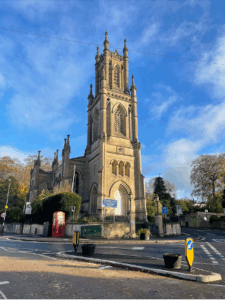
Officially, this VIP is known as the “Carbon Reduction Journey,” but in reality we are faced with a task that is much broader and more complex. The aim of this project is to support St. Stephen’s church in Lansdown as they strive toward sustainability. In this case, ‘sustainability' refers to more than just reducing carbon emissions to become environmentally friendly. The goal of the church is to persist and grow as an important part of the Lansdown community, meaning that sustainability must be achieved financially and socially as well as environmentally.
The following are some of the sustainability challenges currently facing the church that we hope to help mitigate over the course of this project:
- Structural degradation: Erosion due to heavy rain has caused structural damage to the vestry walls and lack of proper drainage causes regular flooding in the basement.
- Expenses: The cost of running the church, including staffing, energy, maintenance and annual diocese fees, is higher than the amount being earned through donations.
- Lack of community integration: Due to the layout of the church building, mainly poor connectivity between the main level and the community space in the basement, St. Stephen’s is unable to support as many events as desired.
- Lack of environmental sustainability: The church currently relies on carbon-dependent sources of energy and heating, like incandescent bulbs and an expensive HVAC system. It is necessary to reduce carbon usage in order to meet the Bath and Wells Diocese’s goal to be net zero by 2030.
Our team is addressing these problems through the interlinking lenses of decarbonisation and community involvement. The church building needs to be refurbished in the near future, which provides an opportunity to make the space more appealing as a community hub and to implement sustainable infrastructure, lowering the running cost of the building. When refitting church buildings, best practice requires an understanding of where people gather in the building and what they are doing. This allows money and energy to be saved by limiting things like heating and lighting to certain areas. In this way, a vital part of this project is gathering insight into the spatial needs of the community in order to efficiently and effectively decarbonise the building.
Over the next several months, we will act as consultants, applying our diverse knowledge to assist the St. Stephen’s team in achieving their vision of a sustainable future. While the deciding power ultimately lies with them, we will work hard to provide possible solutions backed by data and research that could feasibly be implemented. We feel strongly that this project has potential to make a real impact in terms of sustainability and by fostering a sense of community in Lansdown.
Our Team
Our team consists of seven undergraduate students and four postgraduate students. We have a range of academic specialties including architecture, management, natural sciences and decarbonisation.
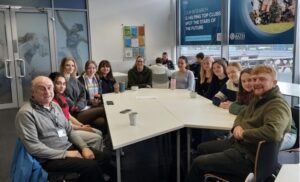
Our project is championed by Brian Rutter (Dept. of Mechanical Engineering) with assistance from Jonathan Foyle (Dept. of Architecture & Civil Engineering) and David Williams (Dept. of Mechanical Engineering). We are very grateful for their guidance and expertise!
October and November Update
Our first official meeting took place on Oct. 21st and was followed by a group visit to St. Stephen’s on the 30th. We were welcomed by the lovely clergy team, Rev’d Philip Hawthorne – who introduced us to the needs and goals of the church, and Rev’d Debbie Pow – who gave an informative tour of the building. This meeting served as a launching point for our team, helping to solidify our understanding of what the church is trying to do and why it is important.
On November 1st, a few of us were fortunate enough to attend a meeting with the St. Stephen’s Vision Group, a passionate and motivated group of individuals from the administration and congregation, who meet regularly to discuss the future of the church. At this meeting, we were introduced to The Beacon of Lansdown Project, a fundraising initiative organised by the Vision Group in order to mitigate the challenges described above and bring to life a future vision of St. Stephen’s as “a fully accessible, eco-efficient and financially sustainable building with flexible layouts and modern facilities.” Keeping this vision intact is extremely important to our team, as we respect the amount of time and effort the Vision Group has dedicated to this initiative. Their vision is a strong foundation which we hope to build on and add further value to.
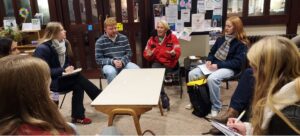
Our most recent meeting at St. Stephen’s church was with Sallie Blanks, a member of the church choir with an impressive background in project management, who is acting as liaison between the church and potential architects. We were joined at this meeting by architecture professor and historical building conservationist Jonathan Foyle, and Bath and Wells Diocese Net-zero Officer Dan Wills. As we walked through the church, Sallie reiterated the challenges facing St. Stephens. Based on our research, we were able to float solutions and Dan provided us with insight on the feasibility of these solutions from the diocese’s perspective. For example, chandelier-style infrared heating (like this) is easy to pass through diocese approval so long as there is adequate proof that no unintended consequences of this heating style will arise. We also discussed the idea of installing solar panels on the roof of the church. Again, Dan provided a valuable perspective, reminding us that proper justification and proof of cost reduction would be needed to gain approval.
The main takeaway from this meeting? It’s great to have ideas, but it is necessary to have a clear purpose and the ability to show how such ideas will serve the purpose without negatively impacting anything else.
Current Action
As this project is multifaceted, we have split into three sub-teams based on the strengths and interests of our members: Community, Decarbonisation and Architecture.
Community: The community team is focusing on developing surveys for both the church congregation and the wider communities of Lansdown and Snow Hill. These surveys will provide us with an understanding of how St. Stephen’s can grow as a community space based on the needs and interests of the local population. They recently met with Richard Joiner, a professor in the Department of Psychology, who advised them on ways to improve the survey questions and best practices for distribution and analysis.
Decarbonisation: The decarb team is working on researching sustainable technologies and determining the feasibility of use at St. Stephen’s based on case studies of sustainably refurbished churches. They are gaining an understanding of the current infrastructure at St. Stephen’s using survey questions from A Rocha UK’s Eco Church programme.
Architecture: The architecture team plays an important role as a connection between the community and decarb facets of this project, since both need to be understood in order to implement valuable architectural changes to St. Stephen’s church building. The team have been analysing the current floorplan based on the future needs of the church to identify areas for improvement.
What’s Next?
In early December, four of our team members will give a presentation and participate in a poster session to showcase our project thus far. They are currently preparing for this event while continuing to work in our sub-teams.
Community: The community team will continue to develop the survey questions and seek approval from the university ethics board. The goal is for the survey to be distributed by the end of January 2026.
Decarbonisation: The decarb team is working towards developing an action plan to elevate St. Stephen’s from their current Bronze Eco Church Award to a Silver or Gold level. This will be done using extensive background research and resources provided by A Rocha UK.
As well, there is potential to further analyse the energy efficiency of St. Stephen’s using the Zebra thermal modelling tool, which was developed by the University of Bath and will provide insight for potential changes.
Architecture: The architecture team is aiming to provide the St. Stephen’s team with an architectural brief and concept sketches based on the needs of the church community and potential for sustainable refits. These briefs can then be used by the church to guide their hired architect.
Blog Post by: Alex Holman, MSc Decarbonisation, Department of Mechanical Engineering

