

Picture the scene: your manager approaches you and asks, “how many international students do we have?” No problem. You pull up the data, you calculate it, you get a number. You are diligent in your work, so you ask your colleague to double check, but they get a different answer. Why? How? Pondering this over a cup of tea, your manager asks again, “so, how many non-UK students do we have?” Uh, what?
You realise you are using these terms interchangeably but meaning slightly different things. When you bring back your colleague and the three of you discuss, you realise the use case is about fee income, and so what your manager requires is the number of “overseas fee-paying students.”
Different Options
At lunch you go to the Wessex Staff Hub and overhear Admissions and Student Immigration talking about fee status, visa status, and nationality. The Student Recruitment team join them and talk about new students coming from an international boarding school in London. On returning to your desk, you receive the International Relations Office newsletter, with an article on students by country of domicile. You are boggled.
Enter the University Glossary
You grumble with your friend over Teams, and they say, “have you heard about the University Glossary?” You open it, revealing a collection of terms with clear definitions written by Data Stewards, the data subject matter experts at the University. Those fabulous Data Stewards have enabled you to have a standardised, reusable set of terms that will prevent miscommunication and ensure that next time, the data aligns with the question being asked. It will save you time, and you’ll get the right answer.
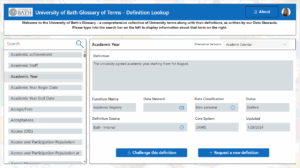
You realise that by using incorrect terms, different definitions can lead to different outcomes. You share the Glossary at your next team meeting, they give you plenty of other use cases:
“Woah, this might solve my ‘year’ problem. Like are we talking academic year, tax year or calendar year? When we work across both government and university financial years there is so much room for error!”
“Right!? And when we get to graduation date, is that when they finished their degree, or when they attend the ceremony? Explains why our alum contact us… now we know which definition to use!”
“Argh! About once a week I have to explain that Food Safety is not always part of Health and Safety – its different legislation – I’ll point them to the glossary.
Conclusion
A week after finding the Glossary, you feel more confident when your manager asks you for data; you start to ask more questions about what they really need, and therefore which definition you should use. The Glossary helps you know you are reporting on the right thing for the right purpose. It also helps you when reading other reports: you can double check that what is being provided is using the same definition.
You bookmark the Glossary and refer to it often, sharing with new colleagues to help them too.
Respond