
Author: Dr Daniel Coren, Director of Studies for Automotive MSc Courses
Jet propelled cars seem to be in the headlines lately. Having been an impressionable adolescent in the 1980s, it got me reminiscing about a certain sci-fi show; Buck Rogers in the 25th Century. I wonder what he would have made of it all? A bit of digging informed me that Buck had an engineering background and was already riding around in a rocket ship by 1928, so maybe not all that impressed after all?
Picture This
In the world of cars, design and engineering come together with sometimes unpredictable levels of success. Witness the aerodynamic beauty of Franso Scaglione’s Alfa Romeo Berlina Aerodinamica Tecnica (BAT) concept cars. Clever though the Marcos Xylon might have been, it took the Adams brothers to interpret the brilliant engineering of Frank Costin to produce the sleek profile of the1800 GT. Iconic though the Lamborghini Miura undoubtably is, even with input from Dallara, it was more likely to be admired while parked on Carnaby Street than seen fluttering its eyelashes on the banking at Monza. Ultimately, engineers need designers to challenge them with ‘impossible’ ideas to stimulate the visual landscape of next-generation cars. Designers, on the other hand, need engineers in order to steer their dreams towards drivable realities. Did somebody say Luce?
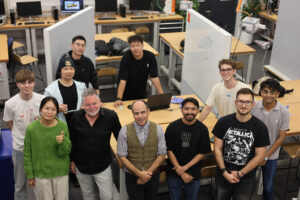
Can engineers make use of recent developments in digital tools to bridge the gaps between art, design, and engineering, with the aim of better communicating ideas visually? As part of their studies, Automotive MSc students at the University of Bath were recently invited to participate in a specially curated ‘day of the car’, led by professional automotive designer Tony Hunter. This featured a guest lecture, followed by tuition with practical vehicle design sketching techniques, and a hands-on vehicle design exercise. All of which provided the opportunity for students to convert ideas into hand-sketches and then into realistic digital images, with a little help from new kid in town, ‘GenAI’.
Private Viewing
To get our appetites wetted, Tony delivered a guest lecture during which he led us through a series of design concepts by means of a private viewing of elements from his design portfolio. This airing of inspirational imagery, usually kept behind closed doors, was akin to getting special access to the archive of your favourite museum. Spotting hints of design features that seem familiar, because they’ve since made their way into production vehicles, was a bit like witnessing the unveiling of the sinopia beneath a famous painting. Hearing gleaming details of the back stories being woven together with imagery on display provided great insight into the design philosophies underpinning a range of concepts, from road cars to film cars, a sprinkling of science fiction toys, and few cases of ‘what might have been’ too. It also revealed some of the decisions which led to certain designs, design elements, or making it all the way through into production. Not so much a brief history of car design, but more of an opportunity to understand how design and engineering functions exist and cooperate withing an industrial setting. By learning which designs worked, and understanding why, ideas might also be germinated for successful novel future cars, designed with a new set of challenges and opportunities in mind. Food for thought, for sure.
A View to a Quill
How do you teach an engineer how to design their dream car? Even a lifetime of immersion in car shows, design studios, and manufacturing workshops may not be enough: a foreboding learning curve. Or as Aristotle put it: the roots of education are bitter, but the fruit is sweet
Generative Artificial Intelligence (GenAI) seems to be almost omnipresent. Can it be called upon to be used as part of this challenge? If so, do you achieve it by asking it to design the ‘absolute bestest’ ever car, then sit back, job done? Not quite. To quench our thirst for new knowledge, Tony introduced us to a visual GenAI tool, Vizcom (other tools are available), and with it a brave new world.
An abridged method might look something like this: germinate a new idea or vehicle concept. Think about any special features or functions, and the setting in which you imagine the car exiting. It was somehow reassuring to learn that hand-sketching is still a central part of the process; the mighty pen lives on! Sketches (physical or digital) are then presented to Vizcom. The first attempt is rarely the last in any tradition development process, and that rule remains firmly in place here. Editing can be performed using a mixture of text-based prompts, but local image snapshots can also be used to highlight element that you do or don’t like.
As part of a demonstration of how readily animations of fresh designs could also be prompted, we were treated to a sneak preview of what the next Bond car might look like; the Bentley inspired design speeding through the streets of London a nod to the Flemming’s original Bond stories. Creative juices now suitably flowing, we were ready to have a go.
Ready, Get Sketch, Go!
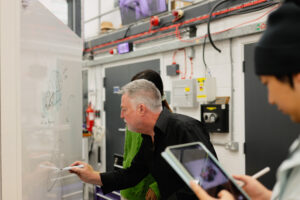
To allow digits to put digital tools through their paces, our automotive engineering teaching lab doubled-up as a make-shift design studio. An intentionally unrestrictive brief: ‘exciting sustainable transport’, was set to encourage a playful yet responsible response; to encapsulate the spirit of motoring, get the imagination of our students centred somewhere between the 21st and 25th century, and perhaps channel their inner designer. Scenarios were discussed and-sketches started to appear on white boards. A phone provides a convenient way to capture a digital image and make ready for Vizcom to do its thing.
First result: Mmm, that’s not quite what I had in mind. The initial imagery returned certainly elicited strong response, ranging from wow! to what? With a perhaps dash of incredulity thrown in too. There is an initial tendency to be drawn to the fast-responding text prompt function to bring refinement, but if unchecked, it seemed quite easy be lead down an unintended path towards something ranging from visual cliché, to an automotive equivalent of Frankenstein. Who knew that Mary Shelley had a part to play here?
Intuition kicked in quite quickly, and going back to the drawing board was actually an effective and appealing part of the process. Under the guidance of Tony, revised and refined sketches were hand drawn and found to be more likely to more quickly result in a Vizcom output which aligned with concept in the mind’s eye of the engineer. It was pretty rewarding to see life-like representation of what just a few hours or even minutes before had been the but the seeds of an idea. Indeed, this proved to be a somewhat addictive process and curbing the enthusiasm to ‘Vizcom’ any idea that pops into your head becomes a challenge! A statement widely associated with Albert Einstein comes to mind: logic can get you from A to B. Your imagination can take you everywhere.
Tales of the Less Expected
I never said that! No! That’s not what I meant! Most of us can recall a moment where these words were uttered, in despair or frustration, or sometimes with hilarity. Hitherto, this would have predominantly person to person, but in the 21st century, perhaps more commonly human to device or software tool.
For most users, enticed by the rapid-response nature of the tool, frustration arose when the imagery returned not quote what was expected. On reflection, images that perhaps lacked detail, or perhaps included ‘stray’ sketch lines, which were dismissed or filtered out by the eye of the designer, were dutifully treated as an instruction by the tool.
At some point this started to seem analogous to having a conversation with a person, where the messaging, or instructions, lack clarity, or are embodied by ambiguity. This brought reminder of Carl Rogers’ Active Listening technique, which aims to disentangle confused communication; something which might be familiar to engineers with respect to humans or machines! An unexpected observation arose: could this design tool be used for conversation skills development? Perhaps it could be used as a tool for allowing people to see into the mind’s eye of a 25th century engineer: a wonderous place!
Can these tools be used to help you develop the skill set of a design director, rather than a designer in the purest sense? And as such, is the central role still very much in the human domain? One thing that still holds true, even amidst artificial support tools, the successful realisation of genuinely innovative design requires careful consideration for the essential elements of art, design, engineering, manufacturing, and driving experiences.
Want to see more? Look out for upcoming LinkedIn posts from Bath Automotive MSc students sharing their new designs.
Respond

