Written by Dr Pete Manning, Senior Lecturer, Department of Social and Policy Sciences
In August 2025, we received news that we had secured a Fulbright Global Challenges Teaching Award (CGTA) – the first such grant successfully awarded to the University of Bath. The Fulbright GCTAs partner UK and US universities in the co-delivery of teaching, where UK and US student counterparts are brought together through an approach known as Collaborative Online International Learning (COIL) – a form of Virtual Exchange (VE). COIL and VE approaches promise significant benefits for the student experience – and, indeed, the University of Bath’s wider internationalisation strategy – such as encouraging intercultural learning and dialogue; forms of (virtual) mobility that remain accessible, inclusive, and affordable to all students; and the development of employability and digital skills that are increasingly crucial for workforce readiness.
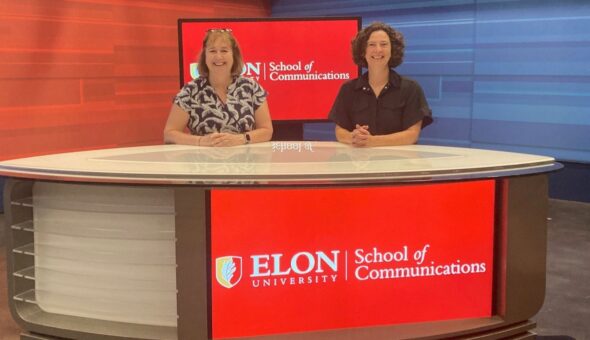
With international collaboration and dialogue at their core, VE and COIL approaches lend themselves to learning about and tackling urgent global challenges: Fulbright has awarded four paired grants to develop collaborative teaching around misinformation, health inequality, climate action, and peace and justice. University of Bath was selected as the UK lead for the peace and justice award, and has been partnered with Dr Sandy Marshall at Elon University, North Carolina. Innovative, interdisciplinary and inclusive teaching are at the heart of Elon’s mission, and the university has been “…ranked #1 in the nation for excellence in undergraduate teaching for a fifth straight year”.
Sandy, our teams, and I have been working closely since September 2025 on the redevelopment of the Atrocities, Conflict, Human Rights unit – a final year option on the BSc Criminology in the Department of Social and Policy Sciences – in anticipation of co-delivery in October this year. From the start, Sandy and I worried that existing research and teaching on issues of peace, conflict and justice was struggling to keep up with the rapid geopolitical changes, challenges, and crises that we have witnessed in recent years. We saw technology – especially artificial intelligence and the role of social media – as key forces shaping these changes that could pose significant threats, but also potential opportunities. We agreed that six weeks of collaborative online exchange between UK and US students focusing on AI and social media in conflict and peace would offer a platform for students to learn with and from each other, encouraging mutual understanding, while equipping students to tackle issues of conflict, peace and justice with a greater empathy and respect for difference.
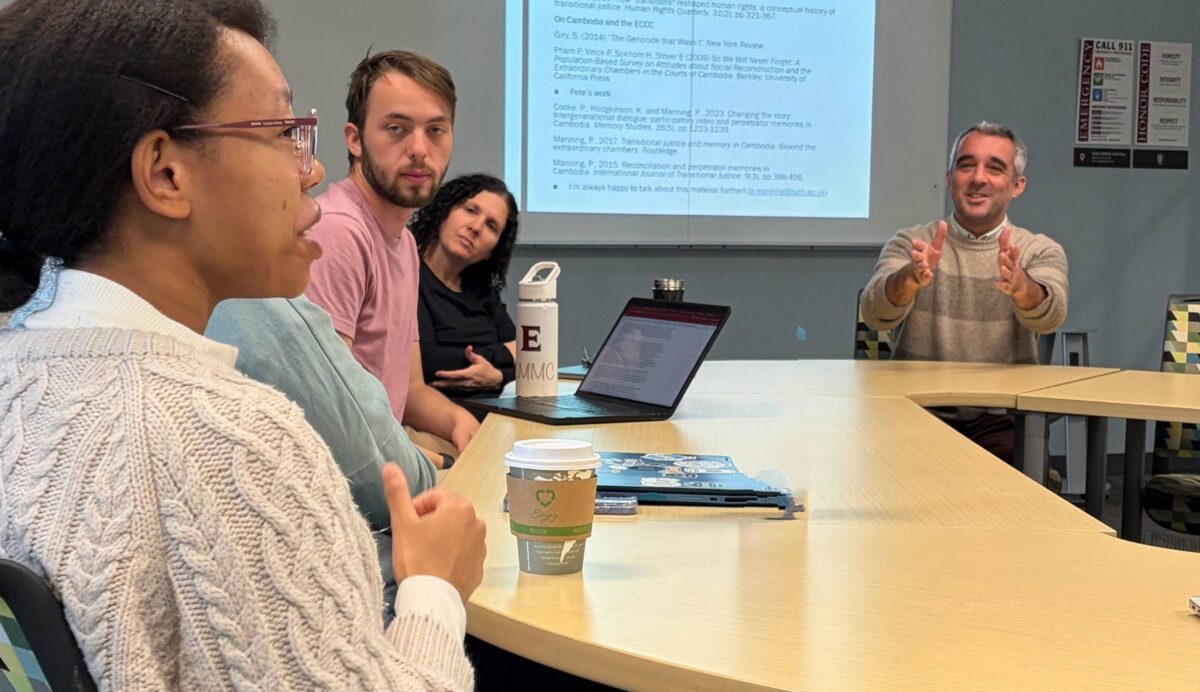
As part of the award, I conducted an institutional visit to Elon in October 2025, giving guest lectures and seminars to Elon undergraduates, meeting colleagues across Elon’s College of Arts and Sciences, presenting my own research, while working with Sandy on our VE/COIL project. I was struck by Elon students’ curiosity and insight, as well as the commitment to high quality and engaging teaching among staff. There is much to learn from the partnership with Elon, from their work reflecting on and promoting global learning internationally, to more locally focused engagement that brings Elon faculty into dialogue with its immediate community and their histories, such as the Power and Place Collaborative – often utilising student led and participatory approaches to learn about (often challenging) local stories and issues.
Sandy and colleagues from Elon University’s international and learning technology teams will be reciprocating with a visit to the University of Bath around 19-23 March, for meetings and co-presentations.
Going forward, Fulbright encourage GCTA grant holders to explore ways to scale up and multiply their learning from their initial VE/COIL projects for the benefit of others at their respective institutions. We have one eye on this task with our recent award of a Humanities and Social Sciences Teaching Development Fund project, “Developing VE/COIL approaches for internationalisation at University of Bath” (with Marie Salter and Emily Richards). Our central aim is to raise awareness of the benefits of VE/COIL approaches to teaching and the student experience, while producing a guide and resources to make VE/COIL uptake as accessible and straightforward as possible for colleagues across the University. Our plan then is to recruit a group of ‘pilot’ or ‘second wave’ VE/COIL projects for rollout in the Academic Years 2026/27 and 2027/28.
If you are interested in talking about VE/COIL – or becoming involved in the “Developing VE/COIL approaches for internationalisation at University of Bath” Teaching Development Fund project – please contact me on the link below.

Respond