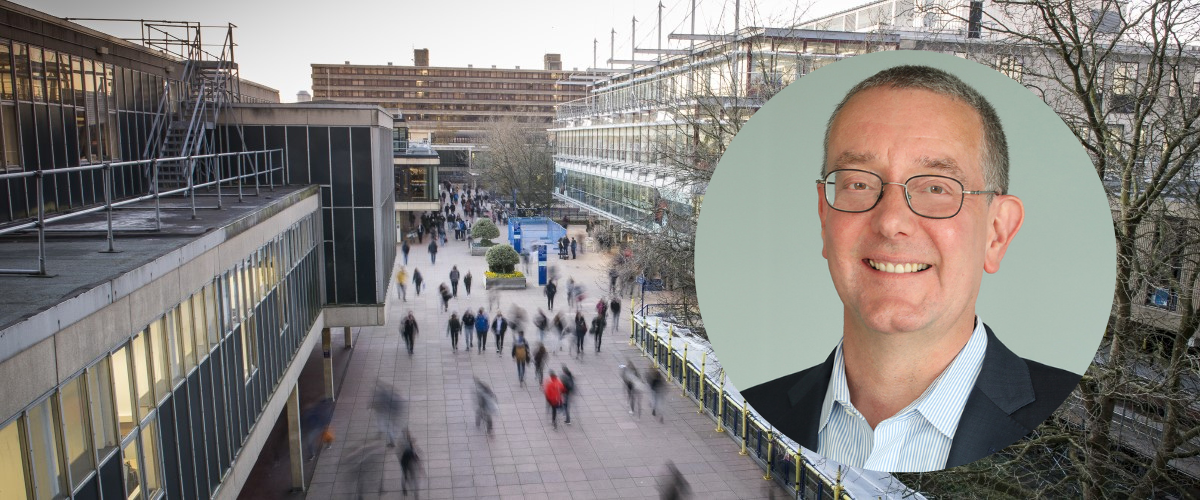
From battling the elements on his journey to campus to becoming Chief Operating Officer of Chase in New York, Mike Ashworth’s career has taken him far beyond Bath. He began his career at JPMorganChase as a programmer in 1986. Five years later, a six-month assignment in New York changed the course of his life, and he never looked back. Since then, he has held leadership roles across technology and operations, culminating in his appointment as COO of Chase.
As a member of the University’s US Foundation Board and a generous supporter of Bath, Mike reflects on the experiences that shaped his career, the opportunities that changed its course and why he remains committed to helping future generations of Bath students.
What are your most vivid memories of your time at Bath?
Probably the weather. I lived off campus for all but my final year, and in my first year I was placed in a house in Bathampton. Every day began with a walk up the hill and across the golf course to get to the University, often in horizontal rain. The landlady was also a little unusual, so it was not the easiest introduction to university life.
Despite that start, Bath quickly became a place where I found my footing. I had, immediately prior to university, lived in a small village in Cornwall, so Bath introduced me to different people and ideas and gave me a much greater sense of independence. It was an important period of growing up, even if most days still began with a wet walk up the hill.
Academically, the course was unusual because it combined economics, computing and statistics. There were only a handful of us, so although we joined larger groups for maths, computing and economics, our econometrics classes were tiny. That made for a close-knit course and gave us the chance to know our lecturers well. It was also an interesting time to study computing, although probably none of us could have imagined how central technology would become to almost every part of life and business.
Beyond the course, I became involved in the Students’ Union from a political perspective. Its meetings gave me an early opportunity to debate, challenge ideas and learn how to make an argument. Those experiences stayed with me, although others may have different views on whether my debating style has improved since then.
Did you have a particular career in mind as an undergraduate?
Not really. I had no clearly defined career plan until I completed my placement with the Department of Energy in London, where I worked on energy demand forecasting.
The experience taught me two things: I did not want to work in the Civil Service, but I might enjoy being a statistician or programmer. Just as importantly, it was my first proper experience of working in London and proved invaluable when I applied for jobs in my final year.
You started out as a programmer and now work at the highest levels of a global organisation. Can you talk us through that journey?
I joined J.P. Morgan in London as a programmer in the Investment Bank. After about five years, I was sent to New York for six months to help fix a project that was going badly across the two locations. Some of the London business leaders moved to New York while I was there, so I stayed.
That assignment led to a series of broader technology roles. I eventually ran trading technology and then all technology for the investment bank. Following the Bear Stearns merger in 2008, I moved into a firmwide role leading infrastructure. In 2013, I became head of technology for the consumer bank, before moving from technology into operations in 2016.
Each move took me further from where I had started, but the common thread was solving complicated problems and learning new parts of the firm. In 2026, I was named Chief Operating Officer for Chase. Today, I lead around 40,000 operations employees and am responsible for our product operating model.
Was there a turning point that shaped your career?
Looking back, there were three.
The first was moving to the US. What was meant to be a six-month assignment in 1991 became a permanent move and changed the course of my career.
The second came after the Bear Stearns merger, when I left the Investment Bank to lead Firmwide Infrastructure. It meant stepping away from the part of the firm where I had spent my entire career and taking on a very different challenge.
The third was moving from technology into operations. That required me to apply what I had learnt in a new context and develop a much broader understanding of how the firm serves its customers.
None of those moves came with complete certainty. In each case, I had to learn quickly, build new relationships and become comfortable operating in an unfamiliar environment. That willingness to step into something new has shaped much of my career.
You live and work in New York. What has living in the US taught you, personally or professionally?
New York was a refreshing change from London: more dynamic, more innovative, more meritocratic and with better restaurants!
Over time, I also came to appreciate the extraordinary variety of the US as a whole. Every state is different, and the range of people, food and landscapes means there is always something new to discover. The US became home, and I became a citizen in March 2004. My wife is American and although my kids have dual citizenship, they see themselves as American except when watching football.
Professionally, being in New York placed me at the centre of JPMorganChase’s growth and evolution. I have been able to see the firm change enormously while also building a life in a city that continues to change just as quickly.
What keeps you motivated?
The people and the problems.
I have spent 40 years at JPMorganChase, which is much longer than I could have imagined when I joined. I have stayed because the firm has continually given me opportunities to learn, take on difficult challenges and work with exceptionally talented people.
I genuinely believe it is one of the best companies in the world. That is not simply because of its scale or success. It is because of the standards we set, the importance of the work we do and our willingness to invest for the long term. There is an expectation that you will take responsibility, keep learning and leave things better than you found them. That has made the work consistently interesting and meaningful.
The firm has also never stood still. I have worked through major mergers, moved between countries and taken on roles across technology, infrastructure and operations. Each experience has given me a different perspective on the organisation and a new challenge to solve.
What motivates me now is the opportunity to help shape the firm’s next chapter. The responsibilities are different from when I began, but the appeal is much the same: working with good people on difficult problems that matter. There is still a great deal to do, and that is exactly what keeps me interested.
You’re a generous donor to the University. Can you tell us why you choose to give back in this way?
Bath played a pivotal role in my life. It gave me the confidence and experience to think more broadly about what I might do, and my placement in London was an especially important part of that journey. It provided my first real insight into working life and helped set me on a path I could not have imagined at the time.
Looking back, I can see how much the right opportunity at the right moment can shape someone’s future. That is why giving back matters to me. I want more students, whatever their background, to have the support and experiences that allow them to broaden their horizons and recognise their own potential.
Bath had only around 3,500 students when I was there. It has grown considerably since then, but it has retained the ambition, innovation and academic excellence that made it special. I feel very fortunate to have studied there, and I am proud to help extend those opportunities to the students who follow.
Why was it important to you to stay involved with Bath through the US Foundation Board?
I have always felt a strong connection to Bath, and joining the US Foundation Board was a way to turn that connection into something practical by helping the University build for the future.
Through the Board, I can understand Bath’s ambitions in greater depth, contribute my experience where it might be useful and help strengthen the University’s relationships with alumni and supporters in the United States. It allows me to do more than remain interested in Bath’s progress. It gives me a way to take part in it.
That involvement is particularly meaningful because I have lived in New York for many years. The Board keeps me connected to Bath from the other side of the Atlantic and allows me to hear directly about the University’s priorities, its progress and the difference its work is making.
Ultimately, my involvement is driven by gratitude, but it is firmly focused on the future. I want to help Bath build on what makes it special and continue giving students the foundation to pursue ambitions they may not yet have imagined.
When you look back at the student who arrived at Bath years ago, what do you think they would make of where you are today?
The student who arrived in 1982 would be completely astonished.
At that point, I was still adjusting to university life and had only just begun to think that I might enjoy being a statistician or programmer. I certainly had no grand plan and would never have imagined that a job in programming would eventually lead to a four-decade career in New York.
There is always some luck involved in a career, along with the willingness to take opportunities when they appear. Even so, I would not have been imaginative enough then to see any of this coming.
What advice would you give to Bath graduates at the start of their careers?
Broaden your experience whenever you can. The world is changing quickly, particularly because of AI, so learn how to use new tools. At the same time, do not lose sight of the real problem you are trying to solve or why it matters.
That means working hard, staying curious and making yourself available for new experiences. Not every assignment will be exciting, even when it is important. Sometimes you simply have to knuckle down and do the work.
Most importantly, take opportunities when they arise, even if you cannot predict exactly where they will lead. My “six-month New York assignment” is a great example.
Respond