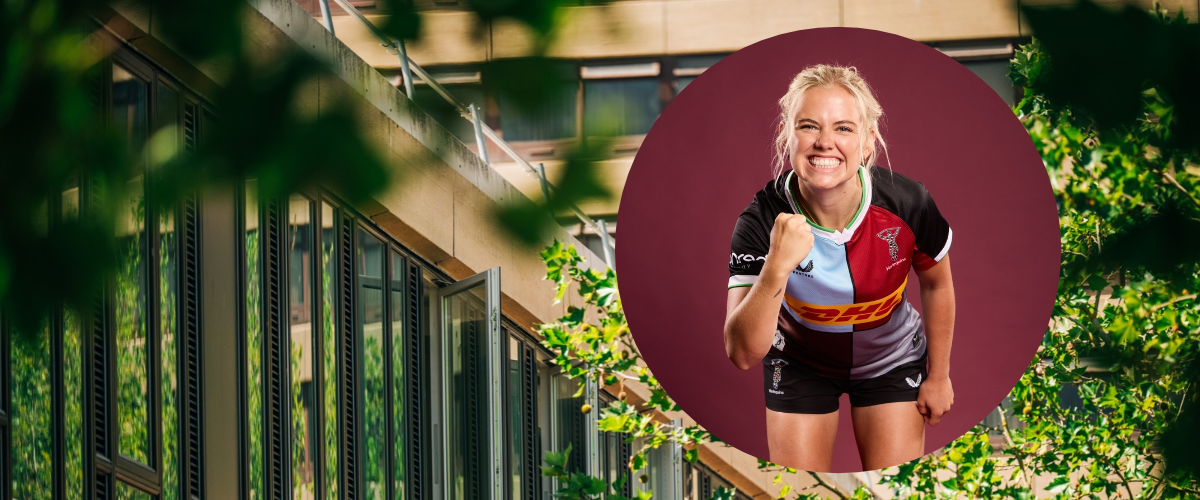
Grace Crompton does it all. Alongside her professional rugby career with Harlequins, she's also a teacher. If that wasn't enough, she runs The Crompton Club, a coaching initiative with the goal of giving girls in rugby a sense of belonging.
The well-oiled balancing act started at Bath, where she studied Sports Management and Coaching alongside the beginning of her professional rugby career.
Why did you choose to study at Bath?
I chose Bath because it felt like the perfect combination of a strong university and a place where I could continue developing as an athlete. I wanted to study Sports Management and Coaching, but I also needed to be somewhere that understood high-level sport and would allow me to balance both. Bath allowed me to develop academically while continuing to pursue rugby seriously.
Did you have a particular career in mind when you chose your course?
I didn't have one specific career mapped out, but I knew I wanted sport to be a big part of my life. I was interested in the management and coaching side of sport, as well as the performance side. At the time, I don't think I could have predicted exactly where rugby would take me, so I wanted a degree that gave me different options.
What are your favourite memories of studying at Bath? Are there any places or moments that stand out?
A lot of my favourite memories are actually the everyday ones: training, travelling to games, being around my teammates and the friendships I made. Trying to balance university life with rugby
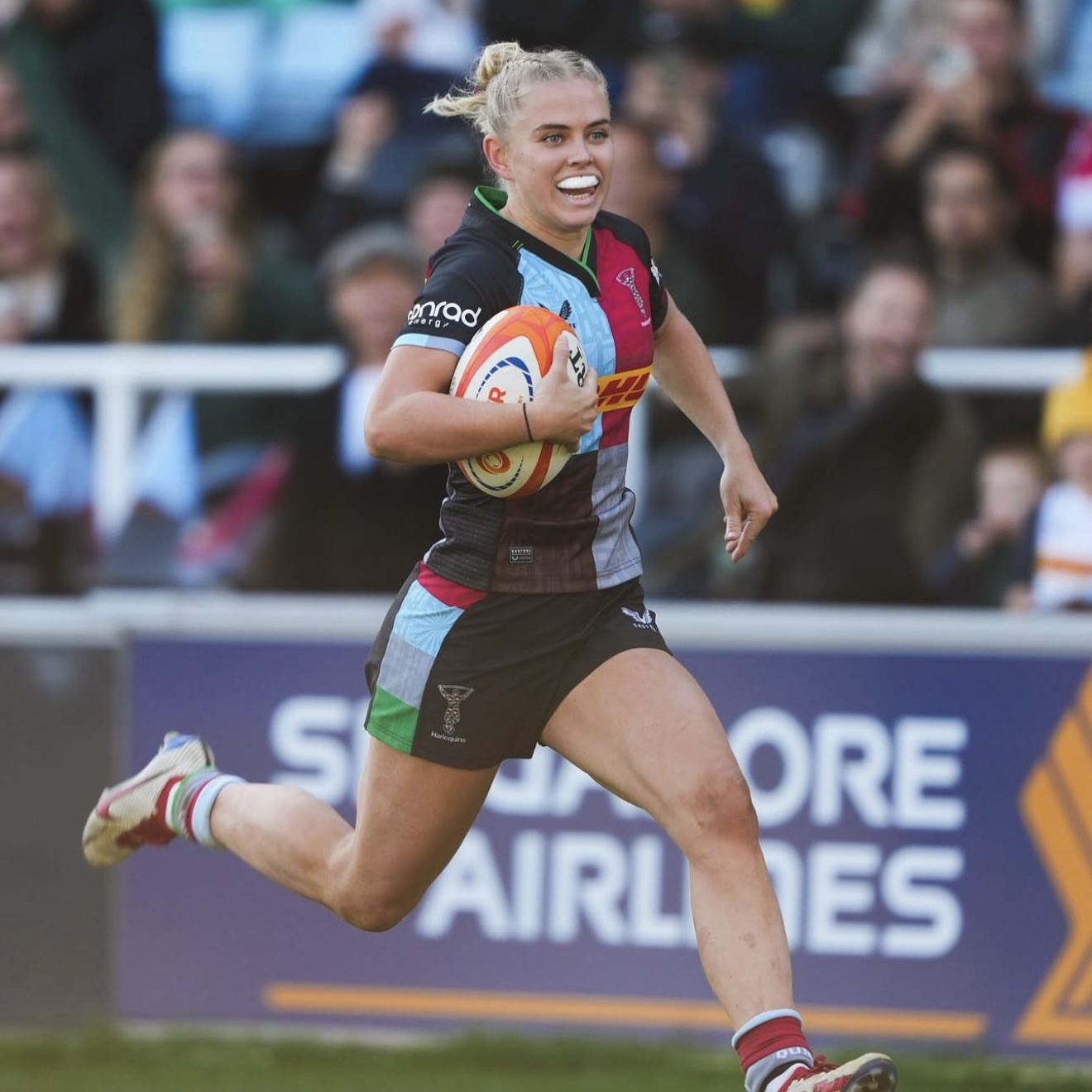
meant that I was always busy, but there was a real sense of community. I also loved being in Bath itself. It's such a beautiful place and I have lots of memories of exploring the city with friends, grabbing food and having a bit of normal student life around the rugby and studying. Looking back, I think I appreciate those moments even more because life has become so busy since graduating.
What was it like balancing your studies with playing rugby at a high level?
It was challenging, but it taught me a huge amount about time management and discipline. There were times when I was training, travelling or playing and then having to come back and get university work done. I had to become very organised and learn how to prioritise. You can't always give 100% to everything at the same time, so you learn to manage your energy and make the most of the time you do have. Those skills have stayed with me throughout my rugby career and are still incredibly important now.
Tell us about your journey since graduating. How did you get from Bath to playing at the Paris Olympics and for the Harlequins?
It's been a journey that I don't think I could have predicted when I graduated. While studying at Bath, I spent four years playing for Bristol Bears, continuing to develop my rugby alongside my studies. I then moved into the GB Sevens programme and went on to compete on the HSBC World Rugby Sevens Series.
From there, I was fortunate enough to represent England and Team GB at major tournaments, including the Commonwealth Games and Rugby World Cup, and eventually the Paris 2024 Olympics. Alongside Sevens, I've also been able to develop my 15s career with Harlequins. Being able to play both forms of the game has been a huge part of my development and something I'm grateful for.
The journey hasn't been completely straightforward, though. There have been setbacks, moments of self-doubt and plenty of times when I've had to be patient. I think that's probably one of the biggest things I've learnt – your journey doesn't have to look exactly how you imagined it to still be successful.
You’re a teacher alongside playing professional rugby. How do the two sides of your career complement each other?
I love the fact that they are so different but actually have a lot in common. Rugby has taught me about communication, leadership, resilience and working with different personalities, all incredibly useful as a teacher. Equally, teaching has made me a better rugby player and coach. You have to understand how different people learn and communicate, and you have to be patient and adaptable. I really enjoy being able to show young people that you don't necessarily have to choose one path. You can have lots of different interests and try multiple careers.
You founded The Crompton Club to support the next generation of female rugby players. What inspired you to start it?
The Crompton Club came from wanting to give girls the kind of support and opportunities that I would have loved when I was younger. I started rugby relatively late, at 16, and I remember feeling like I was playing catch-up and questioning whether I really belonged. I was lucky to have people around me who believed in me, but I also realised how important that support can be for young girls. I wanted to create something that was about more than just rugby skills. It's about confidence, friendships, belonging and helping girls feel like they have a place in the sport. I want girls to be able to see what is possible for them, whether they want to play socially, represent their school or club, or ultimately pursue rugby at the highest level.
How do you balance your commitments?
I'm still learning! I think organisation is probably the biggest thing. I have to be really clear about what needs doing and when, and I try not to overcomplicate things. I also think it's important to recognise that you can't do everything perfectly. There are weeks when rugby needs to come first, and others when work or The Crompton Club needs more attention. I've become much better at understanding my own energy and knowing when I need to slow down. Rest is also part of being productive, particularly when you're combining elite sport with work and running a business.
What have you learnt from your experiences in elite sport that you want to pass on to young women through the club?
The biggest thing is that confidence doesn't always come first. Sometimes you have to be brave enough to try, make mistakes and then build confidence from the experience. I've learnt that setbacks aren't necessarily a sign that you're not good enough. There have been plenty of moments in my career where things haven't gone to plan, but they've often ended up teaching me something valuable. I also want girls to understand that they don't have to change who they are to be successful in sport. You can be competitive and ambitious while still being yourself. You can be strong, make mistakes, ask questions and take up space.
If you could go back to your student days at Bath, what would you tell yourself?
I'd probably tell myself to enjoy it and not worry so much about having everything figured out. I was always thinking about what was next and whether I was good enough, particularly with rugby. I would tell myself to trust the process a little more and enjoy the opportunities in front of me. I'd also tell myself that your career doesn't have to follow a straight line. The things I studied at Bath, the people I met, the rugby experiences I had and even the things that didn't work out have all contributed to where I am now.
Respond