Since 2021 we’ve been running professional development programmes for researchers to develop their skills and confidence in leading public engagement and outreach. The Outreach and Public Engagement Leadership (OPEL) programme was funded by Ogden Trust and STFC, while the Inclusive Leadership for Public Engagement with Research (ILPER) was funded by NERC. OPEL has run three times and ILPER just once.
Taking part in the programmes has proven to be groundbreaking for some of the participants.
Through both programmes we helped researchers develop an understanding of leadership that is quite different to how leadership is more usually considered in a research setting. To be acknowledged as a research leader, you typically become the best in your field and leadership is positioned as being at the top, or front. Leadership for public engagement is not like that. It’s a form of supportive leadership: helping others do good work, aligning your work with others’ priorities, and working with friends and allies for mutual benefit.
As well as reporting improved skills and confidence in leading outreach and public engagement participants reported taking a more strategic approach to their work, understanding how outreach and public engagement fit (or don’t fit) into institutional priorities, being able to make a stronger case for outreach and public engagement, and taking ownership of the title “leader”.
Participants have reported using the skills, ideas, and concepts they’d developed by participating on the programme in other aspects of their professional lives. The ability to see multiple perspectives, to re-frame activities so they work for others, and how to delegate to others while remaining supportive are all key skills in being a successful academic.
So what was it about our programmes that worked?
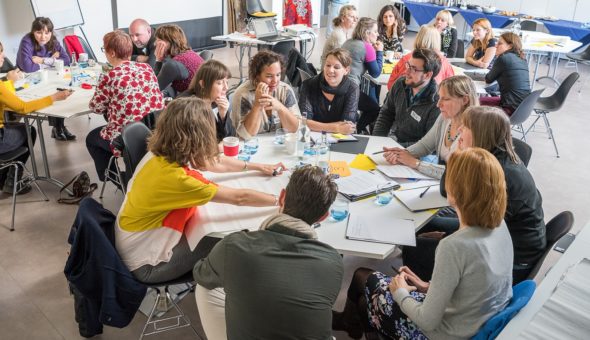
The cohort: participants reported feeling good about being with others who had similar passions and commitments towards developing and delivering high quality, inclusive public engagement and being part of research culture were diversity and difference are valued. While the funding of the programmes created a disciplinary boundary around both participant cohorts, we also worked hard to create a strong cohort throughout the programme which started at the recruitment stage.
The structure: the programmes consisted of formal workshops, personal learning goals, informal peer groups meetings, and mentoring. This combination was essential. The workshops provided content and some initial discussions between participants. The learning goal gave the participants something to apply the new ideas to. The mentors helped participants make sense of the workshop content in their own settings, as well as providing personalised support with the learning goal. The peer group meetings were not as consistently useful due to differences in personal development and how well the format worked for the people on the programme.
The content: we covered key ideas including models of leadership, research culture and how to change it, funding for public engagement, and inclusive practice. Often presenting an overview of concepts, with models or frameworks to help participants make sense of the ideas and begin to consider how they could apply the tools and frameworks in their own settings.
The duration: The Ogden/STFC programme was a 12 month programme with no more than 36 hours of commitment over that time. The NERC programme was a 12 week programme. The funding forced our hand with this as it came through NERC’s Short Training Course call. We wanted to see if we could build on the Ogden/STFC model and deliver something as effective in a more focused time period. It worked.
Expertise of the team: a key project we worked on together was the ChallengeCPD@Bath project which helped us really understand how the cultures of research and PE combine to make training a difficult area of work. We have very complementary skills sets with Helen being an institutional leader of PER since 2012 and David doing a lot of work to understand outreach and public engagement at sector level. We also worked with fantastic colleagues (Dom, Charlotte, Lesley, Furaha) who bring similar skill sets and backgrounds but with different and intersectional identities. Our networks were also important as we were able to invite guest speakers to join the programme at timely points.
The uniqueness of leadership for outreach and public engagement: public engagement is still an optional part of academic practice and there is no sector level reporting or governance. We also know that public engagement is not a consistently applied term meaning there are different interpretations at individual, department, and institutional levels. These features of public engagement means that leadership of outreach and public engagement has to respond to the complex, ambiguous, and dynamic nature of university priorities which requires developing an understanding of the bigger picture of your department / faculty / institution, re-framing to align with others’ priorities, working with allies, and being comfortable in spaces where you are not the expert to help others do good work. It turns out that these skills are useful way beyond outreach and public engagement.
You can read the evaluation reports for the Outreach and Public Engagement Leadership programme here, and the Inclusive Leadership for Public Engagement with Research here.
Helen Featherstone, PhD is Head of Public Engagement, University of Bath
David Owen is Director of Gurukula engagement consultancy

Respond