My experience since the last blog
Since my last blog post, two and a half months ago, I have travelled to 8 different places across Argentina. After leaving Chaco and the Rivarola family, I did a whistle stop weekend in Uruguay (to renew my visa), stayed with a family just outside of Buenos Aires, and returned to Bahía Blanca again. I continued to enjoy teaching English in language schools but have realised that teaching isn’t really a passion of mine, neither is it something I didn’t enjoy. In fact, many of the interactions I had with students centred around their own interests, passions and personal lives. Like in my other placements, I was constantly being invited to family gatherings and birthdays as well as being toured around local museums and embarking on random trips to local petting farms! As mentioned previously, Argentines seem to know no concept of strangers, and I was once again warmly embraced in to their lives.
Initially, when booking my flights, I planned to return to England about a week after my programme finished. However, the programme finished two weeks earlier than anticipated and so I had some time on my hands to explore Argentina, which despite moving around a lot for placements, I had actually only seen a fraction of. The Northern provinces caught my attention in particular. I had read about them in my ‘Lonely Planet’ guide (top recommendation) as being culturally distinct due to pre-Columbian Andean influence. Admittedly I had also selected them over other places because it was July at the time (darkest Winter in Argentina), and being closer to the equator, the temperatures were much higher compared to Patagonia in the south. Being an unashamed sun worshipper, this was honestly the deciding factor. To begin with I had a planned to go with a good friend, also from England doing the same programme as me. Unfortunately our plans fell through so I was to go it alone which was slightly daunting, but also an alluring prospect, given that being lucky enough to stay with host families, my life had consisted of incessant socialising for the past 5 months.
Salta
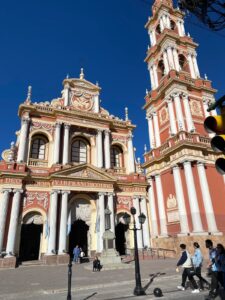
My travels began with Salta, or as Argentinians nickname it ‘Salta la Linda’, or ‘Salta, the beautiful one’ and the city lives up to the name. The central area of Salta is filled with stunning colonial architecture, that appears as if its straight from a postcard.
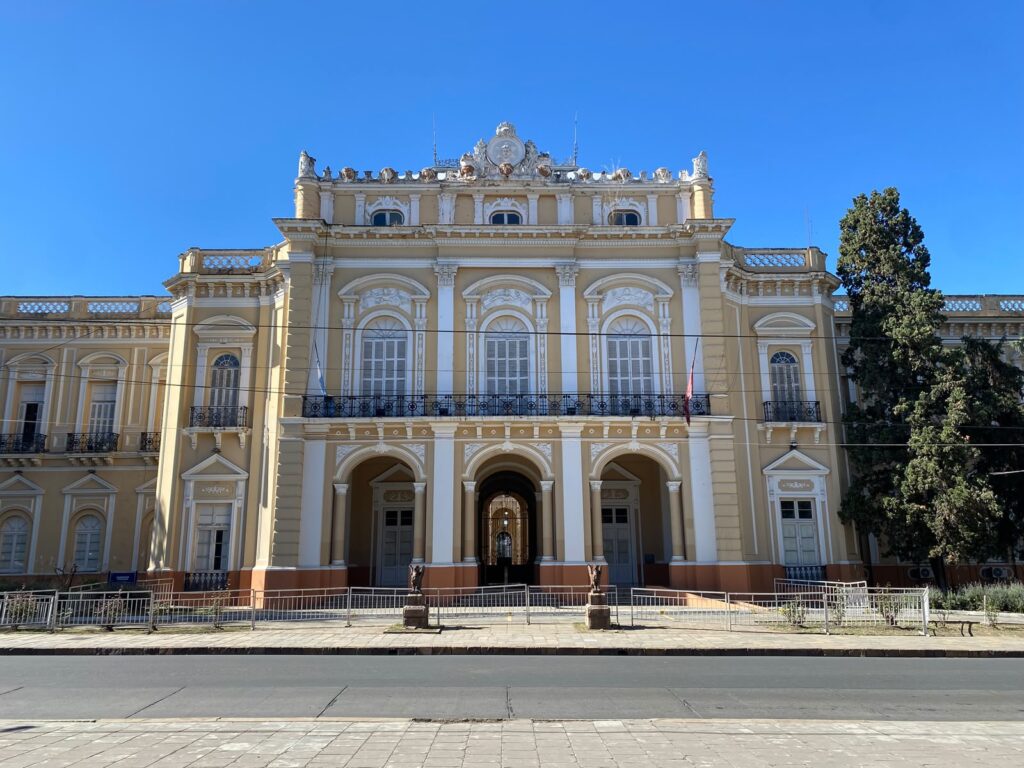
It’s a highly populate city, and there was lots going on. For me however, I was captivated by it’s history. Martín Miguel de Güemes led ordinary civilians or ‘Gauchos’ in ‘La Guerra de Salta’ which subsequently led to Argentina’s Independence. Several museums are dotted around El Plaza Mayor, in which they describe the incredible resilience of the Saltean people during their relentless fight for Independence.
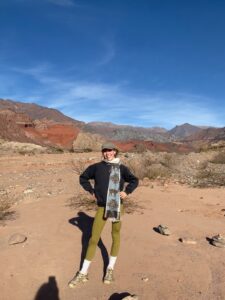
Having said this, I longed to escape the city and so I went on a guided tour to La Garganta del diablo and the Cafayate wine region. The tour minibus journeyed through the Calchaquíes Valleys, which are famed for their striking red rock that goes on for miles on end. It was like we had landed on planet Mars. I also found that it was a great idea to book on to tours, that day I met other travellers from Italy, The Netherlands, Ireland and Germany and for the first time I was having to speak more English than Spanish to communicate!
Tilcara
Salta lived up to its reputation as ‘The Beautiful one’, however I found being in such a large city with so many people paradoxically isolating. I realised I had taken for granted the small towns that I had previously been located in, and the hospitality and familiarity of my host families. I had gone from socialising and chatting all day every day, to sometimes not muttering my first word until midday.
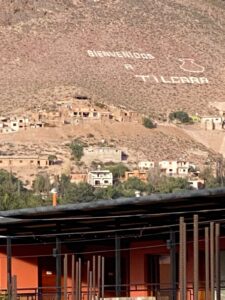
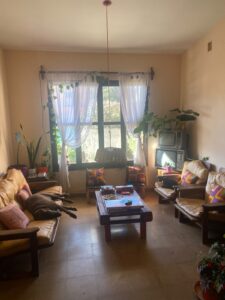
It was very strange. Tilcara, a much smaller town, contained a bohemian spirit that made me feel more at ease. My hostel was small and adorned with traditional Andean crafts and pottery. It felt homely and inelaborate.
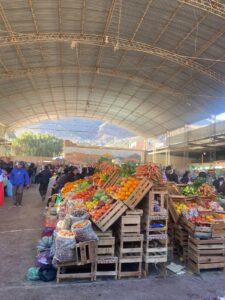
Each morning I would walk down the main road and five ladies at different food stalls would call out to me ‘señorita, señorita queres una tortilla rellena’, offering me traditional Andean street food. Tilcara had a simultaneously lazy and chaotic feel.
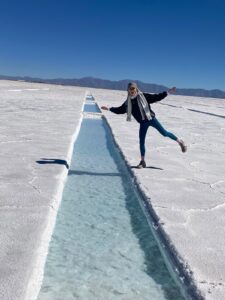
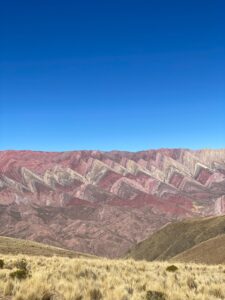
I was to stay here for four days, it was a central location, ideal for making day trips to the sights I wished to see. The thing that people don’t appreciate about Argentina is it’s sheer size, and this only became apparent to me when I saw ‘Las Salines Grandes’, 212km of salt flats and the next day I saw ‘la sierra de catorce colores’, The Mountain of Fourteen Colours. Both breath-taking, and yet so distinct from each other.
One of the greatest memories I have of Tilcara is my visit to a Llama sanctuary. Llamas are considered integral to Andean and Indigenous culture, trade and agriculture. I was therefore willing to make the one hour’s up-hill climb to the Llama sanctuary to learn more. The sanctuary was owned by a couple who genuinely adored these animals, far from a tourist trap, a group of ten of us walked with the llamas, fed them, and brushed their hair.
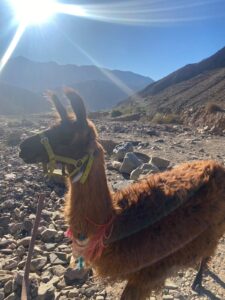
Llamas are a result the breeding of guanaco and vicuna, thus similar to dogs, they are domesticated animals and wouldn’t survive in the wild without human care. My llama for the session, was called Caprichosa or Capricious, and contrary to her name she was very calm and I was in awe of being so close with such a beautiful creature.
Iruya
I was sad to leave Tilcara. I felt comfortable in the town, which was touristic but not too crowded, meanwhile there was things to do without being overwhelmed by choice. My next destination was to be vastly different from anywhere I had been to yet in Argentina. Iruya is a village nestled on the mountainside of at an elevation of almost 3,000m. Iruya was slightly off the beaten track, I had heard that many tourists refrained from going there due to its remoteness and difficulty to access.
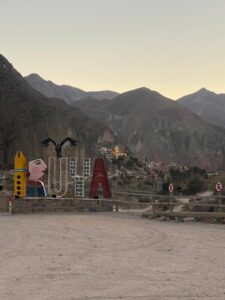
The bus journey from Tilcara I think was enough to put anyone who doesn’t take well to heights off, steadily climbing up mountainsides and undulating between grassy valleys. Meanwhile, not to sound painfully uptight and British, nobody was wearing a seatbelt and the driver was stopping every 30 minutes to smoke, I began to feel a bit shaky.
Upon arrival at the bus station, a man greeted me and asked if my name was Nell (I had booked a tour with him the previous day), his name was Jorge and he had come to ‘welcome’ me to the village. This gives you an idea about the size and proximity of this village!
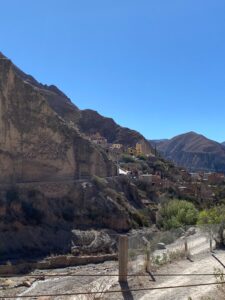
After declining Jorge’s offer to take me to my hostel (I am still unsure if this was overly cautious of me or just a fair measure taken by a female traveller), I climbed a very steep hill to get to my hostel. Eliana, who worked there, was a no-nonsense lady that spoke rapid Spanish, but was all the while accommodating and gave me plenty of hiking recommendations around the area. However, when I said I was going to walk into the town, she laughed and said ‘para que?’ (for what?). Essentially, there was nothing in the town, apart from a church, four eateries, a hotel, and a viewpoint. After walking around the entire ‘town’, which took me probably twenty minutes, I sat down outside the church and realised I was being stared at by everyone who walked by. I soon became a bit unnerved, and actually started to cry for feeling so perceived. Iruya, is close to the Bolivian boarder, and also home to the Kolla Indigenous community. As an English girl, I stuck out like a sore thumb. Initially, this was really unsettling, but after an emergency call with my mum (which I still do at 21), I realised that its usually curiosity that as humans causes us to stare, rather than malintent.
Despite my discomfort to start with, Iruya became one of my favourite places I visited in Argentina. It was simply stunning, and more so, it felt so unspoilt by humans and sacred – given that the families living there had done for centuries. I made a trip to San Isidrio, an even smaller village whilst I was there.
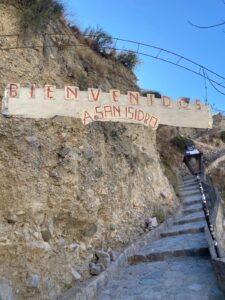
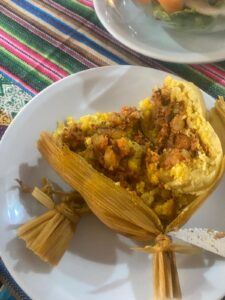
I sat in the back of the guide’s 4x4 truck with a German girl and Argentinian girl. It was comforting to speak to people who also weren’t from the village and exchange our travel experiences. Iruya, due to it’s peripheral location, also provided me with flavoured food I didn’t know Argentina possessed; llama stew (hypocritical I know after my declaration of love for llamas), tortilla de papas, and tamales (steamed corn parcels filled with spiced meat).
I left Iruya feeling grateful for having just seen it and curious to weather I would ever visit such an isolated place again.
San Salvador de Jujuy
San Salvador was the land of the unknown for me. I didn’t do much research about it, because it was simply near to an airport so was therefore a convenient stop off, nor could I pronounce the ‘Jujuy’ part. It’s funny how quickly you adapt to ways of living, because after sleepy Iruya, arriving in Jujuy was like being introduced to a city for the first time ever. Immediately outside the bus station, there were streets breaming with fruit and vegetable stalls, flee markets and tourist salespeople parading the streets, targeting anyone that looked similar to myself (pale, lost, with lots of bags). After dumping my bags at my Airbnb, I explored the town some more. Like Salta, Jujuy is home to some beautiful religious and colonial buildings but it’s lasting impression was it’s business and heat? I couldn’t believe that 28 degrees was winter for them…this did not aid my attempts at concealing myself as a mysterious traveller. It was plainly obvious that I was English, as I walked around rosy-cheeked in a t-shirt, whilst those around me were fashioning puffer jackets and boots.
I was only in Jujuy for two days, so I wanted to make the most of the beautiful greenery that surrounds the city. This vegetation are known as the ’Yungas’ of Jujuy, a subtropical mountain forest, which appeared particularly lush having been amongst the dry and arid rock formations in Tilcara and Jujuy. So, I made the 45 minute bus journey to the ‘Termas de Reyes’, or the ‘Kings thermal springs’, named so because it is believed that the ancient Andean King used to travel to the area to take advantage of the natural thermal hot pools and their healing properties. I spent the day doing a small hike to a viewpoint overlooking the Yungas, listening to ABBA Oro, reading my book and dipping in and out of the pools. It was pure bliss, and I learnt that being outdoors really gives me an unrivalled sense of peace, or simply feeling content.
Buenos Aires
After my make-shift spa retreat, I was to head back to Buenos Aires for a couple of days before my flight home to England. As a child that was basically forced to love football given my Dad’s obsession with the sport, I couldn’t believe my luck when I realised I was going to arrive in time to see Argentina in the World Cup Final. In true Gringo fashion, I met up in an Irish pub with some other friends from the programme and we watched together. The result was obviously not wanted nor expected (Argentinians are very confident in their football abilities, or rather, Messi). Yet, the way in which my time ended in the country was like a microcosm for what it has come to mean to me…. Argentina lost, yet they still paraded on the streets, millions celebrated at the Obelisco, waving flags, singing chants, with joy not bitterness. The Argentine people have an unwavering pride that is not lost in the battle to be number one. They pick themselves and carry on, always singing ‘Vamos Adelante’.
Respond