
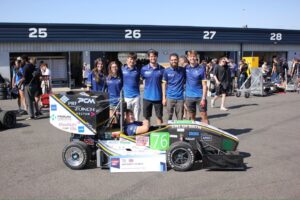
This blog will take you through some of my experience at Team Bath Racing electric and how it has developed my employability through a use of different skills. For context I am a 2nd year Integrated Mechanical and Electrical Engineering student at the University of Bath. TBRe is the university of Bath’s Formula Student team, which is an international engineering competition held in the summer every year, where each university displays what they have designed and manufactured over the academic year. Participating in this project has been an enriching experience that complemented my academic studies. It directly contributed to the Claverton Employability Passport learning outcomes of my Claverton Scholarship by pushing me to develop my confidence, professionalism, teamwork and communication skills in a fast-paced environment.
Modelling sub sections of an electric powertrain
I simulated an electric powertrain using a software called MATLAB and SIMULINK, these two tools allowed me to model the physics happening inside of an inverter, which basically just takes AC voltage from the battery and converts it to DC voltage so that it can be used by the motor. This model could then be integrated in to a whole car model to be used to simulated how our car would handle when changing certain parameters. This is useful as it allows us to see how our car will handle before we make certain design choices.
Some key milestones from this project:
- Built 2 SIMULINK models, which will provide genuine performance for the team after testing
- Contributed overall to the Mathworks simulation award in FSUK (1st place prize of £1000) and FSG (3rd place $1500)
- The simulation work directly strengthened my analytical and problem-solving skills, teaching me how to troubleshoot complex models, which is a highly transferable skill for my future engineering career.
PCB Design & Manufacture
I helped design a brand-new PCB (printed circuit board) for the car. A printed circuit board is just a way of making a circuit in a small compact durable form. This was the dashboard PCB, which sits behind the drivers display and takes all the onboard signals and datapoints from the car and displays it to the driver. This was the only board I personally helped design, but I also manufactured many other boards including High voltage battery cell monitoring boards. This board monitors individual temperatures, current and voltages, making sure we stay within the regulated temperatures and power ratings. The telemetry boards measure all sorts of things such as tyre pressure, brake pressure, car speed etc.
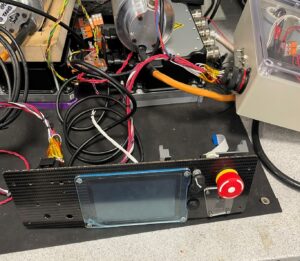
Key milestones from this project:
- Manufactured multiple critical car components, this helped bridge the gap between theoretical design and physical manufacturing was one of the most impactful parts of my development.
- Designed a new interface for the driver, which taught me to view engineering problems from the perspective of the end-user.
Loom manufacture
For my final contribution, I measured, stripped and crimped wires to motorsport standard. These wires (looms) are essentially the nervous system of the car. They transport the communication between telemetry boards to the main computer and then from the computer out to its respective destination, like the dashboard to display information to the driver or to the battery to draw more power.
Key milestones from this project:
- Manufactured motorsport grade looms, this highly detailed work required lots of patience and focus ultimately, improving my hands-on engineering skills.
- Helped improve the cars’ reliability through new loom manufacturing methods. Following protocols and engineering practices allowed the car to complete the endurance event at Germany, which is a 22km timed event.
A challenge I overcame
Everything I did here was a new thing or building upon existing skills, so a challenge I overcame was asking a lot of questions. I knew the experienced members were busy doing their things, but I had to continuously ask them questions as that was the only way I was going to learn. I became more comfortable seeking support by watching how collaboratively the senior members worked together. By the end I knew when to ask for help and how, making sure my point was clear so that I took something away from the conversation.
How this experience improved my employability
Doing all of this has meant I have become more employable due to all the real-world experience I have gained not just on my course but outside of it. I have been told multiple times by employers that Formula Student is one of the best experiences to be involved in at university by far.
I feel as if my journey at TBRe has not only improved my employability but my university journey and I can’t wait to return to it after placement hopefully taking on a greater responsibility and making major decisions.
Thank you for reading my blog on how TBRe has improved my employability and I would like to especially thank my family friend for introducing me to Formula Student at the age of 17 – it was a pivotal moment for my professional development.
Respond