
Introduction
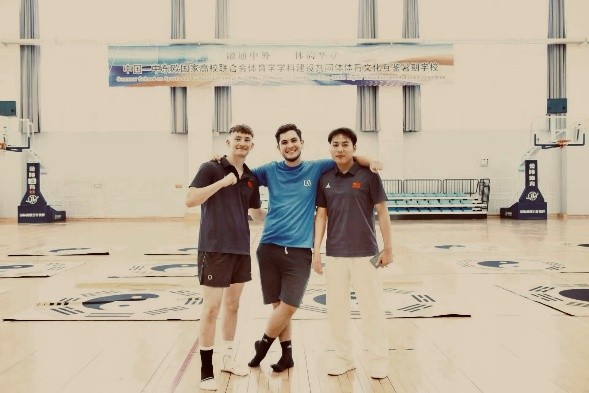
A two-week summer school in China was the greatest learning experience of my life. Alongside practising traditional Chinese martial arts, I immersed myself in the culture, explored incredible places, and made friends with people from all across the world. From climbing Thousand Buddha Mountain, to learning Sun Bin Boxing, the experience came with its challenges, but left me with the most amazing memories.
Upon hearing about the opportunity, I knew it was right for me. I wanted to broaden my knowledge beyond modern combat sports, as well as explore an extremely unique part of the world. I was also eager to bring new knowledge and ideas back to the sports science and martial arts community at Bath. Little did I know, I would also be leaving as a more confident, independent, and employable person, ready to take on the challenges of my future life and career.
So, after a week full of applying, planning, and anticipation, I was on the plane to China, a place I would never have thought I’d be visting that summer!
My First Taste of China
 I arrived in Jinan at 7:30pm, greeted by a summer school volunteer. After a swift bit of teamwork to get my rather large suitcase into the boot of the taxi to the hotel, I said goodbye to Mr. Wang Enhao, and hello to the skyscrapers of Jinan - the ‘City of Springs’ and capital of Shandong Province.
Out the window of the taxi, it felt more like Tokyo than China! Multi-coloured lights lit every street, with restaurants around every corner, and a staggering number of motorcycles, tuk-tuks, and taxis making the city feel alive, despite the questionable road rules!
Having arrived at the hotel, I was met by more extremely friendly volunteers, as well as my fellow summer school students, most of whom were from Eastern Europe. Before long, my new-found friends and I hit the street, in search of food!
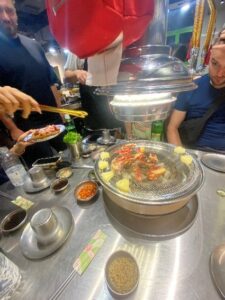
By the end of the evening, we had sampled meats, fruit, vegetables, squid, and spices from a family-run restaurant (most of which we cooked ourselves on the BBQ in the middle of our table), as well as ice cream, and, of course, Chinese beer (Tsingtao is class).
From Ancient Traditions to Futuristic Tech
The following morning, we had our first class: Baduanjin. A traditional Chinese form of wellness exercise involving eight gentle, flowing movements that challenge your posture, breath regulation, flexibility, and mental focus. This would form the basis for the martial arts we would soon learn.
Our teacher, Professor Wang Fei, was amazing. He had high expectations but created an excellent learning environment for us to ask questions, make mistakes, and really get stuck in! The sessions were surprisingly difficult, but you were left feeling accomplished yet relaxed after each session.
 We also visited Shandong University School of Physical Education. Here, we tested some of the technology used to measure their athletes’ components of fitness, such as virtual cycling, automatic sit-up recorders, and interactive fruit ninja! We were even lucky enough to try on a very clever glove, which clenched your fist solely by the power of your thoughts! It was amazing to see some unique sports science tech that still had meaningful applications to the real world.
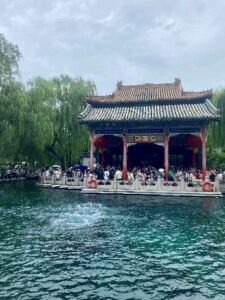
But it was time for a break from the tech, so I visited ‘Baotu Spring’. Praised by emperors and writers for over 3,500 years, I too was struck by the site’s charm and tranquillity. I even got to taste it with a spring water tea. In fact, Emperor Qianlong did the same thing 300 years ago. He traditionally carried water from Beijing’s Jade Spring Hill, but after tasting tea brewed from Baotu Spring, he loved the sweet taste so much that he switched his preference and officially named it the “First Spring under Heaven”.
We then had our first introduction to traditional Chinese martial arts. We practised Wu Bu Quan, learning the five stances and three hand forms, which we incorporated into a full routine. This was tricky to get right, demanding flexibility, balance, and concentration, but by the end, we all fought and flowed as one.
Reaching Enlightenment
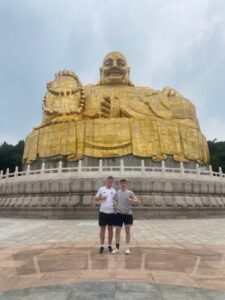 After another Wu Bu Quan class, I climbed Thousand Buddha Mountain, my favourite location of the trip. It was a windy, winding, tough trek up, but the incredible view of Jinan was worth the struggle.
Not to mention the gargantuan golden Maitreya Buddha statue, which absolutely amazed me. I saw people pray to this, as well as the other holy statues in the temples and caves of the mountain. It was a truly magnificent place, away from the stress of the city. It felt both calm and enlightening – the perfect way to end my time in Jinan.
A Feast of New Culture
It was time for the next phase of the trip, all to do with embracing intangible cultural heritage, which meant being brave and trying new things. We travelled north-east through Shandong province to Anqiu, arriving at a huge international hotel, with the best hotel room I’d ever stayed in. It was on the 11th floor, with a fantastic view of the city and lake below. In the evening, we were lucky enough to be offered a sit-down meal. Greeted by a huge round table, with an even huger lazy Susan, the local cultural food and drink of Anqiu and Weifang span in front of our eyes. Mushroom meatballs, pickled vegetables, a giant sea bass, some extremely strong spirits, and snails were all up for grabs!
A Celebration of Tradition
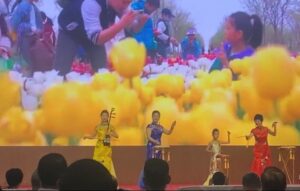 The next day was the Intangible Cultural Heritage Exhibition. Hundreds gathered from Taiwan, Shandong, and other Chinese provinces to appreciate and exchange their cultural practices. We watched traditional martial arts, acrobatics, singing, dancing, and drama! There were even traditional fine arts, crafts, and medicine for sale.
Sun Bin Boxing & BBQ
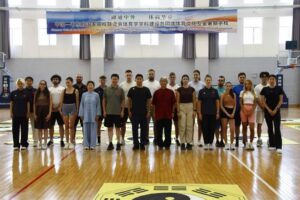
We embraced even more cultural heritage with Sun Bin Boxing training at the Qingyun Mountain Martial Arts Hall. This was the hardest martial art yet, requiring strength and control. The routine took hours to learn, comprising about 50 different movements, which all needed to flow with one another.
But it was all worth the effort, as we were rewarded with what I would call the best BBQ of my life. Pork skewers, Zander fish, mussels, shrimp, tofu, and crickets (to name a few) were served and displayed beautifully in front of our eyes, prepared on huge BBQs and stewing pots right outside our dining area - a Mongolian hut!
Next thing you know, I was drinking, laughing, and forced to make a toast every 5 minutes on a table full of the local Chinese people. In the morning, we painted traditional pottery, designed kites, and tried woodblock printing.
The Last Dance
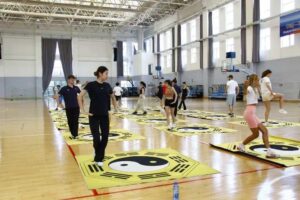 The last day of the summer school meant our last martial arts class. Bagua Palm - seemingly the easiest and simplest of the martial arts, but actually one of the hardest. The class involved several hours of circular stepping and holding precise arm and palm poses, demanding coordinated body movement, sustained mental focus, and flexibility.
Our master, Mr. Liu Baohe, was extremely passionate, ensuring to make our mistakes known to the whole class! He even selected me to ‘feel his qi.’ By this, he meant extending my arm at full force into his abdomen, while he contracted and rolled his stomach… It was a demonstration of the qi, or internal energy, that was flowing around his body, as well as the strength and control of his abdominal muscles. Never before had I felt someone’s qi, but it was safe to say the master had lots of it.
Bullet Train to Beijing
Unfortunately, it was time to say our goodbyes. I thoroughly enjoyed the summer school, learning from masters of traditional Chinese martial arts, exploring the wonders of Shandong, and eating and drinking with friends. However, I still had more to explore!
I took a bullet train to Beijing, China’s capital city. My hotel was perfectly positioned in the city centre, yet nestled within a narrow, traditional alleyway, called a hutong – where communities would once share water wells and socialise in the street.
That night, I walked along Qianmen Street. It bustled with people, street food, and shops, while retaining its traditional charm. My dinner? A huge yet humble spicy pork skewer.
Views to Remember and My Final Taste of China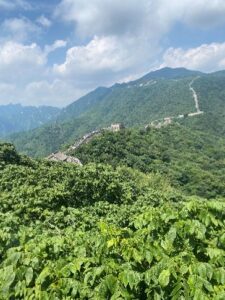
The next morning, The Great Wall of China awaited. After a long coach ride, walk, and cable car up, I was standing on China’s most famous landmark. The wall, built over two millennia to protect Chinese empires from invaders, stretched as far as the eye could see. The enormous, jagged mountains and intense, green valleys created an epic backdrop, and one that I will remember for the rest of my life.
I visited Jingshan Park in the evening, where the highest pavilion offered a fantastic view of the city lights. I then took the metro to Houhai, a lake lined with various bars and restaurants, offering live music, and some very friendly cats. After exploring the nearby hutongs, I made friends with a local, and we rode back together on bikes through Tiananmen Square.
Next up was the Temple of Heaven, a magnificent, ancient imperial complex, where emperors performed rituals and annual sacrifices to pray for good harvests. I explored the whole park and was amazed at the attention to detail of the many beautiful temples, pavilions, and gardens. It was a true staple of traditional Chinese architecture. I ended my trip to China with a delicious meal in Quanjude – a traditional Peking duck restaurant.
Conclusion & Acknowledgements
If this summer school taught me one thing, it was to “flirt with the world” — to interact with and embrace unfamiliar places, people, and experiences. One small decision, one ‘yes’, can change everything. I have made friends and contacts from Europe and China, and I am now much more open to the possibility of travelling, living, and working abroad. I have also become a more independent, confident, and open-minded person. If you’re considering a summer school abroad, or anything that pushes you outside your comfort zone, I’d encourage you to take the opportunity and see where it takes you.
A huge thank you to the Gold Scholarship Programme and the GSPO fund, as well as the Student Money Advice team and their Discretionary Internship Bursary, for making this trip possible. I am also grateful to Martin Gore and the Summer Abroad Bath team for advertising the summer school and answering my questions. Another huge thank you to Shandong University, namely Professor Wang Fei, for his support before, during, and after the summer school, and of course for organising such an incredible experience. And a big thank you to our martial arts teachers: Professor Wang Fei, Mr. Wang Guobin, Mr. Liu Haigang, Mr. Liu Baohe and his wife, and Mr. Zhang Jinwu, the legendary cameraman.
And a final, heartfelt thank you to the summer school students and volunteers, and to the people of China, for being so incredibly kind, helpful, and funny. You made my first experience travelling alone, and my first time in China, an incredibly welcoming and exciting one — filled with growth, laughter, and memories that I'll carry with me long into my life. Gānbēi!
And thank you for reading. I hope to have inspired you in some way. I apologise for the number of times I said “huge” and mentioned food!
Respond

