As AI tools become part of how people search for and find information, there’s growing pressure on content teams to 'optimise for AI'. One of the most common suggestions is to add more FAQ sections to pages, on the assumption that AI prefers questions and answers.
For higher education and public sector websites, this is where alarm bells should start ringing.
At the University of Bath, we’ve found something reassuring: our content already works well for AI search without staff needing to learn new techniques, bolt on FAQ blocks, or rewrite pages to sound conversational. That’s because structured content that is written in plain English has been central to how our website works for years.
Why we generally advise against FAQs
At Bath, we usually recommend that people not use FAQs - even when they’re presented openly and not hidden in accordions.
This isn’t because FAQs are always inaccessible by default. It’s because, in practice, they tend to create other problems that are harder to see but just as important.
FAQs often:
- duplicate information that already exists elsewhere on the page
- flatten hierarchy by giving definitions, rules and edge cases equal weight
- encourage important content to be written reactively rather than structured deliberately
- make pages longer and harder to scan, especially for people with cognitive or processing needs
From an accessibility perspective, this matters. Even without accordions, long FAQ lists can increase cognitive load and obscure what’s most important. For screen‑reader users and people scanning quickly, a clear page structure with meaningful headings is often easier to navigate than a list of loosely related questions.
More broadly, FAQs encourage patching rather than fixing. They’re often added because something isn’t clear, but instead of improving the page's structure, the uncertainty is pushed into a separate section.
That doesn’t mean FAQs are never appropriate. In rare cases, they can be useful for:
- genuine follow‑up questions
- operational detail
- edge cases that don’t belong in the main flow
But a simple test helps keep things honest:
If someone needs the FAQ section to understand the page's main point, don’t add FAQs; redesign the page.
In most cases, clearer headings, better structure and more explicit statements remove the need for questions altogether.
The quiet problem with FAQs
Let’s be honest: most FAQs aren’t actually frequently asked questions. On institutional websites, they often become dumping grounds - places to put definitions, rules, conditions, and caveats that should really be part of the main content.
Over time, this causes problems:
- important information is pushed to the bottom of the page
- hierarchy is lost, and policy starts to look optional
- content gets duplicated and reworded slightly
- pages become harder to maintain and easier to misinterpret
When your content covers policy, employment terms, funding rules, or staff and student responsibilities, that lack of clarity isn’t just frustrating, it’s risky.
Why it feels like AI is pushing us this way
AI systems do well with explicit, clearly labelled, and easy-to-extract content. FAQ blocks happen to make that job easier, which is why they feature so heavily in AI and SEO advice.
But that doesn’t mean AI needs content to be written as questions and answers.
What AI needs is:
- clear statements
- consistent structure
- defined scope
- predictable patterns
This isn’t a new idea, and it’s not something that people have to relearn just because AI is involved. Recent thinking about how AI search systems select and reuse web content shows that they work best with content that’s clear, well organised, and made up of straightforward statements that can stand on their own.
In practice, that's exactly the same sort of content people look for when they are reading formal guidance: information that’s easy to find, easy to understand, and clearly explains what applies in a given situation — without having to dig through a list of questions to piece it together.
This approach is reflected in guidance on writing content that AI systems can extract and reuse reliably.
FAQs are just one way of achieving clarity. They’re not the only way, and for institutional content, they’re often the weakest one.
Structured content answers questions without losing clarity
Good guidance pages already answer the questions people have - they just do it in context.
Clear headings, direct statements, and worked examples often do a better job than a detached FAQ section. For example, a sentence like: 'Paid time off is granted where medical appointments cannot reasonably be arranged outside normal working hours.' answers several frequent questions at once, without losing nuance or authority. AI tools can extract it. People can understand it. Nothing important is hidden or oversimplified.
Turning that same information into an FAQ rarely makes it clearer and often removes the conditions that matter.
How the University of Bath platform supports this by design
This is where Typecase, the University of Bath’s publishing platform, comes in.
From the outset, Typecase was built around structured content rather than free‑form pages. Content creators choose defined content types and complete specific fields: titles, summaries, headings, body content, contact information, related content, instead of starting from a blank page.
This wasn’t designed with AI in mind. It was designed to:
- help users find what they need
- keep information consistent across the site
- support accessibility
- make content easier to maintain and reuse
But those same decisions happen to line up perfectly with how AI systems interpret content.
Because:
- page titles and summaries clearly signal purpose
- headings are meaningful and consistent
- guidance and policy pages follow predictable patterns
- content types describe intent, not just layout
AI tools can already surface and summarise our content accurately without staff adding FAQs, rewriting pages as conversations, or following special optimisation tips.
If authors use the right template and write clearly, the structure does the work.
What this looks like in practice on bath.ac.uk
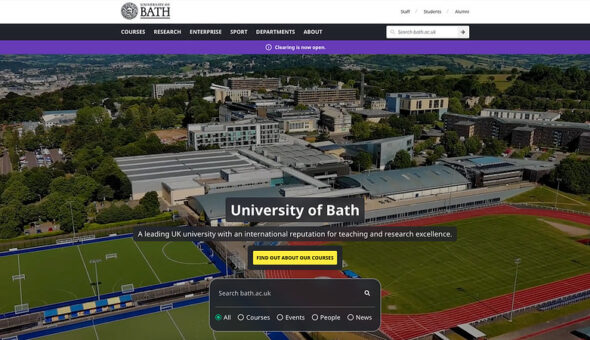
You can see this working across bath.ac.uk.
Our course pages follow a consistent structure that clearly separates entry requirements, course structure, fees and careers, making key facts easy for both applicants and AI tools to extract without distortion.
HR guidance pages, such as those on flexi- time and medical appointments, explicitly state rules and conditions, use numbered points and examples, and avoid hiding essential information behind FAQs.
And undergraduate recruitment landing pages, like Undergraduate Study 2027, use clear sections and links to authoritative detail rather than trying to answer everything in one place. In each case, the content works well for AI search not because it’s been optimised with special techniques, but because it’s structured around intent, hierarchy and clarity from the outset.
We didn’t design for AI - we designed for the future
One of the core principles behind Typecase was building for future use. When we started the Typecase publishing platform project back in August 2017, the aim was to create content that wouldn’t be tied to a single channel or technology.
AI-mediated search is simply one example of that future arriving.
Because our content is structured and explicit:
- it can be summarised without losing meaning
- it holds up when lifted out of context
- it’s less likely to be misunderstood or misquoted
- it still works for people first
That matters particularly in higher education and the public sector, where trust and accuracy are non‑negotiable.
The takeaway
AI doesn’t need us to turn institutional web pages into conversations. It doesn’t need extra blocks or quick wins at the bottom of the page.
It needs content that:
- says important things clearly
- keeps hierarchy intact
- still makes sense when parts of it are reused elsewhere
At the University of Bath, structured content has been helping us do exactly that for years. AI just happens to benefit from it, too.
Respond