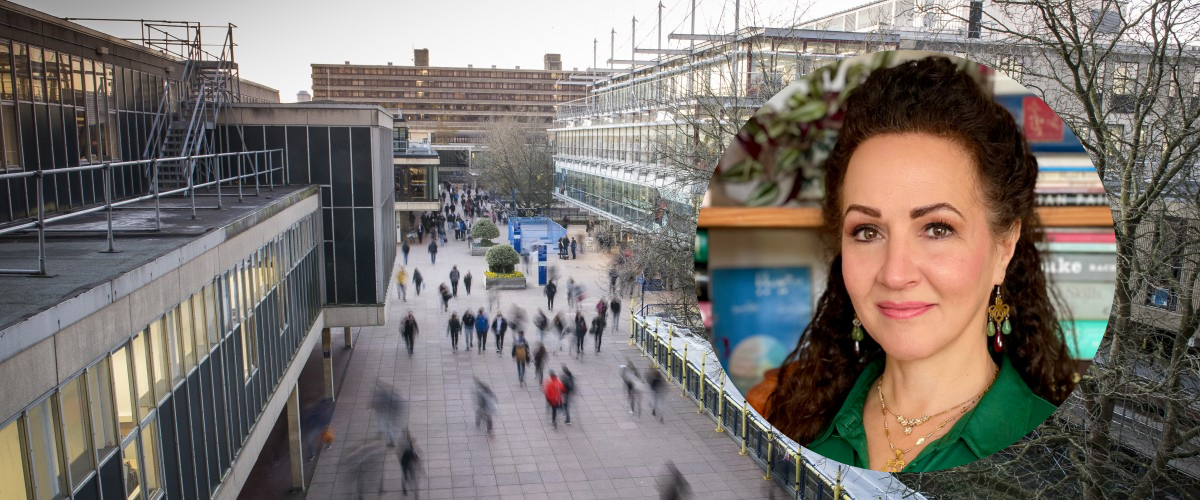
Simi's colourful life has seen her trade a career in commercial banking for a passion project that became her calling: Simi's Kitchen, where she teaches cookery and caters across Bath, specialising in Persian food
This year, that passion culminated in her first book, Fermented Dairy of Central Asia, the perfect way to blend her natural curiosity and pride for her Turkic Iranian heritage.
Why did you choose to study at Bath?
I had visited Bath as a child and it was such a lovely place, I always remembered how beautiful it was and wanted to return one day. It also happened to have one of the best business degrees, and because it was a thin sandwich course, I could gain work experience while I studied. From every angle it was a great choice for me.
Did you have a particular career in mind when you chose your course?
No, I chose something I thought I'd enjoy and that might lead to a job, but there wasn't a burning desire to do something specific in business. My family is very academic, so I felt a bit of a black sheep studying business at the time!
Can you tell us about your experience of studying here?
Campus was much smaller and greener than it is now. Most of my friends were fellow DBAs, as we were called then, and we would hang out in our campus accommodation, the sports centre, the Student Union bar, or the bar by the lake. I remember the fireworks on Bonfire Night by the lake especially – the reflections in the water were spectacular – and watching the new sports centre being built. I started doing yoga back then, and I still do yoga now, with the same teacher!
What made you want to return to the University for further study? Tell us about the experience.
After my undergraduate degree, I moved to Canada, volunteering with UNICEF and the Art Gallery of Ontario. I then came back to Bath to do a PhD. At that time, the School of Management was ranked as the best place for management research, and I also knew some of the lecturers. I was lucky enough to get an Engineering and Physical Sciences Research Council (EPSRC) grant and research exactly what I was interested in: applying the theory of evolution to the social world – in my case, through a study of micro firms.
A PhD suited someone like me who prefers to follow their own curiosity. I had far more freedom than as an undergraduate, and I could go down as many research rabbit holes as I liked. It also humbles you – you realise how much you still don't know, which makes you a more curious and less presumptuous person generally.
Describe your career journey since graduating. What is a typical day like in your current role?
After graduating, I landed my ideal job as a Customer Experience Manager in commercial banking, looking after small firms. I left that job after two years to go travelling on a late gap year. After that, I returned to Bath.
I then started Simi's Kitchen. I offer cookery classes and catering in and around Bath, growing, foraging, or buying from local producers – grocers and butchers in town – and turning their hard work into delicious meals. My classes suit all levels, and I teach food from all over, but I specialise in Persian food. In my classes I teach techniques people can use daily.
Through it, I have met many wonderful people around the world – foodies tend to be very kind and generous. I could not imagine the possibilities which have come my way since. For example, for several years I judged restaurants, and more recently I am a judge with the Great Taste Awards.
In the last three years, I have returned to my academic roots, researching, writing, and giving talks and demonstrations on the life and foodways of my Turkic Iranian heritage.
What do you enjoy most about your career?
All of it. I'm very curious, so I delight in researching something and then sharing what I've found. I come from a long line of teachers and academics, so being in a library, university, or teaching environment is in my DNA. What I am particularly thrilled about is being able to preserve our culture, history, language, and wisdom through food and stories.
Your book, Fermented Dairy of Central Asia, was released this year. Can you tell us about this?
It genuinely feels like kismet that I should have written this book. In it, I tell the story of fermented dairy as both cultural tradition and biological adaptation. Because I have a PhD in evolution, I start from when our ancestors came down from the trees and trace it all the way through to modern kitchens. I try to blend scholarship and firsthand narrative, and it draws on nutrition science, autoanthropology, and ancestral knowledge. An indigenous Turkic food researcher, I show how milk’s fermentation nourished societies and shaped the global diets and identities we all inherit today.
I was more nervous ahead of the launch than I had ever been about my PhD. This was my first book, and I had done everything myself. People I deeply respect in the food world were generous enough to read it early: Ken Hom asked to see it once it was done; and I wrote to Sandor Katz, the fermentation expert – he read half of it within a day and offered me a quote. He and Ken, along with the cheese writer Jenny Linford, all gave quotes that appear on the back of the book.
I had a wonderful launch at Toppings in Bath, which felt like a real honour, and I am still enjoying sharing my findings on podcasts and at events around the world. Recently I was in Iran, and my book was accepted into the Tabriz Central Library, which my father and his friends founded. It was a lovely, full-circle moment for me.
If you could go back in time to when you were a Bath student, how would you spend 24 hours?
Let’s say it’s a Saturday. After coffee at home, I would walk from Bathwick Hill into town, through Great Pulteney Street onto the Saturday Farmers' Market, then meet friends in town for lunch. On weekdays, after lectures and study, I would attend one of the many creative classes. Each year I tried something different, such as poetry, glass work, and painting when I was a student.
What advice would you give to others hoping to build a career around something they love?
I found my ikigai (a reason for being), as my Japanese friends call it, quite late – until a few years ago, I had no idea what it was. Some people know from childhood that they want to be an artist or an astronaut; I didn't have that. But I loved what I was doing, and I think that shows – you can't fake genuine enthusiasm. I am curious by nature, and I love sharing my findings.
My advice would be to “trust the process”, as they say. Things tend to fall into place when they are ready, not necessarily when you want them to. I don't think I would have got very far reaching out to people like Sandor Katz seven years ago – but with this book, at this time, I did. If you can find the thing you love doing, do it as well as you can, share it, and enjoy the journey.
Respond