
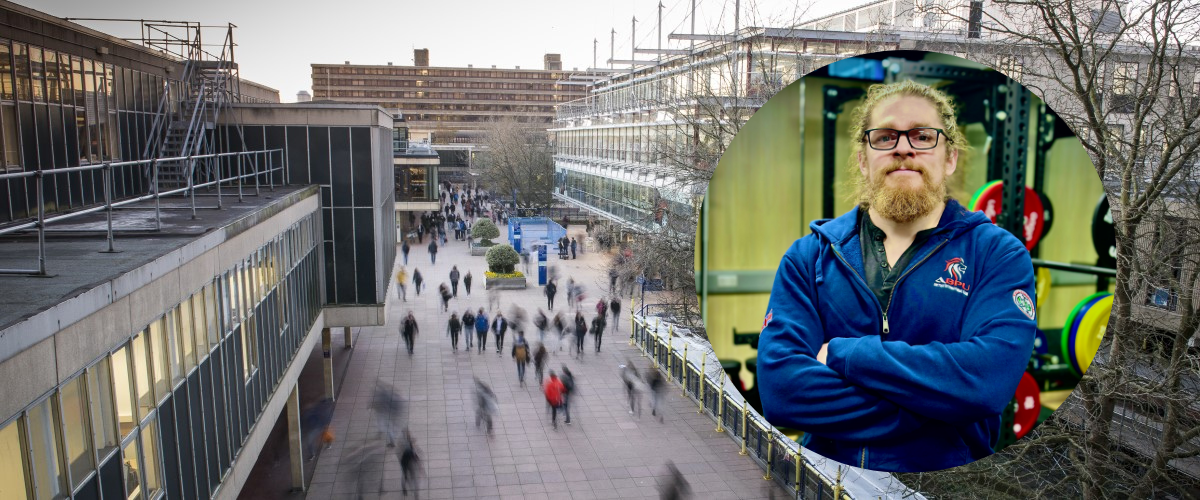
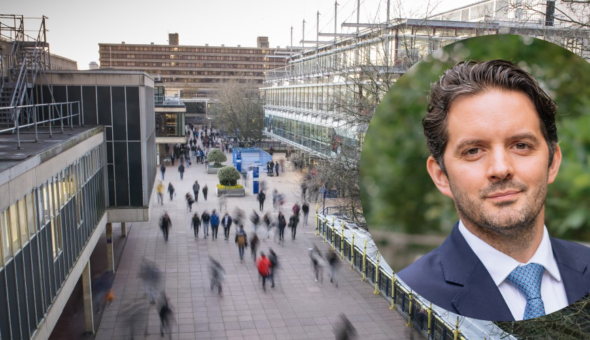
By day, maths grad Steven has a successful finance career. By night, he’s a powerlifting superstar – and his love of the sport began right here in Bath.
Steven started competing in 2022. By 2025, he had gained British, European and World Championship titles. His journey to victory hasn’t been without setbacks. In 2016, Steven suffered a catastrophic knee injury and returned to lifting simply to regain the strength to walk.
The analytical mindset he developed during his degree helped him stay focused – ultimately powering him to the heights he has reached today.
What first drew you to Bath, and what were you hoping to get out of your university experience?
I was drawn to the strength of the Mathematical Sciences course and the quality of the Sports Training Village (STV), which was quite new at the time.
I wanted a university experience that was academically challenging but also supported a high level of physical activity – and to find a sport to focus that discipline on.
Did you have a clear career direction in mind when you started your degree?
I didn't have a specific career path beyond knowing I wanted to apply the logical thinking and problem-solving skills learned on my course. 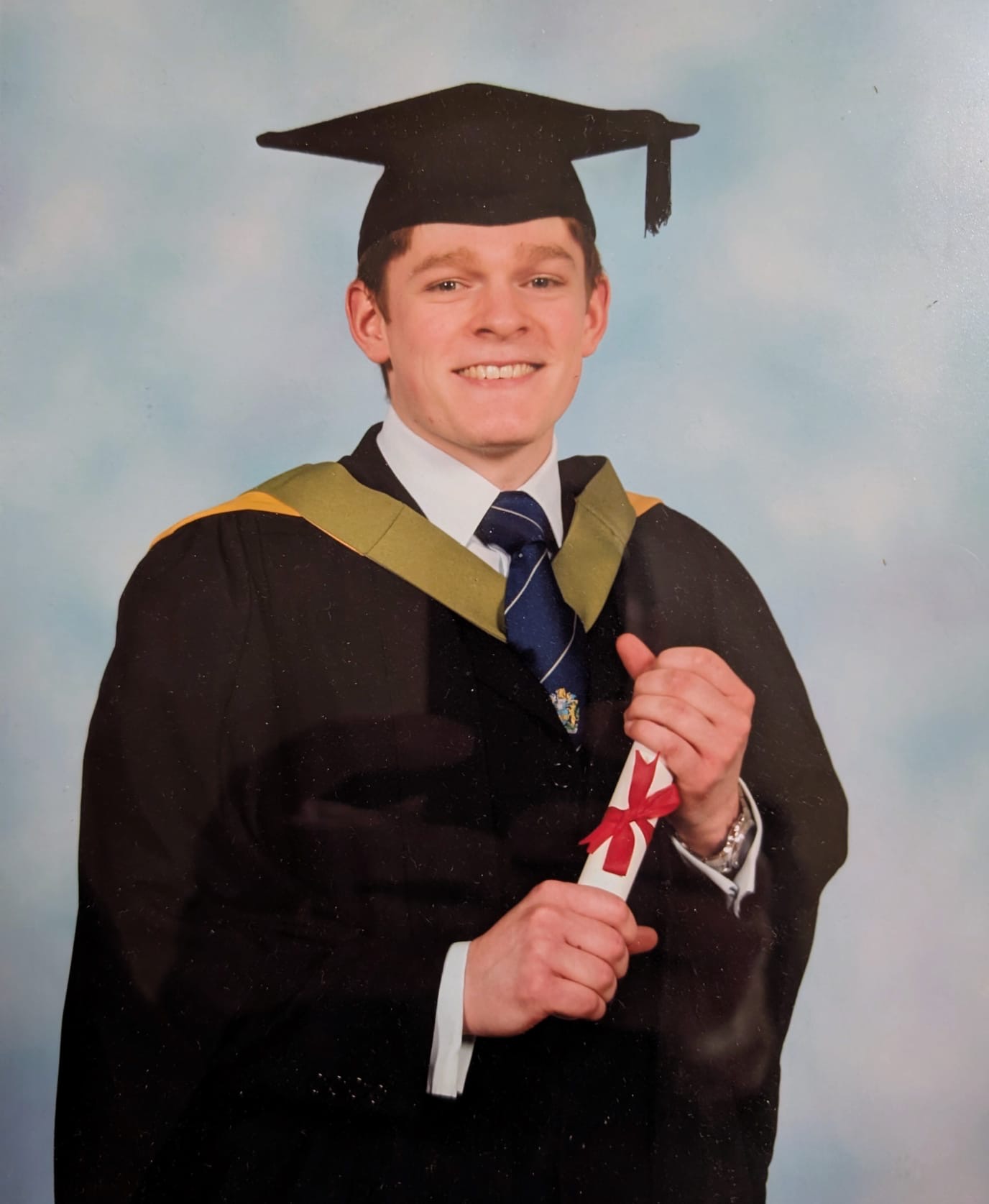
My career in finance took shape as a direct application of that discipline. One of the other attractions of my course was the sandwich placement year at Dunkley’s, which is where I first experienced life as a trainee accountant, and indeed where I joined as a graduate in 2010.
When you look back, which memories or places on campus stand out most vividly for you?
The atmosphere of the STV is what stands out most. It was such a motivating environment, seeing athletes from different sports training every day. It was great to train alongside elite level athletes – including Olympians and professional rugby players.
I also vividly remember the long hours spent in the lecture theatre down by the lake, and playing pool next door during breaks. I’ll always have a soft spot for Mendip 1!
You began powerlifting while at Bath. How did you first get involved, and what do you remember about those early sessions in the STV?
I started lifting weights in the newly opened STV because the facilities were world-class. Initially, it was just general strength training, but the environment naturally made me want to push for concrete numbers.
I remember the excitement of the early sessions. Although back then my aim was to condition myself for other sports hobbies, powerlifting fostered a competitive spirit that was perfect for channelling the dedication I was, until then, only applying to my degree.
Were you part of any clubs, teams, or student communities during your degree, and what impact did they have on you?
The conditioning from strength training in the STV built the foundation for pursuing football and boxing during the early parts of my uni life. The community of high-level athletes and analytical intelligence amongst my classmates fostered a culture of perfectionism and resilience that was infectious.
How has your career unfolded since graduating, and what does a typical day look like in your current role?
My career began in public accountancy while completing my ICAEW chartership at a Bristol firm called Dunkley’s. There, I prepared accounts and tax computations for external clients and carried out statutory audits, which gave me a strong technical grounding alongside the rigour of the chartership exams.
I then moved into financial services, working with organisations like St. James’s Place plc and Columbia Threadneedle Investments, where I led and contributed to large-scale global projects and applied the advanced analytical skills I developed at Bath.
More recently, I have worked in financial consultancy with Wincanton, focusing on financial planning and analysis, running seminars on reporting controls and accounting standards transitions, and project managing external audits.
In the past decade, a typical day has involved data analysis, strategic problem-solving and management of risk and controls within complex organisations.
What do you enjoy most about your work, and has balancing a full-time job with elite-level training changed how you approach your career?
I most enjoy the intellectual challenge and seeing a long-term strategic plan come to fruition. Balancing a full-time job with elite-level training absolutely changed my approach to my career. It forced me to be ruthlessly efficient with my time and prioritise tasks, minimising wasted effort, a skill that is invaluable in the finance world, and paid dividends in productivity throughout many of my roles to date.
In what ways did your time at Bath shape you?
Being immersed in the competitive environment of the STV and the boxing club and being a multiple Bath Half Marathon finisher instilled a belief that sustained dedication, regardless of external obstacles, leads to mastery. Consistency really is the key to improvement and success.
You've achieved great things in your sport. Which moments or titles meant the most to you, and why?
The most meaningful achievement was completing the powerlifting "Triple Crown" in 2025: winning the British, European and World Championship titles in a single season. 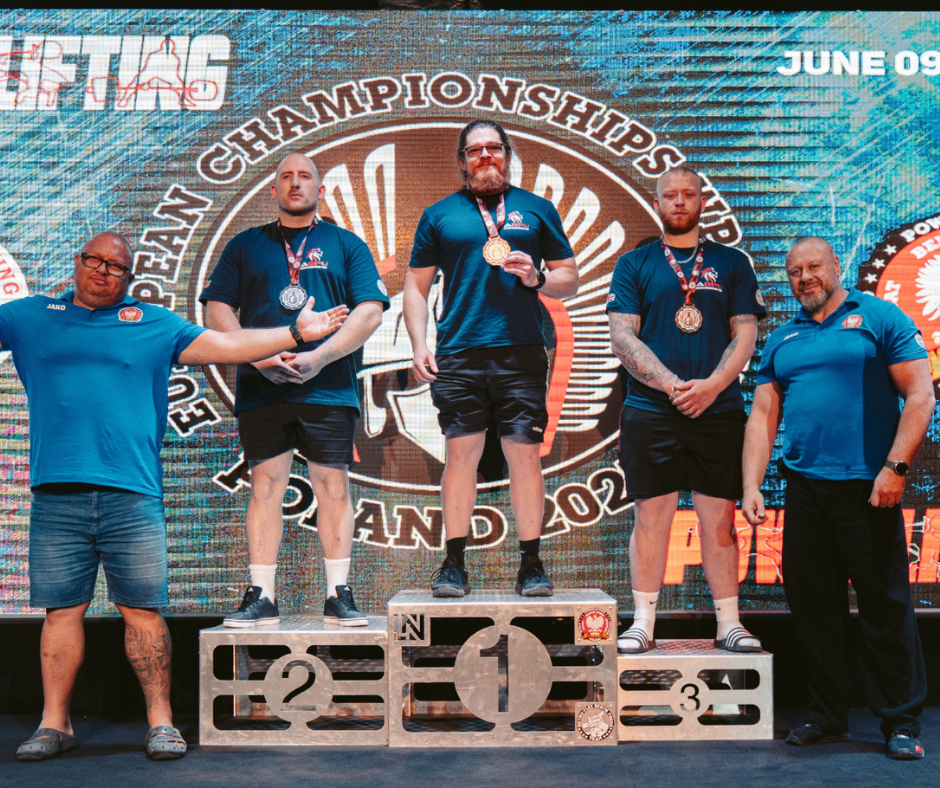
The World Title validated the nine years of methodical commitment it took to rebuild my body and my competitive mindset after a catastrophic knee injury.
What helped you stay focused through recovery, and what did you learn from that period?
Following a bad tackle in a football match I underwent a full knee reconstruction. My meniscus and MCL were stitched back together, and a new ACL was built from part of my hamstring, secured with screws in my tibia and femur.
Rehabilitation was long and painful, and I owe a great deal to my partner, Natasha, who supported me both physically and mentally throughout. I drew heavily on the analytical discipline from my degree, reframing recovery from something to endure into a long-term strategic plan. I learned that resilience isn’t a single defining moment, but the quiet commitment to turning up every day for years.
I returned to the gym simply to rebuild enough muscle to walk again, then to relearn how to walk symmetrically without pain or limping. Along the way, my strength gains surpassed my pre-injury levels, instead of plateauing like they had before. What began as rehabilitation gradually became something I genuinely enjoyed.
You recently returned to campus to compete. How did it feel to step back into the STV?
Returning to the STV for the competition was incredibly nostalgic; I could feel myself being transported back to where the initial spark was lit.
What advice would you give students who are trying to balance academic goals with emerging passions of their own?
My advice to students is that discipline is transferable. Use the methodical approach you apply to your academic studies, be it mathematical analysis or essay writing, and apply that same focus to your passion. That discipline, not motivation, is what builds success in academia, in professional endeavours and in the gym.
Responses
Thankyou for the reminder not to give up from a fellow Bath person recovering now