
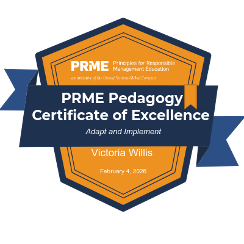
Last month I was awarded the PRME Pedagogy Certificates of Practice and Excellence, international certifications linked to the UN-supported Principles for Responsible Management Education (PRME). I was delighted to receive the certificate – who doesn’t enjoy a micro-credential to post on LinkedIn? – but the process itself was perhaps even more valuable than the outcome.
At the University of Bath we increasingly talk about preparing students to navigate complex global challenges. The PRME pedagogy certification offered an opportunity to reflect on how this ambition translates into everyday teaching practice.
For colleagues who may not have come across it before, PRME (www.unprme.org) is a global initiative encouraging business schools to prepare students to address complex social, environmental and economic challenges through responsible management leadership. The pedagogy certification focuses specifically on teaching practice and asks a simple but important question: how do we design learning that helps students navigate real-world complexity?
Moving beyond technical finance problems
As someone who teaches finance, this raised an interesting challenge.
Finance education is often seen as highly technical. We teach students how to value assets, manage risk, analyse markets and make investment decisions. These tools are essential. But the financial decisions made by firms, governments and investors also have profound implications for society and the environment.
The certification encouraged me to think about how those wider implications might be more explicitly visible in the classroom.
In practice, this meant framing finance problems slightly differently. For example, students might analyse exchange rate risk or investment decisions while also reflecting on power structures and long-term incentives created by financial markets.
The goal is not to prescribe particular viewpoints, but to help students recognise that financial decisions exist within broader systems. Technical knowledge remains essential, but it becomes part of a larger conversation about responsibility, uncertainty and trade-offs.
A reflective process
The certification process itself is quite reflective. Participants explore a range of pedagogical approaches linked to responsible management education, including systems thinking, experiential learning and interdisciplinary teaching. Much of the work involves examining your own teaching practice and considering about how small changes might help students engage more deeply with complex issues. As part of the certification, participants also submit detailed evidence of their teaching, assessment design and student learning.
One aspect I particularly enjoyed was the international community of educators involved in the programme. Participants came from a wide range of countries and disciplines, but many were grappling with similar questions about how to prepare students for an uncertain and rapidly changing world.
Looking ahead
Completing the PRME certification has encouraged me to keep experimenting with ways of integrating systems thinking and real-world complexity into finance teaching. It has also connected me with a global network of educators exploring similar questions.
For colleagues who are interested in sustainability, responsible leadership or interdisciplinary teaching, PRME provides a useful framework for thinking about how these ideas might fit within existing subjects.
Often the changes are quite small: reframing a case study, posing a slightly different question, or designing an activity that encourages students to think about the wider consequences of a decision. Those small shifts can open up surprisingly rich discussions.
Ultimately, initiatives like PRME are less about adding new topics to the curriculum and more about changing how we frame the subjects we already teach. If our students are going to navigate complex global systems in their future careers, helping them see those connections during their studies is a good place to start.
If you are curious about PRME or responsible management education more broadly, I would be very happy to chat about the programme or share resources.
Blog Post By: Victoria Willis, Senior Lecturer of Finance and Subject Group Lead for Finance in the School of Management. Victoria is particularly interested in how finance education can equip students with the skills, critical thinking, and global awareness needed to navigate complex financial systems and contribute to a more sustainable future.