
Hi, my name is James and I joined the University of Bath about 5 months ago. Before that I was at Bristol for ten years where I was a teaching focussed member of staff, and was the equivalent of Director of Studies and Associate Dean, Education. Before that I used to design buildings, including some at Bath Uni, as well as Oxford Brookes and the Tate Modern extension.
During my time at Bristol one of the things I used to really enjoy was blogging about my teaching practice. So now I have joined Bath I wanted to keep up the practice. I love blogs about teaching practice. I love reading about what other people are up to, getting ideas, feeling excited about what is possible in Higher Education. So I would love for you to join me in not just reading the posts, but writing some too.
But for now I am happy to share what I am up to on my unit on Regenerative Design. Regenerative design is a fairly new subject to be teaching and one of the things I really enjoy about it is that much of the learning comes from doing and being, not just knowing. As a result the unit is designed to engage and help students to be regenerative practitioners.
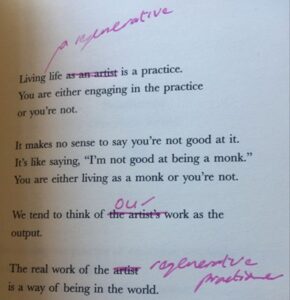
Adapted from The Creative Act by Rick Rubin[1]
But before we get carried away you might well be thinking what is regenerative design? Well Mang and Reed (from the Regenesis group) describe ‘regenerative design’ as: “A system of technologies and strategies, based on an understanding of the inner working of ecosystems that generates designs that regenerate socio-ecological wholes (i.e., generate anew their inherent capacity for vitality, viability and evolution) rather than deplete their underlying life support systems and resources.[2]”
And the RESTORE group define it as:
“Enabling social and ecological systems to maintain a healthy state and evolve[3]”
-----------------------
[1] Rick Rubin, The Creative Act, Canongate Books, 2023
[2] Mang P and Reed B. Regenerative Development and Design. [In: Meyers, R.A. (ed) Encyclopedia of Sustainability Science and Technology]. New York NY: Springer, 2012. Available at: https://doi.org/10.1007/978-1-4419-0851-3_303
[3] RESTORE. Sustainability: Restorative to Regenerative. Available at: https://fairsnape.files.wordpress.com/2021/02/sustainability-restorative-to-regenerative.pdf
----------------------
So that’s all cleared up then. Or is it? If you are anything like me then these words are quite confusing. As an engineer I want to know what this all looks like for me in practice.
As engineers we have spent the last 20 years trying to do less harm in the buildings we design, the roads we specify, the water treatment plants that we maintain. Reaching for the ultimate goal of doing no harm, and mostly we have been focussed on one metric, carbon (or CO2e to be precise). But what if we could go beyond do no harm and what if we could not just consider the climate emergency but all sorts of challenges the world faces. What if we could design buildings that reduce atmospheric CO2, whilst increasing biodiversity, increasing access to education, managing water to reduce flooding whilst increasing access to clean water. What if the act of building didn’t just benefit the owner of the building, or the community around the building, but benefitted people from across the world, where the materials come from, along the supply chain. What if we moved from doing less harm to doing good?
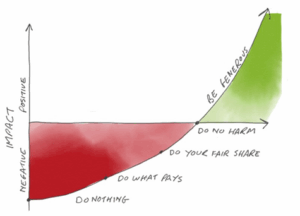
Now for each discipline we might have a different set of what if questions, but hopefully you can see how a regenerative design approach could be transformative. However, some of you will be thinking this is all very well and good, but it is impossible. And you are right, no building built today achieves what I have just described, so then the question becomes how do we make the transition to enable this to happen in the future? And that is what the unit will be all about.
Over the next 5 blogs I would love to unpack with you the approach I have taken to teaching regenerative design to see if there are some helpful approaches you can also explore, maybe it will seed an idea, or maybe you can offer me some ideas, I would love to hear from you. For now, I would love to let you dwell on the idea of regenerative design and encourage you to find out more, so, as part of this blog series I would like to share with you some teaching resources for further exploration, lifted from my Moodle page. Please note these are aimed at engineering students, but as you will see over the course of the next few weeks there is hopefully something for everyone.
Regenerative Practice – Podcasts
Every week I expect you to do a significant amount (up to 7 hours) of individual study, reflection, and practice. As we go through the unit we will add more layers to this, but to get the ball rolling I would like to suggest you try and listen to a podcast a day (although do feel free to take some time off – I try to not work weekends for example). Try and fit it in with other parts of your life, for example getting to/from Uni, going to the gym or for a run or walk, or sitting in a coffee shop drawing people. The only thing I would suggest is that you make a note of what you listened to, and any major learning points or revelations.
There are lots of podcasts out there. Below is a list of some I like, with an episode highlighted from each. There are 7 so one for each day of the week I would recommend doing your own exploration as well:
Flourish with Sarah Ichioka and Michael Pawlyn - Try this episode with Brian Eno
https://www.flourish-book.com/flourishsystemschange-podcast
https://www.flourish-book.com/flourishsystemschange-podcast/imagining-futures-with-brian-eno
From What If to What Next with Rob Hopkins - Try the episode about bioregions (episode 93)
https://www.robhopkins.net/podcast/
Outrage and Optimism with Christiana Figueres Tom Rivett-Carnac and Paul Dickinson - Try this episode on after the COP
https://www.outrageandoptimism.org/
Thrive in Construction with Darren Evans - Try this episode on Straw and Circularity
https://darren-evans.co.uk/thrive-in-construction-podcast/
https://darren-evans.co.uk/podcast/ep-93-straw-circularity-and-the-one-question-nobodys-asking/
Building Sustainability with Jeffrey Hart - Try this episode with Jenny Ford talking about Factory X (a circularity hub)
https://www.buildingsustainabilitypodcast.com/
https://www.buildingsustainabilitypodcast.com/factoryx-jenny-ford-bs108/
The Future of Timber by Evolving Forests - Try this episode with James Solly and Kelly Harrison (sorry, they don’t have their own website, as a result I have linked to the podcast on Spotify but other platforms are available)
https://open.spotify.com/show/52ZZmb0xJpIWiskx9UzvHd?si=d8e27f03aa254f6f&nd=1&dlsi=24f7a730ae5241a9
https://open.spotify.com/episode/1FmG2hvUhK9nJSLHWQftjk
Flash Forward with Rose Eveleth - Try this episode on what happens if we ban cement
https://www.flashforwardpod.com/
https://www.flashforwardpod.com/2019/03/26/earth-the-cement-ban/
You may also like The Future Build Podcast, The New Civil Engineer podcast and The Regenerative Design Podcast.
https://www.futurebuild.co.uk/the-futurebuild-podcast/
https://open.spotify.com/show/3uvjzgWPcNEUW6c50d6Ql9
Blog Post by: James Norman, Department of Architecture and Civil Engineering, keep an eye out for the next blog in his series of blogs this Semester