
8 weeks after my unit on Regenerative Design started, and it is complete. Last Friday the students sat the exam. Later today and tomorrow I intend to start marking the exam scripts, but before I mark, I wanted to have a moment of reflection. To pick out some things that I have learned, that surprised me, that delighted me!
Sharing has improved my practice
My first reflection is that by publicly sharing my work, I have found myself checking it for best practice. This wasn’t a conscious decision. I didn’t set out to do this, but it is a useful reflection.
For example, I have for years used lots of images in my lectures. Whilst these make the lectures enjoyable and visually rich, they also make the lectures less accessible to students who don’t find it so easy to listen to spoken lectures without the words being reinforced by the slides. In this unit many of the slides referred to theories, which were referenced, or case studies. When I pulled the case studies together, it didn’t occur to me to link them to the written text in the book (which students can access for free) but as I wrote the blog on lectures I realised that this would provide some additional reinforcement for students – all I had to do was add the case study number from the book, so I did.
Similarly for the future walk. The original future walk only offered one route, which, whilst an enjoyable and interesting walk “off the beaten track” was not very accessible. This realisation, as I shared the future walk with all of you, led me to create an alternative option. This then led me to suggest other alternative walks – again something I didn’t think about when I first created the unit content and suggested students go for a walk.
This has been a helpful realisation that by asking “how can the content be more accessible” I have added some small tweaks that hopefully achieve exactly that.
Library trip
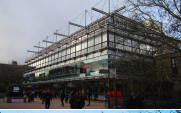
In the third week of the unit we went on an unusual field trip – to the library! The students gathered for a lecture, as normal, where I gave a short presentation on reading, and then we packed our bags, walked about 100m, and met subject librarian David Stacey, who showed us round. Then students were invited to look around the library, find a book from the reading list (which was almost certainly on a different floor to engineering) and take it out, ready for reading.
Before the trip I was nervous. How would the students respond? Would they even come? Would they perceive it as a waste of time?
The response was better than I imagined, there was a joyful atmosphere as we pottered over to the library, it felt very much like a school trip. Students followed David round as he talked to them about the collection and how it was organised. As the talk finished and they dispersed, they kept popping back to see me to show me the books they had decided to take out. Some explained this was their first time in the library. Others wondered why they hadn’t done this earlier. Far from being a flop, the library trip seemed to be a great success. Weeks later books were still being passed around that students had taken out.
But something else also happened on that trip. Several students, at different moments and in different ways, expressed to me that they found reading hard. I hadn’t anticipated this. Working with David we provided some extra information on alternative ways to access books (some books are available as audiobooks, for those that are not, depending on the platform they are available on, some electronic books also have a text to audio function). I also realised that many of the books on my reading list were not heavy on words, they, like my lectures, were very visual. But students wouldn’t know this until they open the books up, so for next year I intend to provide an accessibility statement with the reading list so students can find books that they can enjoy reading.
Spirituality
Engineering and spirituality rarely go together. I don’t think I have found a single podcast or book on the topic. And yet, in regenerative design, spirituality is everywhere. One of the most surprising things reading the mock exam scripts that I marked was the number of students who talked about spiritual practice. I didn’t count but it was more than 0, which is what I might expect. I believe this was enabled by three things, firstly right at the start of the unit I introduce myself, and without going into any details I mention my own faith (I am a Christian). Secondly, I highlight the work of Marwa Al-Sabouni, a Syrian architect and author who links her own Muslim faith to the built environment. Thirdly, when reflecting on regenerative practice, I include a place for spiritual practice. Whilst linking engineering and spiritual practice is unusual, the ability for students with faith to link their faith to the work that they do is profound.
Future Walk
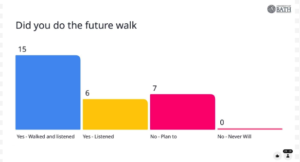
Finally I had my own faith challenged. Or lack of faith I should say. Not in a spiritual sense but in our students. I created the future walk to fill a 2 hour session when I was away accrediting a degree in another part of the country. If I am being honest I wasn’t expecting the engagement levels to be that high, in fact I wasn’t sure if anyone would do it. The week after the walk I decided to find out, just to see. I created a simple Menti with one question:
“Did you do the future walk?”
I was delighted by the results, of the 28 students in attendance (I put the slide up before the start of the lecture, so the students replying were present and at the more punctual end than the number who took the unit (52)) 15 said they had done the walk, another 6 had listened to it but not followed the route, and 7 said they intended to. The question was anonymous so they could write what they wanted (including some “joke” comments in previous weeks) but no student said they had no intention of listening. I had been entirely wrong, far from not engaging all the students had, or intended to, engage and the majority had done the whole walk. Even if the other 24 students who didn’t fill it in had no interest at all, this far exceeded my expectations. So going forward I will have more faith in students, who have positively surprised me in their engagement in this unit throughout!
Closing remarks
Teaching the regenerative design unit has been a real highlight of my year. In a time when social media suggests many people appear to have given up (although no-one I am actually working with has) and the news seems unremittingly grim, it has been a joy to work with students who have shown a genuine desire to learn and develop themselves beyond the exam (although doing well in the exam is obviously important). As I have reflected on the unit the response of the students to my less than standard deliveries methods have been very encouraging, making me think next year how can I go further and develop the unit (whilst still finishing with an exam as the assessment). Thank you for following along with me on this adventure, I hope it has been of use (and joy). I am always up for discussing different ways we can embed regenerative design into programmes so if you are interested, please drop me a line. Until then I hope you continue to explore the activities listed in each week's blog post under regenerative practice.
Blog Post and Series by: James Norman, Department of Architecture and Civil Engineering.
If you missed James other blogs find them here