
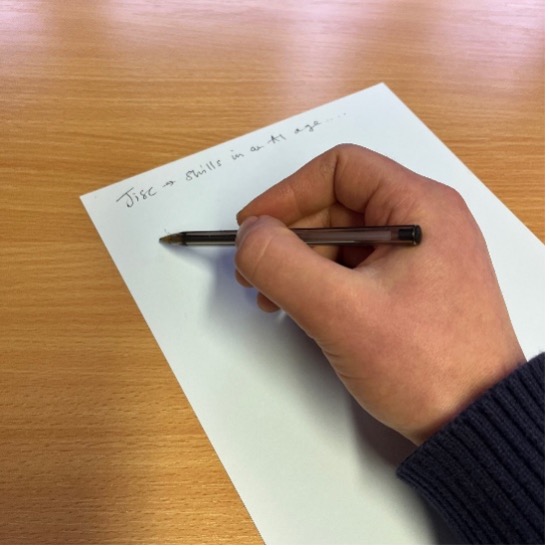
Given we had just entered the central London offices of JISC for a roundtable on AI skills development, it was somewhat surprising to be told to leave all digital devices at the door. The session was to be resolutely analogue: pens, paper, and lots of discussion. Attendees, drawn from diverse HE and FE backgrounds, broadly advocated embracing AI. At the same time, ‘human-centred’ and ‘critical’ approaches were routinely invoked. I’ll provide brief highlights and reflection here, but readers wanting a fuller picture of the discussion should look out for JISC’s own forthcoming summaries.
AI within digital literacies
JISC AI co-lead Sue Attewell began with a call for AI to be embedded within a broader approach to digital literacies. For all the current talk of AI literacy and skills, digital skills have been on the agenda for a long time, with one participant commenting that they are still sometimes seen as auxiliary—or ‘other’—rather than integral, and that this will need to change if we are to establish meaningful frameworks for AI skills development.
Human-centred learning and hybrid work
There was much discussion of human-centred approaches to AI in education, resonating with the CLT’s recent collaborative partnership with Stellenbosch University on Making Human Learning Visible in an Age of Invisible AI. Whilst this feels instinctively right, challenges to this mindset may arise as human-machine interactions generate increasingly hybrid forms of work, knowledge and skills.
There were also calls to support learners’ adaptability and resilience against a backdrop of rapid technological change, challenges to conventional educational approaches, and an uncertain employability horizon. Attendees agreed that staff and students should have a basic understanding of how mainstream GenAI tools work—for example, how LLM training might shape output bias. This was seen as essential for the critical evaluation of GenAI outputs.
The death of disciplinary knowledge?
Some made the provocative claim that the era of GenAI heralds a shift from knowledge to skills. On this view, hard-earned subject expertise will become less important as GenAI tools provide specialist information at the click of a button. Yet who can ‘critically evaluate’ AI outputs, if not subject specialists? Who judges the value of training data? Who detects bias in outputs, or determines safe and ethical applications for these tools? Claims of the redundancy of expertise appear misguided. As a recent article on AI and HE co-authored by the School of Management’s Dirk Lindebaum argues, institutions, teachers, and students should attend more than ever to the status of knowledge and to ‘epistemic agency’ in a world in which GenAI is disrupting higher education.
To nods of recognition, one participant highlighted a misconception that young people are always tech savvy and possess an intuitive understanding of effective GenAI use. It was also argued that staff and students who explore GenAI tools in their personal lives are more likely to use them in academic and professional practice. Experimentation and play were seen as important, suggesting that we carry these principles over into classroom practice.
Teaching and assessment: principles, guidance, and realism
When it came to how teaching and assessment should adapt, the initial emphasis was values-orientated: transparency, ethics, equity and accountability should sit at the heart of educational practice, with institutions and staff modelling the kinds of engagement they would like to see from their students.
It was recognised that there is a strong desire for clear institutional guidance, especially around contested issues such as academic integrity, authorship and originality. Someone pointed out, however, that being overly prescriptive about what staff and students should be doing with GenAI may miss something fundamental about the lived experience of using AI: the ways in which boundaries between human and machine production can be blurred, and the difficulty of demarcating your own contribution from that of the tool—even where you possess high-level academic training in referencing and related skills.
Ideas about curriculum and assessment design varied greatly in scope, from affirmations of existing approaches to more radical visions of assessment overhaul. Everyone acknowledged that overstretched staff and students must be supported to adapt. Disciplinary specifics were also seen as crucial, with a one-size-fits-all approach unlikely to work, not least because employability and skills horizons differ across fields.
When the conversation turned to gaps, risks, and contentious issues requiring national coordination or policy responses, attendees highlighted cyber security, data protection, and over-hasty ed tech partnerships. At the same time, there was a sense that risk aversion could stifle innovation.
A return to first principles?
My takeaway reflection was this: how ‘new’ are the skills and knowledge sets required of students in relation to AI? Might it be that long-valued academic skills—critical thinking, for example—have simply taken on a new urgency in the face of GenAI? The requirements of the roundtable itself—no devices, free-flowing discussion, manual notetaking, mental synthesis—foregrounded how the ‘basics’ of educational practice remain important even as we navigate transformational technologies.
Richard Mason is Curriculum and Academic Developer in the Centre for Learning and Teaching. In AY25/26 he is co-organising bespoke department workshops on GenAI, teaching and assessment as part of the CLT’s wider programme of support. Please be in touch at rfm30@bath.ac.uk if you would like to explore a workshop in your discipline.