
Blog Post By: Mr James Fern, Department for Health (Generative AI Oversight Group Co-chair)
Academics from across the University spent two days at the American Museum designing curricular and assessment for a world in which students can, and will, use GenAI.
It began with a walk.
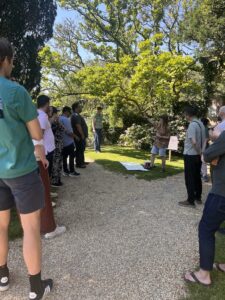 On a warm morning in July, a group of 14 academics from across the University stood in the gardens of the American Museum with their eyes closed, naming only what they could hear and smell. Claire Loder of Bath Spa University led them through the gardens of the American Museum for an hour of noticing: how a planting scheme sets conditions rather than dictating outcomes, how a wood is held together by relationships that are invisible, and what the more than human world can teach us about an ecology of technology.
Nobody mentioned artificial intelligence. They had arrived having read two short pieces. Robin Wall Kimmerer, in Braiding Sweetgrass, treats attention as a discipline that has to be trained rather than a faculty we simply possess. James Bridle, in Ways of Being, argues that intelligence was never the solitary human property we take it for, but something distributed across bodies, species and systems. Neither is a text about assessment, and neither offers a verdict on AI. Together they quietly rearrange the ground on which the argument is usually had.
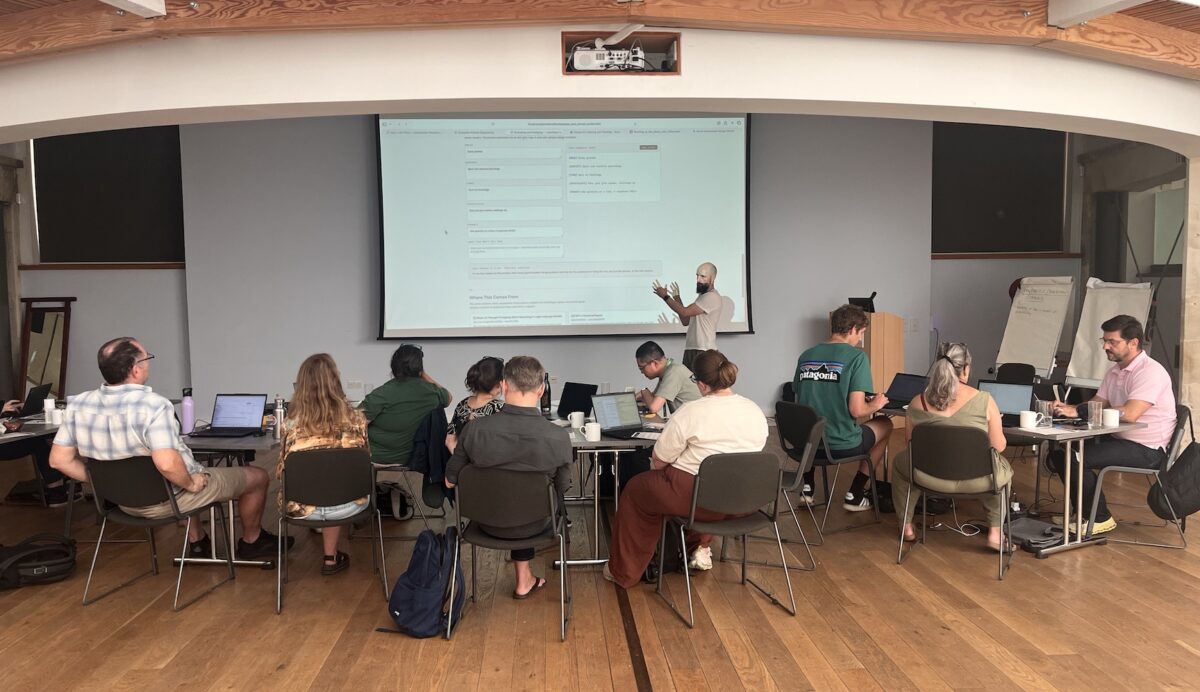
That was the point. "Learning in the Open Lane", a two-day design studio run by the Centre for Learning and Teaching on 8th and 9th July, was built on the conviction that the AI conversation in higher education has got stuck — trapped in a loop of detection, suspicion and enforcement that serves neither staff nor students. The walk was a way of practising, outdoors and at low stakes, the moves the two days would then ask of people indoors: attend to process rather than product; notice that thinking is distributed rather than sealed inside a single head; and choose between a posture of control and a posture of relationship.
The studio takes its name from the University's two-lane assessment framework. The closed lane covers assessment conditions where AI genuinely cannot be used — invigilated exams, vivas, in-person performance. The open lane is everything else. Crucially, two-lane is primarily descriptive, rather than prescriptive: it names the empirical reality that students have access to these tools and that prohibition is often unenforceable and unethical. It does not tell anyone they must use them. What it does do is situate the assessment design question where it belongs — in the hands of the person setting the task – and ensures the necessary support and guidance is available.
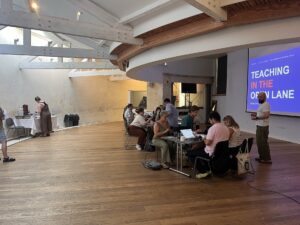
Over two intensive days, participants worked on a real unit or assessment they will teach in 2026/27. They explored windows onto process and took tool interaction seriously as a pedagogical act rather than a technical trick. They explored co-discovery: what happens when staff and students work out the parameters of AI use together, instead of each guessing anxiously at the other's expectations. And they made the case for informed non-use — how a colleague or a student might decline to use these tools for principled educational reasons, and be able to defend that choice without recourse to policing anyone else. They also spent time with the museum's current exhibition on automata: eighteenth-century machines built to imitate life, watched by a room of people discussing twenty-first century ones.
Many participants are committed to piloting their redesigned assessments next year and sharing what happens. The Centre for Learning and Teaching will share examples of the redesigned assessments across the institution during 2026/27.