
Welcome back to the blog on my new Regenerative Design unit. Last week we were talking about the unit design, and how it covered a wide variety of different activities, some led in workshops, and others self-supporting, but all designed to help students not just learn about regenerative design, but to enable them to be regenerative practitioners.
I also confessed that I have taught this before, in fact, in many ways I have been teaching this for over a decade now one way or another. But, and this is a big but, I have always assessed the unit through coursework. Maybe a design project. Maybe a personal development record. Maybe a reflective report. Maybe an interview. Mostly a mix of all of the above. But never have I examined Regenerative Design. In fact, until about 6 months ago I didn’t think it could be done. How can you examine a topic which is so focused on practice? On the doing?
And then I started thinking. The choice to examine the unit wasn’t mine. Nor was it my choice that students could bring in one piece of A4 with notes on into the exam. Nor that they would only get one hour. None of these things were my choice, but they created creative constraints that have forced me to reimagine how I would teach the unit. Of course we are in the prototyping stage here, so I don’t yet know if the exam will work, but it has made me think hard about my teaching.
Engineers are, of course, used to exams. They all took them to get to University (maths and science being pre-requisite subjects) and many of their technical units are examined. But the exams generally focus on the more mathematical side of the subject. Rarely are engineers asked to write long answers or essays. But my unit won’t have any maths in it, so I need to not just create an exam, I need to create a unit that prepares them for the exam. As a result I will be asking three questions. One on the definition of regenerative design. The other two are a bit more complex and require some unpacking.
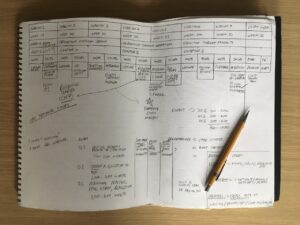
Following a number of diagrams and sketches I have decided that the students will interview regenerative practitioners. For each interview they will go through the same process, they will read a case study about the practitioners work. They will have a workshop where they will design a question, using different design techniques including the double diamond and iterative design approach. They will then ask their questions, in a live environment, which will be recorded (and hopefully shared) and then they will reflect using Gibbs reflective cycle [Gibbs G (1988). Learning by Doing: A guide to teaching and learning methods. Further Education Unit. Oxford Polytechnic: Oxford.]
So for the second question, in the exam they will be given a case study and they will be asked to design a question for a practitioner involved in the study. They must go through the same process, working out what they hope to achieve with the question and then designing a question to be asked. They will be marked not just on the outcome but on the process.
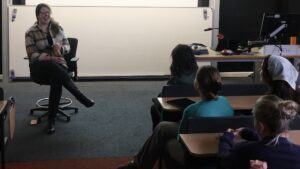
The last question will be about practice. They will be asked to reflect on their own practice (this is where the page of A4 will come in helpful) and, in light of the case study, consider what practice they may change, or continue. Again, they will be marked not just on the outcome but on their ability to reflect on their practice in light of this new information, and again we will create space in the workshops to practice this.
I would never have decided to run interviews if it wasn’t for the exam. I would have done what I have always done, and focused on project work. So, far from being a problem, working to the exam has been a creative constraint that has led to a different outcome.
Likewise the reflection on practice. Whilst I would include some self-learning and reflection, it would be geared around the projects, but here it is more open-ended, more focussed on regenerative practice not regenerative projects. The constraint of the exam, far from forcing me to go backwards, has forced me to go forwards, to rethink how I teach the whole unit, to the point where I wanted to blog about the process.
Next week we will talk about another traditional part of a university degree, lecturing, and how it has changed my approach to teaching. But before you go, each week I share the activity I give my students so you can have a go. This week it is time to get creative. Here are some things you could try:
Draw something. Bath have a number of life drawing classes, consider attending one (for information life drawing often involves drawing people with no clothes on, if this is a concern do double check in advance). Or the Holburne Museum runs all sorts of activities, you can check out their what's on and sign up. Or just pick a nice coffee shop and draw people. Or walk the skyline and draw trees.
Take Photos. Learn to take photos. Think about the composition, light, depth of field, movement. If you haven't done this before do some online tutorials first. But don't just point and shoot, be purposeful, take a walk, use the photo as a way of looking carefully at something, imagine you have a film camera and every shot counts – or use an actual film camera. But be purposeful in taking the photo, slowing down as much as possible.
Write a blog, or poem and share it! Find a place and have a go at capturing a thought or idea. It doesn't need to be big, just a small observation or reflection. My friend Oli tries to blog every day. If you’ve never blogged before I have a workshop running in a few weeks, sign up!
Make something. I love Lego. But you can use anything. Other people may see it as play, but I would see it as part of your creative development. Learning to make models is a good skill.
Create music. Join a band. Join a choir. Play with free online tools. The aim is not to create something perfect but to have a go.
Make or mend your clothes. Add some colour to an old T-Shirt. One of my colleagues walked in with amazing shoes on the other day – when I told him I loved them he told me he had decorated them himself! Make a pasta necklace. Repair the rip in your old jacket. Learn to knit. Learn to crochet. Have a go.
Cook a gourmet meal. Consider the plating of your next meal. Make it beautiful. Place items on the plate. It doesn't have to be expensive, just thoughtful and creative.
If you are stuck - read. I love books on creativity. There are some in the library (see the reading list). Or you can read my book on running your own record label - then start your own, just email me for a digital copy!
Whatever you do keep a record. Add it to your personal portfolio. Don't be critical, keep everything but only share what you want to. You can curate the collection later, but it is hard to back add what you didn’t record. Plus vulnerability and process have huge currency is this new age of AI where it is hard to know the authenticity of work.
Blog Post by: James Norman, Department of Architecture and Civil Engineering.
You can find the first blog in James' series here