
I love lecturing. It’s one of my favourite parts of the job. The joy of standing up in front of a group of people and telling them stories, sharing something of yourself. Being vulnerable. But here is the thing. Over the last decade I have progressively moved away from lecturing towards flipped class teaching. Pedagogies of conversation. Where the taught content is provided via books, videos, worked examples, all available online. And then, when we meet in class it is to do the work and discuss what is going on. The last time I delivered a unit which included regenerative design there were only two lectures in the whole unit. A welcome to the unit and a lecture on, you guessed it, regenerative design.
I must confess, whilst I have enjoyed the challenge of designing units without lectures, from the unit I ran as an office[1], to more standard problem based learning classes and project focussed learning, I have missed the act of lecturing.
So, this time around, on my unit on regenerative design, I have decided to deliver the core content via lectures. This doesn’t mean that the course is all lectures, of the 21 teaching hours available only 5 are lectures, the other 16 are workshops, practitioner interviews, a future walk (more on that next week). But 5 hours is still a lot, at least for me, especially when I could have asked the students to just read the book (the lectures are taken directly from my book on the same topic).
And here is why I am doing it. I think we need to provide our students with collective hope[2]! There has been lots of conversation about the changing attitude of students, and about the changing world (AI, geopolitics, climate change, there are lots of challenging narratives for our students to manage), but I don’t often hear people link them together. Regenerative design is about creating a positive future. Yes, students can watch videos about it, or read books about it, but I think there is something powerful in them collectively being given the imagination infrastructure to enable a different set of outcomes to emerge. So this year I will lecture.
As I write this I am just one week into the course and I received the following email (which made my day/week/month/year):
“I don't often do this, but I wanted to email you and say that even after just two sessions with you, I feel very optimistic about the future of the construction industry. I have never felt engaged in a module to such an extent that I feel truly inspired and hopeful about future progress and how our industry can be redefined to tackle the context of this module.” – Anonymous – used with permission
And this is why I have lectured. I hope that sense of optimism that this student experienced (and others have expressed verbally) is shared collectively, that there is a reinforcing cycle where it becomes discussed and talked about. That the future does not seem set, locked into the dystopian future social media seems to want to feed our students.
The sense of collective hope comes from three places I believe. Firstly the theory of Regenerative Design, which tackles a number (but not all) of the challenges we and our students face.
Secondly the imagery I use. Every lecture starts with a slide with an image by James McKay, who works at the University of Leeds. I first encountered his work in Paul Chatterton’s book “Unlocking Sustainable Cities”, and was mesmerised by it. It paints these wonderful and optimistic pictures of what a future town or city could look like. I have not encountered before such detailed and immersive images which fuelled my imagination. I loved them so much that when I wrote my own book on the Future of Structural Design I asked him to create a series of 4 images to accompany the 4 main parts of the book[3]. These images, especially when projected onto the big screen in a lecture theatre, hopefully start to build that imagination infrastructure, triggering the what if questions we need to ask.
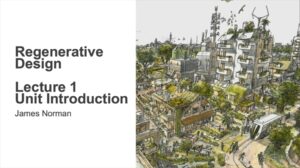
Finally, I use case studies. These case studies are not perfect, but they illustrate aspects of a regenerative future. Taken from across the world they show engineers that the ideas are possible. That the laws of nature allow it even if the systems we create as people make it really hard to do. The case studies don’t just include projects, they also include companies, practitioners and in one case the 20 year story of my industries change in understanding around carbon (a story which is still being written). The case studies are all taken from my book, which the students can access for free, so although the slides presented (see examples below) have sparse text, the full description is easily available to the students.
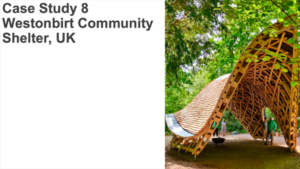
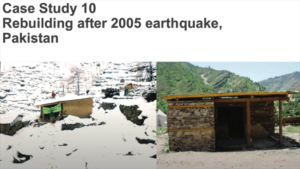
All of this is designed to give collective hope. Yes, I could make videos and share blogs for the students to watch and read, but the value of experiencing this together, in a room, is, I believe, important.
Next week we will all be going into the future. But before you go, it’s time for this weeks regenerative practice activity.
Connecting with nature[4] - As the days get longer and the weather gets nicer it is time to get into nature. You have some options:
Go for a walk/explore - there are so many options in Bath, here are a few destinations you can walk to/explore: Browns Folly, The Wheat Sheaf in Combe Hay, Newton St Loe, Kelston Roundhill, Dundas Aquaduct, The Bath Skyline. Some of these are less accessible than others. For a detailed list of different locations and how accessible they are I suggest referring to the following website https://www.accessiblecountryside.org.uk/somerset Wherever you choose don’t forget to follow the Countryside Code.
Do a bioblitz - using an app pick a location and record all the nature you see. You can do this from inside or outside. For tree identification use the Woodland Trust Tree Identification app. For wildlife, bugs and plants use the Seek app. And to identify birds by their song you can use the Merlin app.
Sit and observe - pick a point, take your time and observe nature. Draw or paint what you see. Write about it. Take photos. Or just sit and look. To help you slow down take a picnic or make a drink. Just make sure you leave no trace afterwards.
[1] https://bilt.online/the-office-episode-0-trailer/
[2] Collective hope is unpacked in Fife, Maggie. 2024. “The Generative Power of Collective Hope”. Feminist Philosophy Quarterly 10 (4). https://doi.org/10.5206/fpq/2024.4.16644
[3] Bath staff and students can access this book for free via the library by locating it on the Construction Information Services portal – however you need to go through the library to verify you are part of the University. The book is very technical – but I think the 4 drawings are worth the cost of admission on their own. If you would like access to them let me know – James has used a creative commons copyright.
[4] We recently ran a Regenerative Design Anti-Conference and this write up highlights the importance of ecological literacy and connecting with nature, which is why these activities are so important. https://www.linkedin.com/pulse/regenerative-design-what-we-should-teaching-how-nick-francis-hotye/?trackingId=BSHvyYTuT5%2BKVhebOJL%2Ffw%3D%3D
Blog Post by: James Norman, Department of Architecture and Civil Engineering.
Keep an eye out for the next blog in his series of blogs this Semester.
If you missed James first blog you can find it here