
Back in 2022, when I was researching my book on Regenerative Design I started coming across future imaginings of the world that I found really helpful. Whether James McKays drawings, which featured as part of Paul Chatterton’s book “Unlocking Sustainable Cities”. Christiana Figueres and Tom Rivett-Carnac two future imaginings of the world depending on the choices we make now in “The Future We Choose”. Or Rob Hopkins sending his guests in a time machine into the future as part of his podcast “From What If to What Next”.
As I struggled to understand what regenerative design meant for me and my profession of structural engineers my co-author suggested I try and write my own future imagining and so I started to think hard about what the future might look like for me personally in the place where I have lived for over 37 years, the city of Bath. The imagining of this future Bath took over my conscious headspace for a few months as I walked to and from work, heading down into the city to get the train to Bristol in the morning and back up the hill to get home in the evening. As is often the way for me, I spent hours imagining different scenarios, and the only way to move these thoughts out of my head, to create space for new thoughts, was to write them down. And so, I first drew my thoughts, and then turned them into a piece of prose where I, as a 72 year old engineer, introduce a young engineer to Bath in the year 2050.
That thought piece ended up appearing, in a revised form, in the final version of our book the Regenerative Structural Engineer, but I always wondered how meaningful it would be to people who did not know Bath?
I am currently reading bell hook’s book “all about love” having greatly enjoyed “Teaching to Transgress”, in it she quotes Donnella Meadows (another hero of mine, and the regenerative community at large) who says “A vision articulates a future that someone deeply wants, and does it so clearly and compellingly that it summons up the energy, agreement, sympathy, political will, creativity, resources or whatever to make that vision happen.”
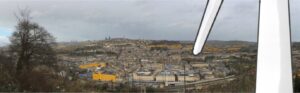
Whilst I cannot claim that my imagining of Bath will do any of this I am curious to see if for my students (and for you) whether embedding the words in a place they know well will help bring them to life. Whether my imagined Bath skyline is more meaningful if they visit Alexandra Park and look out over the city, as I have done many times, and hear the words, rather than hearing them or reading them disconnected from their context.
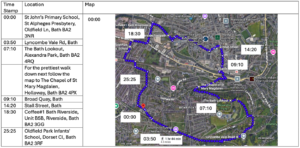
And so I have recorded my words (most are from the book, but some were written for the book and removed) and created a map so students (and you) can walk around Bath whilst listening to this imagined future. I have tried to create a circular walk which is on pavements but avoids busy roads. It is just over a 4 mile loop and you can listen as you walk or stop and listen at each point. The audio is only about 30 minutes, so unless you run it very fast you will need to find other things to listen to in between (or you can just enjoy the natural sounds around you). As a result, the locations are time stamped, so you know when to start and stop the audio.
The route should be accessible to all, but does include a steep hill up to Alexandra Park which may include some steps. Alternatively, after arriving at the short tunnel (which you can go through and then come back through) you can go up through the park to Bear Flat and go down The Holloway. You sadly won’t get such a good view, but otherwise the route will work just as well.
The map and audio for the walk are provided below. You can also access the circular route via google maps here - https://maps.app.goo.gl/HLY4Bz7MJ4oSwMRe8:
My hope is that the future walk will stir in them (and you) a desire to go one step further, not just to see the future as I see it, but to build their own vision for the future, one which is optimistic but achievable. One that is full of life and the thriving of both communities and our local ecosystem (I am often struck by how lucky we are in Bath to be so connected to both nature and society, my daily walk to work now includes walking through Rainbow Woods). Once they have been on their future walk, I hope they will attempt to create their own future imagining – to do this I provided some advice in the Regenerative Structural Engineer in the appendices.
I am not aware of a future walk being used anywhere else in teaching, so I am hoping to find out whether they enjoyed it and found it helpful. I would also love to hear from you. At this stage it is not a research project, just a chance for me to reflect on whether it is useful or not as a teaching tool. So let me know what you think.
And if you are wondering what your homework is for this week, well you guessed it, create your own future walk and share it.
Blog Post by: James Norman, Department of Architecture and Civil Engineering.
Keep an eye out for the next blog in his series of blogs this Semester.