
Blog Post by: Misbah Zahid, MSc Molecular Biosciences (Microbiology), Department of Life Sciences
Hello all!
I’ll be blogging my experience working on a Vertically Integrated Project (VIP) this year. First, a little bit about me— I’m a master’s student studying Molecular Bioscience in the Microbiology stream, and I’m on the VIP - B&NES Public Health Policy team. I have long been interested in public health, so I was eager to jump on this opportunity!
Our project, which started up this year coordinated by Julie Barnett, is focusing on heat in the Bath & North East Somerset (B&NES) region. There were five heatwave periods during summer 2026 with increased temperatures compared to the previous summer. So for our project, we are investigating the effectiveness of cool spaces in the hopes of making improvements for the next summer.
Some of the questions we started with included: Where are cool spaces located? Are there areas in the B&NES region with more or less vulnerable people? What does it mean for a cool space to work well?
Our team is sizeable, and we have a whole range of students from different disciplines with different experiences. I was a bit nervous on the first day, but the diversity of students we have is part of what makes the project exciting. Thus far we have put together 3 teams: a mapping team, a team to learn from cool spaces elsewhere in the UK, as well as an interview and survey team.
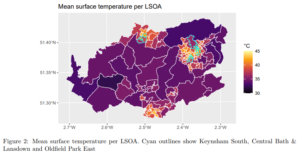
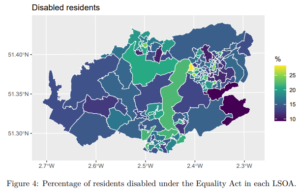
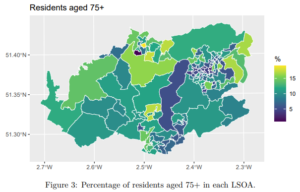
Hugo Lin, the lead of our mapping team, put together a great initial report analysing the relationship between heat exposure, vulnerable residents, and cool spaces in the B&NES region during one of the heatwaves in the summer of 2026. This is a great launching pad for our mapping team to continue to develop. I’ve attached some of the figures from his report below so you can take a look for yourself.
We also had a talk with Claire Mock-Munoz DeLuna from the B&NES public health team. We learnt that cool spaces, which function similarly to warm spaces, were set up a few years ago when there was a rise in health incidents due to a heatwave. Overall, cool spaces are designed less comprehensively than warm spaces. Additionally, while there are currently 15 cool spaces in B&NES, they are not evenly spread out. Funding for venues is another issue, as it is hard to predict if the venue will pull out of the scheme in the future. In the future, the team would like to know what obstacles there are for businesses to join the scheme, and what people look for in a cool space. They also intend to build a plan for more equitable distribution and more facilities.
Moving forward, I’ll be a part of the interview and survey team. We’re interested in hearing the perspectives of those running cool spaces, those who have used cool spaces, and people who did not use but could benefit from cool spaces.
I’ll try to keep up with posting, so be sure to keep an eye out. 🙂